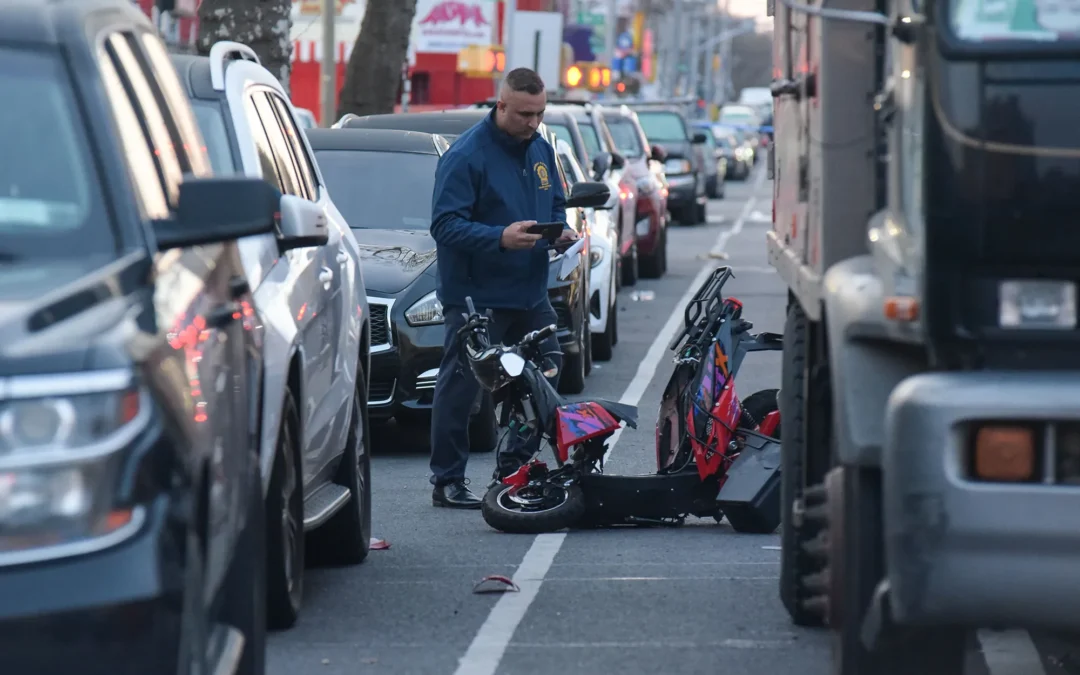
Brooklyn E-Bike & Moped Accidents
Hit by an E-Bike or Moped in Brooklyn? Here's Who Actually Pays Your Medical Bills
The short version
- The device that hit you decides everything. A pedal-assist e-bike, a Class 3 e-bike, and an illegal 28 mph moped are three different legal animals, and each one opens a different door to money.
- New York's $50,000 no-fault benefits follow cars, not bikes. If a car hit you while you were riding, you likely have a claim on that car's policy. If an e-bike hit you, there is usually no policy sitting there waiting.
- There's a new crash report rule. Since 2025, injury crashes involving e-bikes and e-scooters have to be reported — and the rider has to report too, not just a car driver.
- NYC capped every e-bike at 15 mph on October 24, 2025. If the rider who hit you was flying down Flatbush Avenue, that rule now helps prove your case.
- Money can come from places people never think to look: a delivery company's policy, a homeowner's or renter's policy, MVAIC, your own household auto policy, or the battery manufacturer.
- Deadlines are short. 30 days for no-fault paperwork. 90 days if the City is involved. Miss them and a strong case dies on a technicality.
I'm Koenig Pierre. I'm Brooklyn-born and Brooklyn-raised, and I've spent my career representing the people this system tends to steamroll — the ones who get hurt and then get told, politely, that nobody owes them anything.
Here's the call I get more than any other now. Somebody steps off the curb at Church and Nostrand, or walks their kid across Ocean Avenue, and a food delivery rider comes through the intersection at twenty-plus miles an hour. Somebody's on the ground. The rider is shaken, apologizes, maybe leaves. There's no license plate. There's no insurance card. And two weeks later the hospital bill lands on the kitchen table.
That person calls me and asks a fair question: who pays for this?
The honest answer is that it depends on facts most people don't know to write down at the scene. So let me walk you through it the way I'd walk you through it sitting across my desk — no legalese, no runaround. This is for anyone searching who pays medical bills after an e-bike accident in NYC, hit by a moped in Brooklyn what are my rights, or uninsured e-bike rider hit me New York. It also covers the flip side: what happens when you were the one on the e-bike and a car took you out.
First question: what actually hit you?
This sounds like a technicality. It isn't. It's the whole ballgame.
New York sorts these machines into buckets, and the bucket determines whether there's an insurance policy behind the person who hurt you. Under VTL § 102-c, a "bicycle with electric assist" is legally a bicycle — not a motor vehicle. But a lot of what people call e-bikes in this city aren't e-bikes at all. Those fat-tire throttle machines that hit 28 miles an hour with no pedaling? Under VTL § 121-b those are limited-use motorcycles — mopeds. They're supposed to be registered, plated, licensed, and insured.
Which means: some of the riders on our streets are legally required to carry insurance and simply don't. And that changes what I can do for you.
Does it have pedals? Is there a plate? Is there a delivery app bag or a company logo? Is there a sticker on the frame listing a class and a wattage? Take a picture of the frame, the battery, and the bag. That photo is worth more to your case than anything you'll say later.
New York's $50,000 no-fault benefits follow cars — not bicycles
Most New Yorkers have a rough idea that there's "$50,000 of no-fault" out there. That's real. Under Insurance Law § 5103, every registered vehicle in this state carries personal injury protection that pays medical bills, 80% of lost wages up to $2,000 a month, and household help — no matter who caused the crash. I break the whole system down in my guide to New York no-fault insurance.
Here's the part that catches people. That money is attached to a car. Insurance Law § 5102(j) makes a pedestrian a "covered person" when they're hurt by a covered motor vehicle. Bicyclists get treated like pedestrians for this purpose too.
So flip it around. If a bicycle hits a pedestrian, there is no car, which means there's no no-fault pot. New York does not require e-bike riders to carry liability insurance. That's not a loophole somebody snuck in — it's just what happens when the law treats a 70-pound machine going 25 miles an hour the same way it treats a ten-speed.
That's the gap. And filling it is most of my job in these cases.
| What happened | First place I look | Backup sources |
|---|---|---|
| You were walking. An e-bike hit you. | Rider's homeowner's or renter's liability coverage; the delivery platform if he was working | Your health insurance; your own household auto policy in some situations; the rider personally |
| You were walking. A moped or e-moto hit you. | The moped's liability policy, if it was registered | MVAIC if unregistered or the rider fled; the dealer who sold an unregistered machine |
| You were riding an e-bike. A car hit you. | The driver's no-fault PIP, then the driver's liability policy | SUM coverage on a household auto policy; the driver's employer |
| You were making deliveries when it happened. | Workers' compensation if you're classified as an employee | Third-party lawsuit against the driver; the app's commercial coverage |
| You crashed because of a pothole or bad roadway. | A claim against the City of New York | Contractor doing street work; utility with an open cut |
| The battery caught fire and burned you. | Battery or bike manufacturer and the seller | Landlord or building owner where charging conditions were unsafe |
If a car was involved, you're in more familiar territory — the same territory I cover on my New York car accident and bicycle accident pages. If no car was involved, we go hunting. And we usually find something.
The step almost everybody skips: the crash report
In July 2024, Governor Hochul signed a package of e-bike and lithium-ion battery bills. One of them — S.9419/A.7628-A — requires reports after e-bike or e-scooter crashes that cause injury or death.
Read that again, because it's the piece people miss: the rider has to file too. It's not just the car driver anymore. Under VTL § 605, a Report of Motor Vehicle Accident — form MV-104, available from the New York State DMV — has to go in when there's an injury, or when property damage runs past $1,000.
Why do I care so much about a form? Because in these cases the fight is almost never about whether you're hurt. The fight is about whether the crash happened the way you say it did. Six months later an adjuster will tell me there's no police report, no incident number, nothing but my client's word. A filed report is the difference between a case and a conversation.
And if the police brush you off at the scene — which happens more than it should — read what I wrote about what to do when the police won't help you after an accident in Brooklyn. You can go to the precinct yourself. You can file the MV-104 yourself. Do it.
Not sure whether a report got filed after your crash?
I'll check for you. It takes me one phone call and it costs you nothing.
The 15 mph rule changed how I prove these cases
On October 24, 2025, New York City put a 15 mph speed cap on every e-bike and e-scooter on city streets — Class 1, Class 2, Class 3, all of them, regardless of what the machine is rated to do. It came in through the City's rulemaking process, and CBS New York covered the rollout at the base of the Brooklyn Bridge.
Before that rule, arguing an e-bike rider was going "too fast" was a matter of opinion. Now there's a number. If I can show the rider was doing 22 on Flatbush Avenue, I'm not arguing about vibes — I'm pointing at a rule he broke.
It cuts the other way too. If you were the rider and you were over 15, expect the defense to hammer it. New York uses pure comparative fault under CPLR 1411, which means being partly at fault reduces your recovery — it doesn't erase it. And the Court of Appeals settled a related point in Rodriguez v. City of New York, 31 N.Y.3d 312 (2018): a plaintiff doesn't have to prove they were blameless to establish the other side's liability. Those are two different questions and juries get to sort them out.
VTL § 1146 puts an affirmative duty on every driver to use due care to avoid hitting a pedestrian or a bicyclist. Not "if they were in a crosswalk." Not "if they had a light." Due care, period. I lean on that statute constantly.
What if the rider took off, or has nothing?
This is the hardest version of the call, and I get it a lot. No plate. No name. He rode off toward Utica and that was that.
You're not automatically out of luck. Here's where I look:
On MVAIC — the Motor Vehicle Accident Indemnification Corporation exists for exactly this situation, and it's governed by Insurance Law § 5208. Two things about it. First, the notice window is brutally short. Second, MVAIC covers motor vehicles, which is why the classification question from the top of this article matters so much: an unregistered moped may qualify where a legal e-bike won't.
On the manufacturer route — New York's design defect standard comes from Voss v. Black & Decker Manufacturing Co., 59 N.Y.2d 102 (1983), where the Court of Appeals laid out the risk-utility test still used today. If a battery pack failed or a brake let go, that's a real avenue.
And on the delivery company — whether an app is on the hook usually turns on the employee-versus-contractor analysis the Court of Appeals set out in Bynog v. Cipriani Group, Inc., 1 N.Y.3d 193 (2003). Who controlled the schedule, the equipment, the method of work. It's a fact fight, and it's one worth having.
If you're the delivery worker who got hit
I want to speak directly to the riders for a minute, because a lot of my neighbors in Flatbush, East Flatbush, and Crown Heights are out there earning on two wheels.
If a car hit you while you were on a legal pedal-assist e-bike, you are in a much stronger position than most riders realize. You're treated like a bicyclist, which means the driver's no-fault policy should be paying your medical bills — and if your injuries are serious, you can sue that driver on top of it.
"Serious" has a specific legal meaning under Insurance Law § 5102(d). A fracture qualifies outright. The categories about limitation of use are where cases get won or lost, and the Court of Appeals explained how to prove them in Toure v. Avis Rent A Car Systems, 98 N.Y.2d 345 (2002).
Two more cases you should know about, because they're about behavior, not law:
- Pommells v. Perez, 4 N.Y.3d 566 (2005) — if you stop treatment and can't explain why, the defense will use it against you.
- Perl v. Meher, 18 N.Y.3d 208 (2011) — the Court softened the rules on when measurements have to be taken, which helps people who couldn't get to a specialist right away.
I've written more on that specific problem here: I have a gap in my treatment — do I still have a case? Short answer: usually yes, but you need to be able to explain the gap.
People ask me this quietly, like it's a confession. Riding an unregistered moped is a violation. It is not a defense that wipes out your injury claim. It may reduce your recovery under comparative fault, and it may complicate which policy applies — but the driver who ran the red light is still the driver who ran the red light. Come talk to me anyway.
Battery fires are their own category of case
Lithium-ion battery fires have killed and badly burned New Yorkers, disproportionately in the buildings where delivery workers live and charge. The FDNY's safety guidance is blunt about it, and the City has been pushing certified equipment and outdoor charging cabinets through DOT programs.
New York State also banned the sale of substandard lithium-ion batteries for these devices through S.154-F/A.4938-D, part of the same 2024 package.
If you were burned or lost someone in one of these fires, the case usually runs against the battery or device manufacturer, the retailer who sold an uncertified pack, and sometimes the building owner. That last one lives in premises liability, and when a family loses somebody, in wrongful death. Burn injuries and smoke inhalation cases are serious, expensive, and worth doing right.
Keep the bike. Keep the battery. Keep the charger. Don't let a landlord or a fire marshal haul it away if you can help it. That equipment is the evidence.
The deadlines that quietly kill good cases
I hate this part of the job. Somebody comes in with a real injury and real proof, and the calendar has already beaten us. So here's the timeline, plainly.
The 90-day notice of claim rule comes from General Municipal Law § 50-e. If the City is on the other side, you'll also face a 50-h hearing — I wrote a whole guide on how to prepare for your 50-h hearing, and the same machinery applies when the defendant is a public authority, which I cover in my post on suing the MTA after a Brooklyn subway injury.
The general three-year window for personal injury sits at CPLR 214. Don't let that number make you comfortable. The 30-day and 90-day clocks are the ones that end cases.
What to do in the first 72 hours
- Get examined, even if you feel okay. Adrenaline hides a lot. A same-day or next-day record is the backbone of everything that follows.
- Photograph the machine, not just the scene. Frame stickers, battery, plate or absence of a plate, delivery bag, company branding.
- Get the rider's name, phone, and address — and a photo of an ID if he'll show one. "He said his name was Junior" is not something I can serve papers on.
- Look up. Bodegas, buildings, and buses have cameras. Footage gets overwritten in days. Ask the business to preserve it now.
- Make sure a report exists. Police report, or file the MV-104 yourself. Write down the report number.
- Get names and numbers from anyone who stopped. Witnesses disappear. Bystanders on Flatbush do not wait around for lawyers.
- Say nothing recorded to any insurance company until you've spoken with a lawyer. That call is not a formality — it's evidence.
- Save the gear. Helmet, shoes, phone, the bike itself. Damaged property tells the story of the force involved.
If a car was part of it, my post on what to do after a car accident in New York goes deeper on the insurance side.
Hurt by an e-bike, moped, or scooter anywhere in Brooklyn?
Tell me what happened. I'll tell you straight whether you have a case — and I don't charge a dime unless I win. Here's exactly how my fee works.
Where these crashes keep happening in Brooklyn
I don't need a study to tell me where the danger is. The calls come from the same corridors every month: Flatbush Avenue end to end, Nostrand and Church, Utica, Eastern Parkway, Ocean Avenue below the Parkside stop, Atlantic near the mall, and the Bedford Avenue lane through Bed-Stuy and Williamsburg.
These are the streets where a protected bike lane ends without warning, where double-parked delivery trucks push riders into traffic, and where a rider making his fifteenth run of the night is trying to beat a clock somebody else set. I've written about the worst of it in Flatbush Avenue's crash record, and I handle cases specific to Ocean Avenue, Crown Heights, and Flatbush.
Si w se yon moun ki pale kreyòl e ou te nan yon aksidan, li gid mwen an sou aksidan nan New York. Rele m — nou ka pale kreyòl.
Brooklyn e-bike and moped accident questions I get asked every week
Who pays my medical bills if an e-bike hit me in Brooklyn and the rider had no insurance?
If no car was involved, there is usually no auto policy to claim against, because New York does not require e-bike riders to carry liability insurance. Payment typically comes from the rider's homeowner's or renter's policy, the delivery company he was working for, your own health plan, or MVAIC if the device was legally a moped.
Which of those applies depends on facts we gather in the first few weeks — what the machine was, whether he was working, and whether anyone got his name.
Does New York no-fault insurance cover e-bike accidents?
No-fault benefits attach to registered motor vehicles, not bicycles. If a car struck you while you were riding a pedal-assist e-bike, that car's no-fault policy should pay your medical bills and part of your lost wages. If an e-bike struck you and no car was involved, there is normally no no-fault coverage.
Faster throttle-driven machines fall into a contested middle zone, and the classification argument there is worth real money. See my full guide to New York no-fault insurance.
What is the 15 mph e-bike speed limit in NYC and does it help my injury claim?
Since October 24, 2025, New York City limits every e-bike and e-scooter to 15 mph on city streets, regardless of what class the machine is rated for. It helps your claim by turning a vague argument about speed into a specific rule the rider broke.
Video footage, delivery app data, and witness estimates all become more useful once there is a fixed number to measure against.
Do I have to file a crash report after an e-bike or e-scooter accident in New York?
Yes. New York requires a report after any e-bike or e-scooter crash causing injury, or property damage above $1,000 — and the rider must report, not just the driver of a car. The form is the MV-104 Report of Motor Vehicle Accident from the DMV.
Beyond the legal requirement, a filed report is often the most valuable document in the case, because it fixes the date, location, and parties before anyone's memory gets convenient.
Can I sue a food delivery company if one of their riders hit me in NYC?
Sometimes. It turns on how much control the company had over how the rider worked — his schedule, equipment, route, and pace. The Court of Appeals set out that test in Bynog v. Cipriani Group. If the rider counts as an employee, a corporate insurance policy becomes available.
Delivery platforms fight this issue hard, because the answer decides whether there is real money behind the claim or only one person's assets.
The moped that hit me in Brooklyn had no license plate and took off. Do I have any options?
Possibly. MVAIC covers qualifying uninsured and hit-and-run motor vehicle claims under Insurance Law § 5208, and an unregistered moped may qualify where a legal e-bike would not. The notice deadline is short, so this is one to move on immediately.
I also pull camera footage from nearby businesses, look for delivery-app records, and check whether the dealer failed to register the machine at the point of sale as New York now requires.
I was riding an unregistered e-moto when a car hit me. Does that ruin my case?
It complicates your case but rarely ends it. New York uses pure comparative fault, so your own violation reduces what you recover proportionally instead of barring you outright. The driver's negligence still counts against him.
Under Rodriguez v. City of New York, 31 N.Y.3d 312 (2018), you do not have to prove you were blameless to establish the other side's liability. Come talk to me before you assume you have nothing.
What if I was burned in a lithium-ion e-bike battery fire in my apartment?
That is a product case first — against the battery or device manufacturer and any retailer that sold an uncertified pack — and sometimes a premises case against the building owner. Preserve the battery, the charger, and the bike, because that equipment is the evidence.
New York banned the sale of substandard lithium-ion batteries for these devices in 2024, and that ban matters to the claim.
How long do I have to file an e-bike accident lawsuit in New York?
Generally three years for personal injury and two years for wrongful death. The deadlines that actually kill cases are much shorter: roughly 30 days for no-fault paperwork, and 90 days for a notice of claim if the City of New York is a defendant.
Some situations carry even shorter windows. Get your specific dates confirmed rather than relying on the general rule.
What is my Brooklyn e-bike accident case worth?
Any number quoted before someone reads your medical records is a guess. Value tracks how serious your injuries are, how well the treatment is documented, how clear fault is, and how much insurance exists to collect from.
That last factor is why these cases live or die on finding coverage most injured people never think to look for.
Law and sources cited in this article
- N.Y. Vehicle & Traffic Law § 102-c (bicycles with electric assist) and § 121-b (limited use motorcycles).
- N.Y. Vehicle & Traffic Law § 605 (reports of motor vehicle accidents, form MV-104); § 1146 (driver's duty of care toward pedestrians and bicyclists).
- N.Y. Insurance Law § 5102 (definitions, including the serious injury threshold), § 5103 (entitlement to first-party benefits), § 5208 (MVAIC notice).
- CPLR 214 (three-year statute of limitations); CPLR 1411 (comparative fault); General Municipal Law § 50-e (notice of claim); EPTL 5-4.1 (wrongful death).
- Rodriguez v. City of New York, 31 N.Y.3d 312 (2018).
- Toure v. Avis Rent A Car Systems, Inc., 98 N.Y.2d 345 (2002).
- Pommells v. Perez, 4 N.Y.3d 566 (2005); Perl v. Meher, 18 N.Y.3d 208 (2011).
- Bynog v. Cipriani Group, Inc., 1 N.Y.3d 193 (2003).
- Voss v. Black & Decker Manufacturing Co., 59 N.Y.2d 102 (1983).
- Office of the Governor, legislation on e-bike safety and lithium-ion batteries, July 11, 2024 (S.9419/A.7628-A crash reporting; S.7703-B/A.8450-B moped registration at point of sale; S.154-F/A.4938-D battery standards).
- New York City rule setting a 15 mph speed limit for e-bikes, e-scooters, and pedal-assist commercial bicycles, effective October 24, 2025 — NYC Rules.
- FDNY, Dangers of Lithium-Ion Batteries; NYC DOT, e-bike battery charging initiatives.
- New York State Department of Financial Services (no-fault regulation) and the Department of Motor Vehicles.

- Admitted to practice law in the State of New York
- J.D., Hofstra University School of Law
- Focused practice: personal injury, motor vehicle and micromobility crashes, construction accidents, medical malpractice, premises liability, elder abuse, wrongful death
- Serving Flatbush, East Flatbush, Crown Heights, Bed-Stuy, Midwood, Ditmas Park, Canarsie, and all five boroughs
- Consultations are free. No fee unless I win your case.
- Office: 2653 Coney Island Avenue, Brooklyn, NY 11223 · 1-800-946-4616
- Services available in English, Haitian Creole, and Spanish
How this article was prepared: written and reviewed by Koenig Pierre, Esq., a New York-licensed attorney, using primary sources — New York statutes, New York Court of Appeals decisions, New York State legislation, and official City and State agency publications, each linked above. Reviewed and updated July 2026 to reflect New York City's 15 mph micromobility speed rule and the 2025 statewide e-bike and e-scooter crash reporting requirement.
Disclaimer: This article is general information about New York law, not legal advice, and reading it does not create an attorney-client relationship. Laws change and outcomes depend on the specific facts of your case. Prior results do not guarantee a similar outcome. If you were injured, speak with a licensed attorney about your own situation. Attorney advertising.