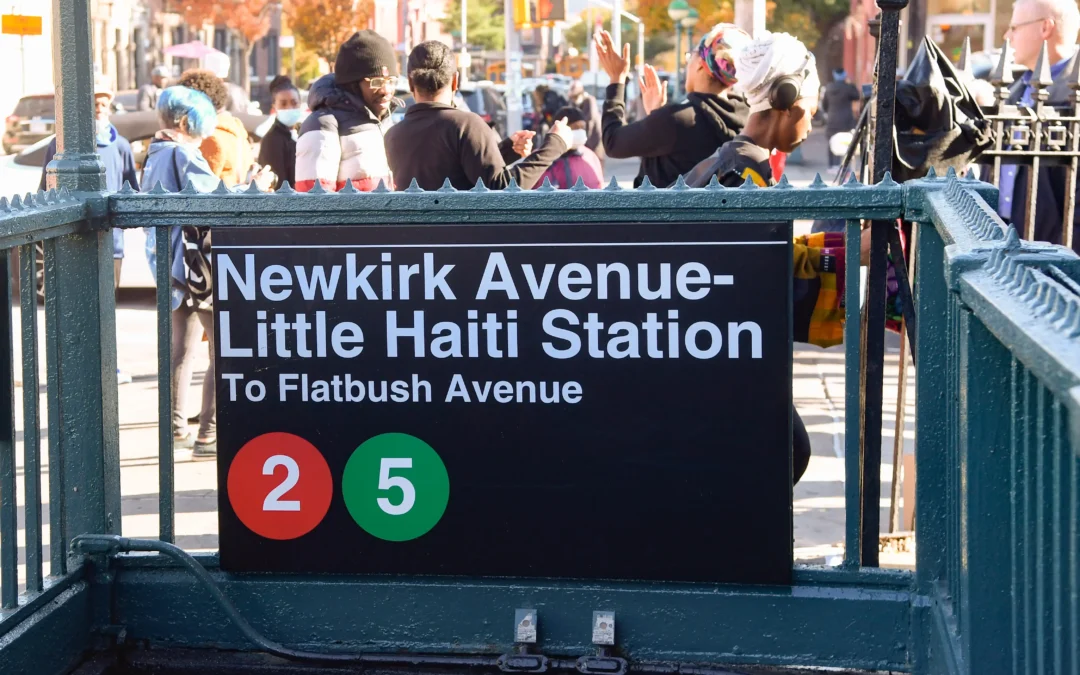
Avoka aksidan nan New York
Car Accidents in Flatbush & Crown Heights:
A Guide for the Haitian Community
Flatbush and Crown Heights are home to one of the largest Haitian communities in the United States. Church Avenue, Ocean Avenue, Flatbush Avenue, Nostrand Avenue, Rogers Avenue — these streets pulse with Caribbean life, commerce, and culture every single day. They are also some of the most congested, accident-prone corridors in all of New York City.
Every year, hundreds of car accidents occur in these neighborhoods. When one happens to you or a loved one, the decisions you make in the minutes and days that follow can determine whether you receive the medical care you need, whether your insurance claim is honored, and whether you can hold the responsible party accountable.
This guide was written with the Haitian community in mind. It addresses not only the legal and procedural steps, but also concerns that are specific to immigrant and Haitian-American families — including your rights regardless of immigration status, how to request a Haitian Creole interpreter, and where to find trusted help in your neighborhood.
Part I
The First 10 Minutes After a Crash
The moments immediately after an accident are chaotic and frightening. Ou pa bezwen pèdi tèt ou — you do not need to panic. Follow these steps in order. Your actions now will shape everything that comes after.
1. Check for Injuries and Secure the Scene
Your first priority is safety — not the cars, not the paperwork, not the other driver. Check yourself, then check every passenger in your vehicle.
Do not move a seriously injured person unless they face immediate danger. Moving them incorrectly can cause spinal or internal injuries.
- If the cars are drivable and blocking traffic, turn on your hazard lights and carefully move vehicles to the shoulder or a side street.
- If it is night or visibility is poor, stay behind the guardrail or on the sidewalk — do not stand in the road.
2. Call 911, Without Exceptions
DO NOT agree if the other driver may tell you, “Let’s handle this between ourselves.” This is one of the most common — and costly — mistakes accident victims make.
In New York City, you are legally required to report any accident involving injury, death, or property damage exceeding $1,000. Aside from the legal obligation, an official police report is your most powerful protection. Without it, the other driver can later deny fault, deny being at the scene, or claim you caused the accident.
Know your local precincts
Flatbush: 67th Precinct — 2820 Snyder Ave | 70th Precinct — 154 Lawrence Ave
Crown Heights: 71st Precinct — 421 Empire Blvd | 77th Precinct — 127 Utica Ave
When you call 911, officers from the nearest precinct will respond. You can also walk into any precinct to file an accident report after the fact.
3. Document Everything At The Scene
Your smartphone is one of your most powerful legal tools. Use it to capture as much as possible while you are still at the scene. There’s no such thing as taking too many photos.
1) Photograph all vehicles
Wide shots showing both cars together, plus close-ups of every area of damage on both vehicles
2) Photograph all license plates
Front and back if accessible. This is very important — the other driver may move or flee the scene.
3) Photograph the roads and surroundings
Skid marks, traffic lights, stop signs, crosswalk markings, road conditions (wet pavement, potholes, poor lighting), and any obstructions.
4) Photograph visible injuries
Any cuts, bruises, swelling, or redness on yourself or passengers — even if it seems minor right now.
5) Record a short video narration
A 30-second video walking around the scene and saying what happened out loud creates a powerful, timestamped record.
6) Screenshot your GPS location and the time
Your photos may already log this data, but a screenshot of a map adds an extra layer of certainty.
4. Exchange Information With The Other Driver
Approach the exchange calmly and without confrontation. New York law requires both drivers to exchange information. Collect all of the following:
- Full legal name and home address
Phone number (personal and work, if available) - Driver’s license number and state of issue
- License plate number
- Insurance company name and policy number
- Vehicle make, model, year, and color
If the other driver refuses to share their information, do not argue. Note their license plate and physical description and report everything to the police officer when they arrive.
5. Identify And Speak To Witnesses
Independent witnesses — other drivers who stopped, pedestrians on the sidewalk, shopkeepers who saw the crash — can provide testimony that is completely independent from either party. In a disputed claim, a witness can make all the difference.
- Look around the scene. Who stopped? Who is watching?
- Politely ask anyone who may have seen the accident for their name and phone number.
- Write down their descriptions in case they leave before police arrive.
- Note any nearby business surveillance cameras — businesses may have footage that captures the accident.
6. Speak with Policy Carefully – and Request an Interpreter If Needed
When officers arrive, give them an accurate, factual account of what you directly observed.
Do not speculate, do not estimate, and do not accept blame for anything.
Critical – Never Say These Things
Do not say: “I’m sorry,” “It was my fault,” “I didn’t see them,” or “I’m fine.” Even an apology offered out of politeness can be used as an admission of liability by the other driver’s insurance company. And saying “I’m fine” can complicate a medical claim if symptoms
develop later.
If asked whether you are injured, the correct answer is: “I’m not sure — I plan to see a doctor to be evaluated.” This is truthful and protects your rights.
Part II
The Next 24 to 72 Hours
The three days following an accident are critically important for your health, your insurance claim, and any potential legal case. Do not delay on any of these steps — some have strict deadlines.
1. See A Doctor – Even If You Feel Fine
This is the single most important step after leaving the accident scene. Car accidents
commonly cause injuries — whiplash, soft tissue damage, concussions, spinal injuries,
internal bruising — that produce no symptoms for 24 to 72 hours. By the time the pain arrives, days have passed, and it becomes far harder to connect your injury to the accident.
1) Go the same day if possible
Visit your primary care doctor, an urgent care clinic, or a hospital emergency room. Do not wait until tomorrow
2) Tell them exactly how it happened
Say: “I was in a car accident today.” This creates a documented medical record linking your condition to the crash — essential for any claim.
3) Keep every document
Medical records, discharge papers, prescriptions, follow-up appointment notes — save everything in one folder.
4) Return if symptoms return
If pain, headaches, numbness, or dizziness appear in the days after, go back immediately. Update your medical records with the new symptoms.
2. Report the Accident to your Insurance Company
Notify your own insurance company within 24 to 48 hours. Most New York auto policies
require prompt notification, and delayed reporting can jeopardize your coverage. Call your insurer’s claims line and provide the basic facts: when, where, what happened, and
the other driver’s information. Be factual and concise. Do not speculate about fault or the extent of injuries. Ask for your claim number and the name of your assigned claims adjuster. Write down everything said during the call, including the date and time.
Warning – Don’t Trust The Other Driver’s Insurance Company
If the other driver’s insurance company calls and asks for a recorded statement, you are
not legally required to provide one. Politely tell them you are consulting with an attorney
before making any statement. These recorded statements are designed to find inconsistencies that can reduce or deny your claim. Always consult a lawyer first.
3. Obtain A Copy Of The Police Report
The official NYPD accident report — the MV-104 form — is one of your most important documents. Insurance companies and attorneys will both need it. Here is how to get it:
- Online (easiest)Go to nypdonline.org
and search by the accident date and your license plate or name. Reports are typically available within 5 to 10 business days.
- In person at the precinct
Visit the precinct that responded to your accident and request the report at the front desk. Bring a valid ID.
- Review it carefully
When you receive it, check that all facts are accurate — the location, vehicle descriptions, and narrative. If there are errors, contact the reporting officer to request a correction.
4. Start and Maintain A Detailed Accident File
Create a dedicated folder — physical or digital — and keep every piece of accident-related documentation in one place. This file is the foundation of your insurance claim and any legal case.
- A written account of the accident in your own words, written within 24 hours while memory is fresh.
- Every medical visit, diagnosis, and treatment received.
- All bills: medical, prescriptions, vehicle repair, towing, and rental car.
- Every day missed from work and the income lost.
- A pain and symptom journal — daily notes on how your injuries affect your life.
- A pain and symptom journal — daily notes on how your injuries affect your life.
- All letters, emails, and notes from conversations with insurance companies.
- All photos and videos taken at the scene.
Part III
Understanding New York’s No-Fault Insurance Law
New York is a “no-fault” insurance state — a system that is confusing to many people, especially those new to the country. Here is what it means for you.
In New York, your own auto insurance company pays for your medical bills and lost wages up to $50,000 — regardless of who caused the accident. You do not need to prove the other driver was at fault to access these benefits. However, there are strict rules and deadlines you must follow.
1. The 30-Day Filing Deadline – Do not Miss It
You must file a no-fault claim with your own insurance company within 30 days of the accident. This is a hard deadline. Missing it can result in losing your right to no-fault benefits entirely — meaning your medical bills and lost wages may not be covered.
File the claim immediately after the accident, even before you know the full extent of your injuries. You can always add documentation as treatment continues.
2. What No-Fault Covers
Medical treatment: doctor visits, hospital stays, physical therapy, prescriptions.
Lost wages: up to 80% of your gross income, capped at $2,000 per month.
Other reasonable expenses related to the accident (such as transportation to medical appointments).
A death benefit of up to $2,000 for funeral costs.
3. What No-Fault Does Not Cover
No-fault insurance does not cover pain and suffering or damage to your vehicle. To recover compensation for these losses, you must either file a claim against the at-fault driver’sinsurance or file a personal injury lawsuit. An attorney can help you evaluate whether your injuries meet New York’s “serious injury” threshold to pursue additional compensation.
4. If You Do Not Have A Car – You May Still Be Covered
If you were injured as a pedestrian or cyclist hit by a vehicle, you are typically covered by the driver’s no-fault insurance — not your own. File a claim with the driver’s insurance company within 30 days.
Part IV
Your Legal Rights As A Haitian Resident
Many members of the Haitian community hesitate to pursue their rights after an accident out of concern about immigration status, language barriers, or mistrust of institutions. This section addresses those concerns directly and honestly
Your rights do not depend on immigration status
Undocumented residents have the legal right to file insurance claims, seek medical
treatment, and pursue compensation in New York civil courts. Immigration status is generally not relevant to a personal injury case.
You have a right to a free interpreter
New York City law and federal law require
language access services from police,
hospitals, courts, and government agencies. You cannot be denied service because you speak Haitian Creole.
You can refuse a recorded statement
The at-fault driver’s insurance company has no legal right to compel your recorded
statement. Always consult an attorney before providing one.
You have 3 years to file a lawsuit
New York’s statute of limitations for personal injury lawsuits is 3 years from the date of the accident. Exception: if a city vehicle was involved, you have only 90 days to file a Notice of Claim.
Partial fault does not end your case
New York uses “pure comparative negligence.” Even if you were partially at fault — say, 20% — you can still recover 80% of your damages. Do not assume fault means you have no claim.
You can sue for pain and suffering
If your injuries are serious — broken bones,
significant scarring, permanent limitation of a body part — you may be entitled to
compensation beyond no-fault benefits,
including pain and suffering and future losses.
“Eske ou ka jwenn yon entèprèt Kreyòl ayisyen pou mwen, tanpri?” — Can you find a Haitian Creole interpreter for me, please?
Part V
Dangerous Intersections in Flatbush & Crown Heights
Understanding where accidents are most likely to occur helps you drive more defensively in your own neighborhood. These corridors have historically seen higher rates of collisions based on NYC traffic data.
Flatbush Ave & Church Ave – Highest Risk
One of Brooklyn’s busiest intersections. The convergence of multiple bus lines (B41, B44, B103), dollar vans loading and unloading mid-block, cyclists, and heavy pedestrian foot traffic creates constant hazards. Left-turn accidents, pedestrian knockdowns, and rearend collisions are all common — especially during morning rush hour (7–9 AM) and school dismissal (2:30–4 PM).
Nostrand Ave Corridor (Flatbush Ave to Atlantic Ave)
Chronic double-parking by delivery trucks and personal vehicles forces unexpected
lane merges. Cyclists riding alongside fast-moving traffic face serious risks. Mid-block pedestrian crossings — especially at night — are a major hazard throughout this stretch.
Empire Blvd between Bedford Ave & Flatbush Ave
A wide, multi-lane boulevard where vehicles travel faster than surrounding streets. The intersection with Bedford Avenue has complex signal timing and frequent left-turn conflicts. Weekend proximity to Prospect Park increases cyclist and pedestrian activity significantly.
Rogers Ave & Eastern Pkwy
Eastern Parkway is a wide, divided boulevard where drivers frequently travel at high speed. Side streets like Rogers Avenue create dangerous merging situations.
Pedestrians crossing Eastern Parkway face long crossing distances with limited
protection between signals.
Utica Ave Corridor (Crown Heights)
One of Crown Heights’ main commercial arteries, lined with Caribbean businesses. High pedestrian traffic, frequent bus stops, and habitual double-parking create constant conflicts. The intersection with Eastern Parkway is particularly high-risk. Be especially alert near markets, churches, and dollar van stops.
Defense Driving Tip
In all of these areas: give extra following distance near bus stops (passengers step into the road unexpectedly), slow down when dollar vans stop at the curb, never assume a pedestrian will wait for the light, and be especially alert in the hour after sunset when visibility drops sharply.
Part VI
When to Hire a Personal Injury Attorney
Not every car accident requires an attorney. But in several common situations, having legal representation dramatically improves your outcome.
1. If You Should Consult An Attorney If…
- You or any passenger suffered injuries of any kind.
- There is any dispute about who caused the accident.
- The insurance company offers a quick settlement — a fast offer almost always means you are worth more.
- The at-fault driver was uninsured or underinsured.
- A city vehicle (bus, sanitation truck, police car) was involved — special deadlines apply.
- You missed work and lost income as a result of the accident.
- Your injuries are serious, permanent, or require surgery.
2. What to Look for in a Brooklyn Personal Injury Attorney
- Free initial consultation – Your injuries are serious, permanent, or require surgery.
- Contingency fee arrangement — you pay nothing unless and until you win your case
- Haitian Creole or French language services — many Brooklyn law firms serving the Caribbean community offer this.
- Experience with New York no-fault insurance — this is a specialized area of law
- No pressure to settle quickly — a good attorney will advise patience and proper valuation of your case
Statute of Limitations – Act Before of Limitations
In New York, you generally have 3 years from the accident date to file a personal injury lawsuit. However, if the accident involved any city-owned vehicle (MTA bus, DSNY truck, NYPD car), you have only 90 days to file a Notice of Claim with the city. Missing this deadline permanently forfeits your right to sue. Consult an attorney immediately if a government vehicle was involved.
Part VII
Community Resources & Where To Get Help
The following organizations serve Brooklyn residents — including Haitian and Caribbean community members. Many offer services in Haitian Creole, French, and Spanish, and several specifically serve immigrants.
- NYPD 67th Street Precinct (Flatbush): Police reports, accident documentation, non-emergency inquiries. 2820 Snyder Ave, Brooklyn, NY.
- NYPD 71st Precinct (Crown Heights): Police reports, accident documentation. 421 Empire Blvd, Brooklyn, NY.
- Brooklyn Legal Services: Free civil legal help for low-income residents, including immigrants.
- Legal Aid Society: Civil legal matters, immigration issues, consumer rights.
- NYC Mayor’s Office of Immigrant Affairs: Know-your-rights education, referrals, multilingual support.
- NY DMV — Accident Reporting: MV-104 accident report filing and retrieval.
- NYC 311: MV-104 accident report filing and retrieval. Call or text: 311
- Caribbean Equality Project: Advocacy and resources for Caribbean immigrant communities in NYC. Search: Caribbean
Equality Project NYC.
Language Access – Your Right
Every New York City agency, hospital, and court is required to provide free interpreter
services in Haitian Creole. When calling any city office or 311, simply say “Haitian Creole” and an interpreter will be connected to the call. You should never be asked to pay for interpretation, and you should never be denied service because of language.
Every New York City agency, hospital, and court is required to provide free interpreter
services in Haitian Creole. When calling any city office or 311, simply say “Haitian Creole” and an interpreter will be connected to the call. You should never be asked to pay for interpretation, and you should never be denied service because of language.
Rele yon avoka aksidan nan Nouyòk!
Were you injured in a car accident and injured in a collision involving a truck? Call Koenig, a New York Car Accident Lawyer serving people injured in New York City (Brooklyn, Manhattan, Queens Car Accident Lawyer, The Bronx, and Staten Island Car Accident Lawyer), Long Island Car Accident Lawyer, and the New York Metropolitan area.
He is committed to serving every client with personalized attention, compassionate customer service, and professionalism. Before you get carried away, call him today!
Blog

Tripped on a Sidewalk in NYC: Who Is Responsible?
Tripped on a broken sidewalk in NYC? Usually the building owner is responsible, but for many 1–3 family homes it’s the City, and you may have only 90 days.
Suing a Commercial Truck Company for an Accident in New York
Hit by a commercial truck in Brooklyn? In New York, you can usually sue the trucking company, not just the driver. Learn who can be held responsible, how much insurance trucks carry, what changed in the 2026 law, and the 30-day, 90-day and 3-year deadlines you can’t miss. Free consultation. Nou pale Kreyòl. Se habla español.

What Happens If an Undocumented Worker Gets Hurt on a Construction Site in NY?
Hurt on a New York construction site without papers? Your immigration status doesn’t take away your rights. Learn how workers’ comp pays your medical bills, when you can sue the property owner and contractor, whether you can recover lost wages, and why it’s illegal for your boss to threaten you with immigration. Free consultation. Nou pale Kreyòl. Se habla español.