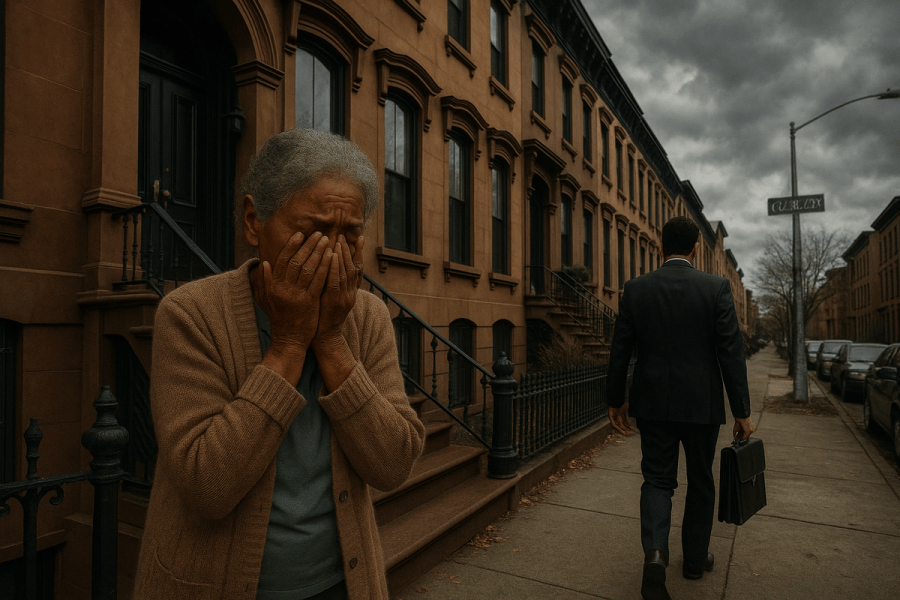
Don’t be a target for deed theft!
Your grandmother came from Jamaica with nothing but determination. Your parents saved for 30 years to buy that brownstone in Crown Heights. Your uncle built his life around that house in Flatbush. For generations, home ownership has been the cornerstone of wealth-building in Brooklyn’s African and Caribbean American communities — and predators know it.
Deed theft is one of the most devastating forms of financial crime targeting homeowners of color in New York City, and Brooklyn is ground zero. According to the New York City Department of Investigation, deed theft disproportionately affects elderly
Black homeowners, immigrants, and long-time residents in neighborhoods like BedStuy, Crown Heights, East Flatbush, and Canarsie — the very communities that have called Brooklyn home for decades.
If you own property in Brooklyn, this is not a distant threat. This is happening on your block. Here’s what you need to know to protect yourself, your family, and the home you worked so hard to earn.
What is Deed Theft?
Deed theft occurs when someone illegally transfers the title of your home out of your name — often without your knowledge — using forged documents, fraudulent signatures, or by exploiting vulnerable homeowners through deception.
It sounds impossible. How can someone steal your house? But it happens more often than you think, and New York’s public property records system, while valuable, can be exploited by those with criminal intent.
Once a fraudulent deed is recorded with the New York City Register’s office, the thief can attempt to take out loans against the property, sell it to unsuspecting buyers, or simply attempt to evict the rightful owner. By the time many homeowners discover what has happened, the situation has become legally complex and emotionally devastating.
On November 12, 2025, Sanford Solny, a real estate investor was recently sentenced to two and a half to seven years in prison for a decade-long deed theft scheme in Brooklyn.
From 2012 to 2022, Solny targeted homeowners facing foreclosure—many of whom were people of color—by promising to facilitate short sales. Instead, he tricked them into transferring property deeds to himself or shell companies under his control.
Prosecutors alleged Solny collected approximately $500,000 in rent from these stolen properties while the original owners were evicted.
After his conviction, a judge nullified the deeds to the 11 properties, allowing victims the chance to regain ownership.
Why Brooklyn’s Black Communities are being targeted
Predators specifically target these communities for several calculated reasons:
Generational wealth without legal safeguards. Many long-time homeowners — particularly elders who immigrated from Caribbean nations like Haiti, Jamaica, Trinidad, Barbados, and Guyana — own their homes free and clear after decades of payments. That equity makes them attractive targets. Yet many do not have updated wills, trusts, or legal protections in place.
Language and immigration status. Homeowners who primarily speak Haitian Creole, French, Patois, or Spanish may face language barriers when interacting with city agencies or reviewing legal documents. Fraudsters exploit this, presenting complex paperwork in English and pressuring victims to sign quickly.
Distrust of institutions. Communities with historical reasons to distrust banks,
government agencies, and legal systems may be less likely to reach out for help early — giving fraud more time to take root.
Neighborhood gentrification pressure. As property values in Flatbush, Crown Heights, East New York, and Canarsie have skyrocketed, so has the financial incentive for criminals to target homeowners in these areas. A deed theft scheme that nets a $700,000 Brooklyn brownstone is worth enormous criminal effort.
Targeting of grieving families. One of the most common scenarios involves the death of a homeowner. Before a proper estate is settled, a fraudster may file a forged deed claiming ownership of the property. Grieving families — already overwhelmed — may not discover the fraud for months.
Common Deed Theft Schemes To Watch For
Understanding how these schemes work is your first line of defense.
The Foreclosure Rescue Scam. A homeowner falls behind on mortgage payments. A stranger approaches claiming they can “save” the home from foreclosure — but only if the homeowner temporarily signs over the deed. The transfer is never reversed.
The Quit Claim Deed Fraud. Fraudsters convince homeowners to sign a quit claim deed — often under false pretenses, buried in a stack of paperwork, or by forging the homeowner’s signature entirely — and then record it with the city.
The Predatory Notary. A notary public (sometimes corrupt, sometimes complicit) notarizes a forged document without the owner’s presence, providing the fraudulent deed with a veneer of legal legitimacy.
The Fake Heir. After a homeowner passes away, a stranger files paperwork claiming to be a relative or beneficiary, recording a forged deed before the legitimate family can act.
The Investment “Partnership.” A homeowner is approached with an offer to invest in or refinance their home. Buried in the documents is a deed transfer. By the time the homeowner realizes what happened, their name is off the title.
Step To Protect Your Brooklyn Property Right Now
You do not need to wait until fraud occurs. There are concrete steps you can take today.
1. Sign up for NYC’s Deed Fraud Alert System. The New York City Register offers a free service called the Automated City Register Information System (ACRIS) Property Alert. Go to acris.nyc.gov and register your property address. You will receive an email notification any time a document is filed against your property. This is free, takes minutes, and is one of the most powerful tools available to you.
2. Check your deed regularly. Visit ACRIS (acris.nyc.gov) and search your property by address. Review any documents recorded against your home. If you see anything unfamiliar, act immediately.
3. Consult an attorney to review your estate plan. If you own a home and do not have a current will, living trust, or designated beneficiaries documented legally, you are leaving your family vulnerable. An attorney can help you establish protections that make fraudulent transfers far harder to execute — and ensure your property passes cleanly to your intended heirs.
4. Be extremely cautious about anyone who approaches you about your home. If a stranger knocks on your door, calls you, or sends mail claiming they want to help you with your mortgage, avoid foreclosure, refinance, or “invest” in your property — treat it with serious suspicion. Legitimate lenders do not pressure you at your doorstep. Consult an attorney before signing anything.
5. Never sign documents you do not fully understand. This seems simple, but
pressure tactics are specifically designed to override good judgment. Take any
document home. Have an attorney or trusted family member review it. Any entity that insists you sign immediately is a red flag.
6. Tell your family about your property ownership. Make sure trusted family members know that you own your home, where the deed is kept, and who your attorney is. Many deed theft schemes succeed because families simply did not know what documents existed or where to look.
7. Keep copies of your deed in a secure location. Store certified copies of your deed in a fireproof safe, a bank safety deposit box, and with your attorney. Having the original documentation makes it far easier to challenge fraudulent filings.
What to Do If You Suspect That Deed Theft Has Occurred?
Don’t wait! Time is Critical. Act fast! If you believe that deed has been stolen:
Contact the NYC Sheriff’s Office Deed Theft Task Force. New York City has a dedicated unit investigating deed fraud. You can reach them at (212) 825-5600. File a complaint with the NYC Department of Investigation.
Contact a New York attorney immediately. A court can issue an emergency injunction to freeze any sale or mortgage activity on the property while the fraud is investigated. The sooner you act, the more options you have.
Contact your local elected officials. Brooklyn’s City Council members and State Assembly representatives have been active on deed theft legislation. They can connect you with resources and apply pressure to expedite investigations.
Reach out to community organizations. Groups like the Brooklyn Legal Services, the Center for NYC Neighborhoods, and the New York Legal Assistance Group (NYLAG) offer free or low-cost legal help to homeowners facing deed fraud.
New York Law Acts As Your Shield Against Deed Theft
In 2023, New York State strengthened its deed theft laws, making deed fraud a Class B felony carrying up to 25 years in prison. Prosecutors in Brooklyn have made deed theft a priority. Additionally, victims of deed theft in New York can pursue civil remedies — including the recovery of damages — against these culprits .
This is important: if you have been a victim of deed theft, you may be entitled to financial compensation beyond simply getting your home back. An experienced attorney can help you pursue all available remedies.
Contact Koenig Pierre, Esq. for help protecting your families legacy. A Brooklyn attorney who will be your shield against those vultures.
From Protecting Your Home to Protecting Your Rights: A Word About Personal Injury Law
Your home is your most valuable physical asset. But your body — your health, your
ability to work and provide for your family — is the foundation everything else rests upon.
Just as deed thieves target vulnerable homeowners, insurance companies and negligent parties often attempt to take advantage of injury victims who don’t know their rights. The tactics are different, but the principle is the same: they count on you not knowing what you’re entitled to.
If you or a family member has been injured due to someone else’s negligence —
whether in a car accident, a slip and fall, a workplace incident, or medical malpractice — here are the most important things to know:
Document everything immediately. Photographs, witness names, police reports, and medical records are the foundation of any personal injury claim.
Seek medical attention immediately — even if you feel “okay.” Many injuries, including whiplash, traumatic brain injuries, and internal damage, are not immediately apparent. Gaps in medical treatment are used by insurance companies to minimize your claim.
Do not give recorded statements to insurance adjusters without legal counsel. Insurance adjusters are trained to ask questions in ways that can reduce or eliminate your compensation. This is the equivalent of signing a document you don’t understand.
Know your deadlines. In New York, the statute of limitations for most personal injury claims is three years from the date of injury. For claims against a city agency — like an injury caused by a pothole or a defective city sidewalk — you may have as little as 90 days to file a Notice of Claim. Missing these deadlines can permanently bar your recovery.
You pay nothing unless you win. As a New York personal injury attorney, I work on a contingency fee basis. You owe me no attorney fees unless my team and I recover compensation for you.
If you have been injured or need legal assistance, Contact a dedicated Brooklyn attorney today!
If you have questions about deed theft, property fraud, or a personal injury matter in Brooklyn or anywhere in New York, our firm is here to help.
Were you injured in a car accident and injured in a collision involving a truck? Call Koenig, a New York Car Accident Lawyer serving people injured in New York City (Brooklyn, Manhattan, Queens Car Accident Lawyer, The Bronx, and Staten Island Car Accident Lawyer), Long Island Car Accident Lawyer, and the New York Metropolitan area.
He is committed to serving every client with personalized attention, compassionate customer service, and professionalism. Before you get carried away, call him today!
Blog
Tripped on a Sidewalk in NYC: Who Is Responsible?
Tripped on a broken sidewalk in NYC? Usually the building owner is responsible, but for many 1–3 family homes it’s the City, and you may have only 90 days.
Suing a Commercial Truck Company for an Accident in New York
Hit by a commercial truck in Brooklyn? In New York, you can usually sue the trucking company, not just the driver. Learn who can be held responsible, how much insurance trucks carry, what changed in the 2026 law, and the 30-day, 90-day and 3-year deadlines you can’t miss. Free consultation. Nou pale Kreyòl. Se habla español.

What Happens If an Undocumented Worker Gets Hurt on a Construction Site in NY?
Hurt on a New York construction site without papers? Your immigration status doesn’t take away your rights. Learn how workers’ comp pays your medical bills, when you can sue the property owner and contractor, whether you can recover lost wages, and why it’s illegal for your boss to threaten you with immigration. Free consultation. Nou pale Kreyòl. Se habla español.