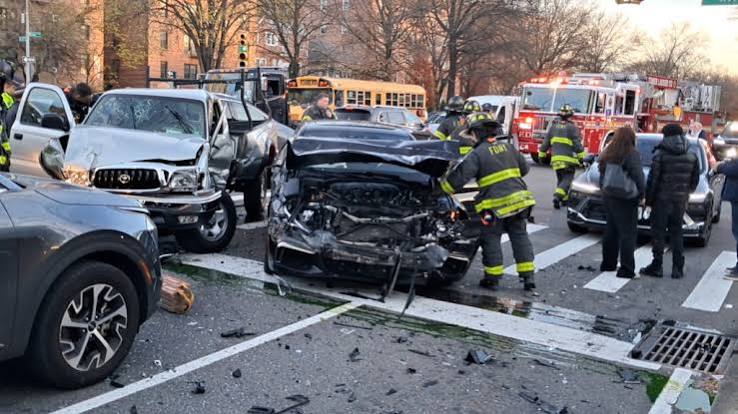
Uber and Lyft Accidents in NYC Are Surging —
Here's Who You Can Actually Sue
As a Brooklyn injury attorney, I've watched rideshare crashes become one of the most confusing — and most winnable — cases in New York personal injury law. Here's everything you need to know before you call anyone.
I want to tell you something that most lawyers won't admit up front: Uber and Lyft accident cases are some of the most complicated injury claims in New York — not because the law is mysterious, but because these companies have spent millions designing insurance structures meant to confuse you. I've seen injured passengers in Brooklyn and across the city walk away with far less than they deserved simply because they didn't understand how the system worked.
That changes right now. By the time you finish reading this, you'll know exactly who can be held responsible when a rideshare accident tears through your life, which insurance policies apply to your specific situation, and what you need to do — today — to protect your ability to recover full compensation.
I don't just write about these cases — I've successfully handled rideshare accident claims right here in Brooklyn and across New York City. My clients have included Uber and Lyft passengers seriously injured mid-trip, pedestrians struck by on-duty rideshare drivers, and cyclists doored or sideswiped by drivers distracted by the app. In each case, I identified every liable party, pursued every applicable insurance policy, and fought to put maximum compensation in my clients' hands. Rideshare accident law is what I do. When you call my office, you're talking to an attorney who has been through this process before — and who knows exactly what it takes to win.
Why Rideshare Crashes Are Exploding in NYC
New York City has more active Uber and Lyft drivers than almost anywhere else on the planet. According to the NYC Taxi & Limousine Commission, there are over 80,000 for-hire vehicles licensed to operate in the city on any given day. That's a staggering number of drivers — many of them fatigued, distracted by the app, or unfamiliar with Brooklyn's side streets — sharing the road with cyclists, pedestrians, and regular commuters.
The result? Serious crashes. Broken bones. Traumatic brain injuries. Spinal cord damage. And families in Brooklyn, Flatbush, Bed-Stuy, and Crown Heights left asking the same desperate question: What do I do now, and who is going to pay for this?
The Big Question: Is the Driver an Employee or a Contractor?
Here's the argument Uber and Lyft make every single time someone tries to hold them accountable: "We're just a technology platform. The driver is an independent contractor. Talk to their insurance." Courts have wrestled with this question for years.
In Salamon v. Our Lady of Victory Hospital, 514 F.3d 217 (2d Cir. 2008), the Second Circuit examined the factors that distinguish an employee from an independent contractor under New York law — including who controls the work, who supplies the tools, and the permanency of the relationship. Applied to rideshare, courts have had to weigh Uber's tight control over driver ratings, pricing, and routing against their contractual classification of drivers as non-employees.
More recently, in Matter of Lowry (Uber Tech., Inc.), 61 Misc.3d 1213(A) (N.Y. Sup. Ct. 2018), a New York court examined the degree of behavioral control Uber exercises over its drivers. While outcomes vary, the trend in New York is toward greater accountability — and an experienced NYC rideshare accident lawyer knows how to use this.
The practical upshot: even if you can't directly sue Uber or Lyft as an employer, the company's massive insurance policies are absolutely on the table — and those policies can be worth up to $1.25 million per incident.
The Three Coverage Periods — This Is Where Your Case Lives
Uber and Lyft insurance doesn't work like regular car insurance. It's structured in phases — and which phase the driver was in at the moment of your accident determines everything. Under New York Vehicle & Traffic Law § 370-a, Transportation Network Companies are required to maintain specific coverage levels tied to these periods.
| Coverage Period | Driver Status | Uber / Lyft Coverage | Who It Affects |
|---|---|---|---|
| Period 0 — App OFF | Personal driving, not working | Driver's personal insurance only | Anyone struck by the vehicle |
| Period 1 — App ON, No Ride Accepted | Waiting for a match | Contingent: $50K / $100K liability + $25K property damage | Third parties, pedestrians, cyclists |
| Period 2 — Ride Accepted, En Route to Pickup | Driving to pick up passenger | $1.25 million liability + UM/UIM | Third parties, pedestrians, cyclists |
| Period 3 — Passenger In Vehicle | Active trip in progress | $1.25 million liability + UM/UIM | Passengers, third parties |
One of the first things I do when a client comes to me after a rideshare crash is nail down exactly which period applied. A driver who just dropped off a passenger and was looking for the next ride? Period 1 rules. A driver with you in the back seat? Period 3 — and $1.25 million is in play. These aren't small distinctions.
You have 30 days to file a no-fault claim in New York.
- New York is a no-fault state. Your immediate medical bills and lost wages (up to $50,000) are covered by the vehicle's PIP insurance — regardless of who caused the crash.
- You must file a no-fault application within 30 days of the accident or you risk losing those benefits entirely.
- For a lawsuit, the general statute of limitations is 3 years under CPLR § 214 — but this can be shorter in certain situations.
- Don't wait. Contact my office today for a free case evaluation.
Who Exactly Can You Sue? All Your Options.
When I take a rideshare accident case, I never assume there's only one defendant. There are often multiple parties whose negligence contributed to what happened. Here's how I think through it:
1. The Uber or Lyft Driver
This is always the starting point. The driver owes every passenger and every person on the road a duty of reasonable care. When they violate that duty — by speeding, running a light, checking the app while driving, or driving while fatigued — they are personally liable. New York's negligence framework, established in Palsgraf v. Long Island Railroad Co., 248 N.Y. 339 (1928), remains the foundational standard: defendants are liable for foreseeable harms caused by their negligent conduct.
2. Uber or Lyft (the Company)
Even where direct employer liability is contested, the company may be liable under theories of negligent hiring, negligent retention, or negligent supervision — particularly if the driver had a prior record of dangerous driving that Uber or Lyft knew about or should have discovered through proper background checks. New York courts recognize these claims. See Kenneth R. v. Roman Catholic Diocese of Brooklyn, 229 A.D.2d 159 (2d Dep't 1997).
3. Another Driver (Third-Party Negligence)
Sometimes the Uber or Lyft driver wasn't at fault — another vehicle caused the collision. You still have full legal recourse against that driver, and Uber and Lyft's uninsured/underinsured motorist coverage can step in if that driver lacked sufficient insurance.
4. The City of New York (Road Conditions)
If a pothole, broken traffic signal, or poorly maintained road contributed to your accident, the City may share liability. Important: claims against New York City require a Notice of Claim filed within 90 days. This is one of the most frequently missed deadlines in all of personal injury law.
Were You Injured in a Brooklyn Rideshare Accident?
I offer free, confidential case evaluations to every injured person — with no obligation and no fee unless we win.
Get Your Free Consultation📞 Or call: 1-800-946-4616 | 🌐 Se habla español | 🇭🇹 Nou pale Kreyòl
What New York's No-Fault Law Actually Means for You
New York is one of a small number of no-fault insurance states. Under New York Insurance Law § 5102, injured people can collect up to $50,000 in Personal Injury Protection benefits for medical expenses and 80% of lost wages — no matter who was at fault. This applies to you as a passenger, as a pedestrian who was struck, or as another driver involved in the crash.
Here's what no-fault does not cover: your pain and suffering, your permanent injuries, your emotional trauma, and your economic losses beyond $50,000. To pursue those damages, you must clear what the law calls the "serious injury" threshold — defined in Insurance Law § 5102(d) as conditions including fractures, significant disfigurement, and permanent loss of use of a body organ.
In practice, most of my clients who come in after a serious rideshare crash do meet this threshold. The key is proper medical documentation from day one — which is another reason why getting an attorney involved early matters so much.
What to Do Right Now If You Were Just in a Rideshare Accident
The decisions you make in the first 48 hours after an accident will shape your entire case. Here's the framework I give every client.
Get Medical Help
Go to the ER or urgent care immediately — even if you feel "fine." Adrenaline masks pain. Delayed treatment gaps will be used against you.
Document Everything
Screenshot your Uber/Lyft app showing the trip details, driver name, and time. Photograph the scene and all vehicles before leaving.
Get Witness Info
Exchange contact information with any bystanders. Eyewitnesses can be the difference between a disputed claim and a clear liability finding.
Don't Talk to Adjusters Alone
Insurance adjusters work for the company, not for you. Their job is to minimize what they pay. Say nothing without your attorney present.
Call an Attorney Now
Multiple deadlines start running the moment your crash happens. A Brooklyn rideshare injury lawyer protects all of them from day one.
A Word About Brooklyn Specifically
I practice right here in Brooklyn. My office is on Coney Island Avenue. I know Flatbush Avenue at rush hour. I know what Atlantic Terminal looks like when an Uber driver is circling for a pickup. I know the intersections in Bed-Stuy and Crown Heights where cyclists and pedestrians are most vulnerable.
I also know that a significant portion of my Brooklyn clients are immigrant families — Haitian, Caribbean, Latinx — who may not fully understand their legal rights, who may be hesitant to take on a billion-dollar corporation, or who may have been told by an insurance adjuster that they don't have a case. They do. And I fight for them.
If you were hurt in a rideshare accident anywhere in Brooklyn — from Bay Ridge to Bushwick, from Canarsie to Clinton Hill — you have rights under New York law, and you have options. My consultations are completely free, completely confidential, and available in English, Spanish, and Haitian Creole.
A Real Brooklyn Rideshare Accident — What Happened and What We Did
I want to share a case that captures exactly why every minute matters after a rideshare crash — and what it looks like when an injured family does everything right from the very first moment.
The call came in while the sirens were still approaching. A daughter had her phone in her hand and did something most people don't think to do in those first terrifying minutes after a crash — she looked up a lawyer and called me. She and her mother were still sitting inside the vehicle on Ocean Avenue between Glenwood Road and Avenue H — one of Brooklyn's most dangerous corridors for vehicle crashes — waiting for the ambulance.
What happened was clear in terms of liability but devastating in terms of impact. Their Uber driver entered an intersection and ran a red light. Another vehicle with the right of way struck them in a full T-bone collision — the kind of impact that sends shockwaves through everyone in both vehicles. The elderly mother bore the worst of it. Her daughter was shaken, scared, and already sensing that something was seriously wrong.
From the moment I picked up that call, we got to work. With the daughter still standing at the scene, I walked her through exactly what to collect. I told her to open the Uber app immediately and screenshot the active trip — the driver's name, vehicle, route, and timestamp. I told her to photograph every vehicle from multiple angles, capture the position of the cars in the intersection, and look for any traffic or security cameras on nearby buildings along Ocean Avenue — a detail most people would never think of while in shock.
Then we handled the reporting. I guided her through how to report the accident to Uber directly through the app, which triggered the company's internal incident documentation process and put them on notice immediately. This matters enormously — early notice to Uber preserves trip data, driver logs, and GPS records that can disappear or become unavailable if you wait days or weeks.
By the time the ambulance arrived and transported her mother to the hospital, we had already done what most accident victims take days to figure out — and by then, it's often too late. The evidence was preserved. Uber's internal records were flagged. And the family had an attorney actively protecting their case from minute one.
Because their Uber driver was actively transporting a passenger at the time of the crash — Period 3 under the coverage framework I described above — Uber's $1.25 million liability policy was fully in play. The case moved forward with a clear liability picture, preserved digital evidence, and a family that understood their rights from the very first hour.
Other situations where insurance coverage gets complicated:
- Amazon & FedEx delivery truck accidents in NYC — similar multi-party liability issues
- MTA bus accidents in Brooklyn — the 90-day Notice of Claim deadline applies here too
- Bicycle accidents involving rideshare vehicles in Brooklyn
- General New York car accident law
Frequently Asked Questions

More From the Blog
Ready to Talk? I'm Here.
There's no cost, no pressure, and no obligation. Just an honest conversation about what happened to you and what your options are. I personally review every case.
Schedule Your Free Consultation📞 1-800-946-4616 · 2653 Coney Island Avenue, Brooklyn, NY 11223 · Response within 24 hours
Disclaimer: This article is for general informational purposes only and does not constitute legal advice. Reading this content does not create an attorney-client relationship. Laws change and individual circumstances vary. For advice specific to your situation, contact Koenig Pierre, Esq. directly.