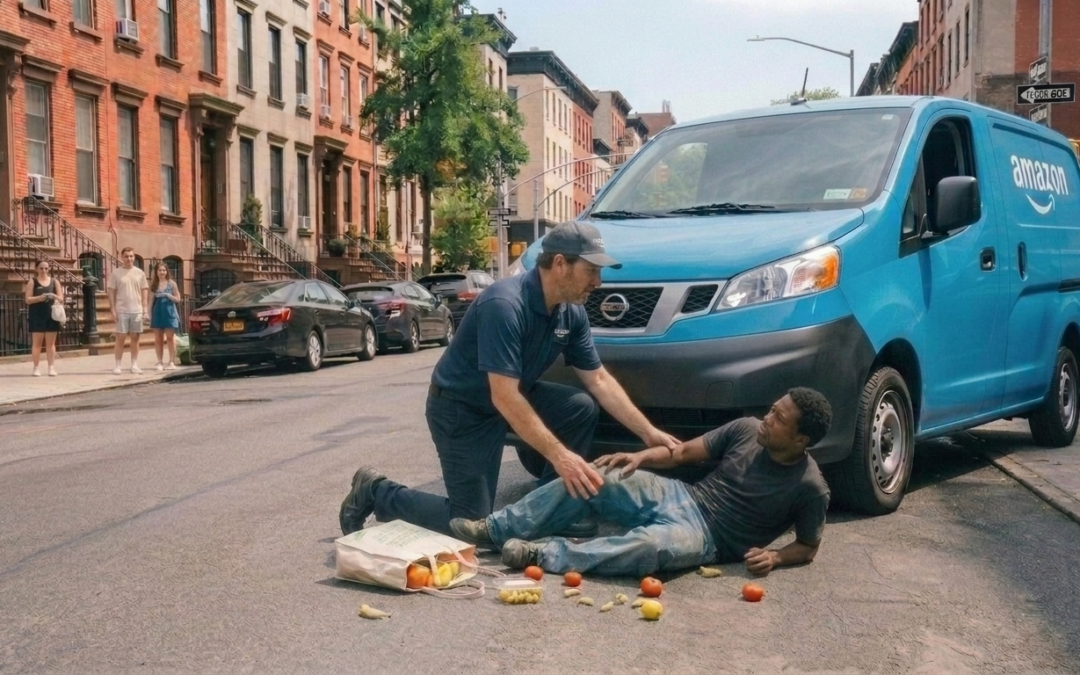
Brooklyn Truck & Delivery Van Accidents
Hit by an Amazon or FedEx Van in Brooklyn: Who Pays for Your Medical Bills?
The van said Amazon. The driver wore the vest. But the company that has to pay you may be a five-person LLC you've never heard of — and if nobody names it in time, that's the only insurance you get. Here's how these cases really work.
You were crossing Fulton at Jay. Or riding up Flatbush past Grand Army Plaza. Or just sitting at a light on Atlantic when a van came out of a double-parked spot without looking.
Now your shoulder doesn't work right, you've got an ER bill on the kitchen table, and somebody from an insurance company you never heard of is calling you very politely.
Here's the first thing I tell people: the logo on the side of that van is marketing. It is not necessarily the name of the company that owes you money. Amazon and FedEx both built their delivery networks specifically so that the company on the truck and the company on the hook are two different things. That's not a conspiracy theory — it's their published business model, and it's the single biggest reason these cases go sideways for people who try to handle them alone.
Let me walk you through it in plain English.
First: your medical bills get paid right away. That part isn't complicated.
Before we get into the corporate stuff, breathe. New York is a no-fault state, and a delivery van is a registered motor vehicle. That means basic no-fault benefits kick in regardless of who caused the crash — up to $50,000 per person in what the statute calls "basic economic loss": medical treatment without a time limit, lost earnings up to $2,000 a month for up to three years, and $25 a day for necessary household help. N.Y. Ins. Law §§ 5102(a), 5103
Where those benefits come from depends on how you got hit:
| If you were… | No-fault usually comes from |
|---|---|
| Driving or riding in your own car | Your own auto policy |
| A pedestrian struck by the van | The van's insurance policy |
| On a bicycle struck by the van | The van's insurance policy |
| A passenger in someone else's car | That car's policy (usually) |
| Hit by an unidentified van that fled | Your own policy, or MVAIC if you have no coverage Ins. Law art. 52 |
This is a real advantage over other kinds of crashes. If a delivery e-bike or moped hits you in Brooklyn, no-fault often doesn't apply at all, because e-bikes are classified as bicycles rather than motor vehicles under New York law. N.Y. Veh. & Traf. Law § 102-c A van is a motor vehicle. So at least the front end of your medical care has a funding source.
The 30-day rule that quietly kills claims
You generally have 30 days from the date of the crash to give the insurer written notice — the NF-2 application. 11 NYCRR § 65-1.1 Miss it without a written explanation the carrier accepts as reasonable, and your benefits can be denied outright.
Two more clocks run behind it: medical bills generally have to reach the carrier within 45 days of treatment, and proof of lost earnings within 90 days. 11 NYCRR § 65-2.4 Thirty days sounds like plenty until you've spent two weeks in physical therapy and on the phone with your job.
Now the real question: no-fault runs out. Then what?
Fifty thousand dollars sounds like a lot until you have surgery. A single shoulder repair, a lumbar fusion, or a traumatic brain injury can burn through it before you've finished your first course of treatment. And no-fault pays nothing for pain and suffering — not one dollar.
To get compensated for the actual damage to your life, you have to bring a claim against whoever is legally responsible. New York bars covered persons from suing each other for pain and suffering unless the injury clears the "serious injury" threshold. Ins. Law § 5104(a)
The statute lists nine categories, and these are the ones that come up most in delivery van cases Ins. Law § 5102(d):
- A fracture — the cleanest category there is.
- Permanent consequential limitation of use of a body organ or member.
- Significant limitation of use of a body function or system.
- The 90/180 rule — a medically determined injury that prevents you from performing substantially all of your usual daily activities for at least 90 of the first 180 days after the crash.
- Significant disfigurement, loss of a fetus, or death.
That last one, the 90/180 category, is where documentation wins or loses cases. It's proved with treatment records and out-of-work notes, not with how you felt. Gaps in treatment destroy it.
And that's where the corporate shell game starts. Because before you can sue anybody, you have to know who "anybody" is.
The Amazon van: three totally different companies, one logo
When you see a blue Prime van on Flatbush, it could be any of three arrangements. They look identical from the sidewalk. They are not identical in court.
1. The DSP van (most of what you see in Brooklyn)
Amazon runs the bulk of its last-mile deliveries through Delivery Service Partners — independent small businesses that lease the branded vans, hire the drivers, and run assigned routes. The van says Amazon. The vest says Amazon. The app is Amazon's. But on paper, the driver works for, say, "Kings County Logistics LLC."
Amazon's standing position when someone gets hurt is that the DSP is an independent contractor and Amazon isn't responsible for what its drivers do. Every DSP is required to carry commercial auto liability coverage — commonly around $1 million — and Amazon's lawyers would very much like your case to end there.
Sometimes $1 million is more than enough. If you have a herniated disc that resolves with injections, fine. But if you're looking at multiple surgeries, permanent nerve damage, or a wrongful death claim, a single $1 million policy split among an injured family is not close to adequate. That's when the fight over whether Amazon itself belongs in the case becomes the whole ballgame.
2. The Flex driver (the one people miss entirely)
Amazon Flex drivers use their own cars — a Corolla, a minivan, whatever — and pick up delivery blocks through an app. No branding at all. If one of them hits you on Ocean Parkway while running Amazon Fresh orders, you may look at the scene and think you were hit by a regular driver with a regular policy. Amazon's commercial coverage can apply when a Flex driver is on an active delivery block, but nobody at the scene is going to tell you that. It comes out through the driver's app data.
This is the same coverage-by-time-period structure that trips people up in Uber and Lyft cases: what's available depends entirely on what the driver was doing in the app at the moment of impact.
3. The line-haul truck
The big box trucks and tractor-trailers moving freight between warehouses are usually run by contracted motor carriers with their own DOT numbers. Those are full-blown trucking cases governed by federal safety regulations, with electronic logging devices, hours-of-service records, and maintenance files that all have to be preserved before they legally disappear. The upside: interstate carriers hauling general freight must carry minimum liability coverage well above what a passenger vehicle carries. 49 C.F.R. § 387.9
The FedEx van: which FedEx is it?
FedEx is arguably even more confusing, because the answer turns on which division you were hit by — and the trucks look nearly the same to a regular person.
FedEx Ground — which handles most residential package delivery, the stuff landing on stoops in Midwood and Bay Ridge — doesn't employ its delivery drivers. It contracts with Independent Service Providers (ISPs): small companies that buy route territories, own or lease the trucks, hire the drivers, and carry their own commercial policies. Same playbook as Amazon's DSPs, different name.
FedEx Express — the overnight and time-definite side — generally uses actual FedEx employees in FedEx-owned vehicles. If an Express driver runs you down on the job, the liability chain is short and the corporate insurance is right there.
So two nearly identical white trucks, two blocks apart on Third Avenue, can produce two completely different cases. Step one is always figuring out which one you're dealing with — and you usually can't do that from a police report alone.
The shortcut most people don't know about: New York holds the owner liable
Here's something that works in your favor, and it has nothing to do with employment law.
In New York, the owner of a vehicle is liable for the negligence of anyone driving it with permission. N.Y. Veh. & Traf. Law § 388(1) Full stop. It doesn't matter whether the driver was an employee, a contractor, or the owner's cousin borrowing it for the afternoon. If the company's name is on the registration and it let that person drive, it answers for the crash.
So when a DSP or an ISP owns the van that hit you, the whole independent-contractor debate never even gets started as to that company. You don't have to prove control. You just have to prove the driver was negligent and had permission to be behind the wheel.
The catch: the Graves Amendment
If the van was leased from a company in the business of leasing vehicles, a federal statute blocks that owner-liability shortcut against the lessor. 49 U.S.C. § 30106 It's called the Graves Amendment, and it preempts § 388 as to professional lessors — which matters here, because delivery contractors typically lease their fleets rather than own them.
But the shield has holes. It only protects a lessor with no negligence of its own. If the leasing company skipped maintenance, ignored a known defect, or handed keys to someone it shouldn't have, § 30106 doesn't cover that. And it doesn't touch the operating company's own liability at all. This is exactly why pulling the title, the registration, and the lease agreement early isn't paperwork — it's the case.
Why the "independent contractor" label isn't the end of the conversation
Here's the part that matters most, and I want to be honest about it: getting the parent corporation into your case is a fight, not a formality. But it is a fight worth having, and it's winnable.
New York courts don't just accept whatever label a contract puts on a relationship. The Court of Appeals has been clear that the critical inquiry is control — the degree of control the company exercises over the results produced, or the means used to produce them. Relevant factors include whether the worker set their own hours, was free to work elsewhere, got fringe benefits, was on the payroll, and worked a fixed schedule. Bynog v. Cipriani Group, Inc., 1 N.Y.3d 193, 198 (2003)
A 1099 doesn't settle it. Neither does a contract that says "independent contractor" in bold on page one. And in the modern delivery economy, the level of control the parent company exercises is extraordinary:
- The app assigns the route, the stop order, and the delivery window.
- Onboard cameras and telematics score the driver on speed, braking, following distance, and whether they looked at their phone.
- The parent company sets appearance standards, package handling procedures, and delivery-per-hour expectations.
- Contractors get penalized — or lose the contract entirely — when their numbers slip.
- The vehicle is branded with the parent's logo, which is precisely what makes you assume you're dealing with the parent.
That last point has its own legal name — apparent agency — and it's exactly the common-sense argument a Brooklyn jury understands: you saw the logo, you trusted the logo, they put the logo there on purpose.
There are also claims that belong to the parent company directly, no agency argument required: negligently selecting a contractor with a bad safety record, keeping one on after complaints, or setting delivery quotas so tight that speeding and sidewalk parking become the only way to hit them. Those are the parent's own decisions, not the contractor's.
Juries have hit Amazon hard when the control evidence came out. But that evidence lives in the parent company's systems — which brings us to the clock.
The insurance layers — and why naming the right entity is the whole case
If you settle with the contractor's carrier early — and they will offer early, sometimes within days, sometimes with real sympathy in their voice — you typically sign a release. That release can shut the door on everyone else, permanently, for a number that looked generous before you knew your knee needed a second surgery.
The adjuster is not being cruel. They're being efficient.
Their job is to close your file for the smallest defensible number before you fully understand what happened to you. That's also why they want a recorded statement in the first week — before your MRI, before your symptoms declare themselves. I wrote a whole piece on why giving a recorded statement almost always hurts your claim, and it applies double here.
Where this happens in Brooklyn
I've lived and worked in this borough long enough to know exactly where the delivery pressure concentrates. It isn't random.
Flatbush Avenue: a Vision Zero corridor with almost nowhere legal to stop
Flatbush is the borough's spine, and the numbers on it are not subtle. NYC DOT classifies Flatbush Avenue as a Vision Zero Priority Corridor containing 11 Vision Zero Priority Intersections, and it crosses 18 other priority corridors. The Downtown stretch ranks in the top 10% of high-crash corridors in Brooklyn, with 55 people killed or severely injured since 2019.
Zoom in on the 1.15 miles between Grand Army Plaza and Livingston Street and NYPD recorded 1,143 crashes injuring 596 people over five years — including 89 pedestrians and 78 cyclists.
Sources: NYC DOT, Flatbush Avenue corridor presentations to Brooklyn community boards; NYPD collision data.
Now here's the part that matters legally, and it's the thing I wish more people understood.
Most of Flatbush's retail stretch has no dedicated loading zone at all. New York created Neighborhood Loading Zones specifically to stop delivery drivers from double-parking, and Local Law 168 of 2021 ordered DOT to install at least five per qualifying neighborhood each year. But the rollout started small: when DOT briefed the Brooklyn Borough Service Cabinet, the entire borough had 24 loading zones — six in Williamsburg on Manhattan Avenue, ten in Park Slope on Second and Third Streets, eight in Sunset Park between 48th and 51st. Not one on the Flatbush retail corridor.
So a driver with forty stops between Atlantic and Church has two options: circle for a legal space and blow the route, or stop in the bike lane. The app doesn't care which. That is not an accident of geography — it's a company decision about how many stops fit in a shift, made in a building far from Brooklyn, and it is precisely the kind of evidence that puts the parent corporation in the case.
Why "he was double-parked" is a legal argument, not an excuse
When a stopped van forces you out of a bike lane and into moving traffic, New York doesn't treat that as your problem. The operator who blocked the lane can share liability with the driver who struck you — and if the blocking driver was working at the time, that driver's employer is in it too. I cover the mechanics on my Brooklyn bicycle accident page, and the same reasoning applies to a pedestrian stepping around a van into a lane they can't see down.
If you were hit anywhere on this corridor, my Flatbush accident page covers the local specifics.
Downtown Brooklyn: a skyscraper district built on a 1950s street grid
Downtown Brooklyn was rezoned in 2004, and the Flatbush Avenue corridor became a tower district — a dozen of the borough's tallest buildings now, including the 1,066-foot Brooklyn Tower. In 2026 the City Council approved a 72-story tower with 1,263 apartments at 395 Flatbush Avenue Extension alone.
Think about what that means for deliveries. Every one of those units generates packages. The streets serving them — Fulton, Jay, Willoughby, Adams, Tillary — were laid out long before anyone imagined same-day shipping, and the curb was allocated decades ago.
Tillary Street and Flatbush Avenue Extension is the worst of it: the funnel where Brooklyn Bridge and Manhattan Bridge traffic meets local streets. A DOT study of that intersection found roughly 37 crashes a year and 112 people injured across a three-year study window. Drivers accelerate toward the bridge approaches while pedestrians cross five lanes and cyclists come off the bridge path into traffic. I wrote a full guide for people hit as pedestrians on Tillary or Flatbush Extension, because it comes up that often.
Red Hook and Sunset Park: where the vans are actually loaded
This is the part almost nobody outside the neighborhood knows, and it's why delivery van cases cluster where they do.
Amazon leased roughly 600,000 square feet of last-mile space in Red Hook alone — about 336,500 square feet at 640 Columbia Street and 312,000 at 280 Richards Street. FedEx built a large last-mile facility next door in Sunset Park. UPS planned a 1.2-million-square-foot facility on 12 acres of Red Hook waterfront. Research from the New York Attorney General's office counted at least 33 additional last-mile facilities across the city.
Two things about that matter for your case:
- These went up as-of-right. Red Hook's industrial zoning let last-mile warehouses be built with no special permit and no environmental impact study — meaning no traffic study, and no required mitigation for the vans they put on residential blocks.
- Red Hook is surrounded by water on three sides with only a handful of truck entrances, so the entire outbound fleet funnels through the same few streets — Van Brunt, Beard, Columbia — and up onto the Gowanus and the BQE.
Every van that hits someone on Flatbush or Fourth Avenue in the afternoon left one of those buildings that morning. The route it was assigned, the number of stops on it, and the time it was expected to finish are all recorded — and they all point back to a facility a few miles away.
The city knows this is a problem. That helps you.
In April 2025 DOT launched a three-year microhub pilot — up to 36 sites where big trucks transfer packages to smaller vehicles. Two of the first Brooklyn locations sit under the BQE: Park Avenue in Clinton Hill between Washington and Hall, and Meeker Avenue in Greenpoint between Sutton and Kingsland. There's also an Off-Hour Deliveries program pushing freight into the 7 p.m.–6 a.m. window, and roughly 90% of goods in this city still move by truck.
Public findings that a corridor is dangerous, that curb space is inadequate, and that midday delivery causes double-parking are all documented in city records. That documentation is available to your case.
Atlantic Avenue and the BQE corridor
Atlantic is wide, fast, and mixed with heavy commercial traffic. Behind it, the BQE bottleneck near Sands Street and Atlantic and the Gowanus Expressway feed the whole last-mile network. When a delivery van and a freight truck are involved in the same crash, you may have two entirely separate corporate structures to untangle at once.
The evidence that legally disappears
This is the part I need you to take seriously, because it's the difference between a real case and a shrug.
Modern delivery vans are rolling data recorders. Onboard cameras, GPS breadcrumbs, telematics scoring every hard brake, app timestamps on every stop, driver messages, route assignments. All of it exists. All of it proves how much control the parent company had — and often, that the driver was behind schedule.
And most of it is on a retention timer measured in weeks. Some of it is on a federal clock. A motor carrier only has to keep records of duty status and supporting documents for six months. 49 C.F.R. § 395.8(k)(1) That's the rule I wrote about in the six-month piece on the Gowanus — six months to keep it, three years for you to sue, and nobody has to warn you about the gap. Vehicle inspection and maintenance records run on their own retention schedule 49 C.F.R. § 396.3(c), as do driver qualification files 49 C.F.R. § 391.51. Corporate camera footage is often overwritten far faster than any of it — sometimes in 30 days.
Nobody has to hand it over unless someone tells them, in writing, that they're legally required to preserve it. That letter is called a spoliation or litigation hold letter, and it needs to go to the driver, the contractor, and the parent company. Once a party is on notice that evidence may be relevant, destroying it can carry real consequences — up to and including striking their defense or telling the jury to assume the missing footage would have hurt them. CPLR 3126; Pegasus Aviation I, Inc. v. Varig Logistica S.A., 26 N.Y.3d 543 (2015)
If that letter goes out in week one, you have a case. If it goes out in month seven, you have a story.
What a hold letter demands
- Onboard and dash camera footage, front and cabin facing
- Telematics and driver safety scoring for that shift
- GPS route data and stop-by-stop timestamps
- The driver's app messages and dispatch communications
- The delivery quota and route plan assigned that day
- The driver's qualification file, training records, and prior incidents
- Vehicle maintenance and inspection history
- The contract between the parent company and the contractor
What to do in the first 48 hours
- Get medical attention today, not next week. Gaps in treatment are the first thing an adjuster uses against you, and adrenaline hides real injuries for days.
- Photograph the back and side of the van. Not just the logo — the fleet or van number, the license plate, and any DOT number or small contractor name printed near the rear door or bumper. That small text is frequently the only clue to which company actually owns the truck.
- Photograph the driver's ID badge or vest text if you safely can, and write down the exact time.
- Make sure a police report gets filed. Ask that the report list the vehicle's registered owner, not just the brand on the side.
- Look for cameras. Bodegas, bank ATMs, residential buzzer cams, and MTA cameras all record these corridors — and most overwrite in one to two weeks.
- Get witness numbers. On a block like Fulton or Church Avenue there are always witnesses, and they scatter in ninety seconds.
- File your no-fault application inside 30 days. This one is non-negotiable.
- Say nothing recorded to any insurance company — including your own — until you've talked to a lawyer.
- Call a local injury attorney early, so preservation letters go out while the footage still exists.
Deadlines worth writing on your fridge
30 days — no-fault written notice 11 NYCRR § 65-1.1
90 days — notice of claim, if a city or public entity vehicle is involved Gen. Mun. Law § 50-e
1 year and 90 days — suit against the City of New York Gen. Mun. Law § 50-i
2 years — most wrongful death claims EPTL § 5-4.1
3 years — most personal injury lawsuits CPLR § 214(5)
These vary with the facts, and some are much shorter than you'd expect. Don't guess at yours.
Why you shouldn't try to sort out the corporate structure yourself
I'm not telling you this to sell you something. I'm telling you because I watch it happen.
Someone gets hit by a branded van. They call the number on the corporate website. A claims service takes the report. A few weeks later a settlement offer arrives that covers the ER visit and a little for the trouble. It feels like the system worked.
What actually happened is that the smallest available insurance policy quietly bought a release for every company above it, and the camera footage that would have shown the driver running eleven stops behind schedule got overwritten on day 31.
You can't sue a company you never identified. And you can't identify it after you've already signed away the right to ask.
Finding the right defendants means pulling the vehicle registration and DOT records, reading the contract between the parent and the contractor, subpoenaing route and telematics data, and being willing to litigate the control question rather than accepting the label on a contract. That work happens in the first weeks or it doesn't happen at all.
What this looks like in practice
$[AMOUNT]
[Settlement / Verdict] · [Year] · [County] County
What happened: [One or two sentences. Where in Brooklyn, what kind of vehicle, how the crash occurred.]
The problem: [What made it hard — the contractor's policy was the only offer on the table, the wrong entity was named at first, footage was nearly gone, liability was disputed.]
What we did: [The specific work — pulled the registration and lease, subpoenaed route and telematics data, added the parent entity, proved the serious injury threshold.]
Prior results do not guarantee or predict a similar outcome. Every case depends on its own facts. Client details have been changed or omitted to protect privacy.
And here's the pattern I see over and over — a composite, not a client, but every piece of it is ordinary:
A home health aide is walking to the B41 stop on Flatbush near Church. A branded van is stopped in the bike lane. She steps around the back of it into the travel lane she can't see down and gets clipped by a car doing 25.
Week one: The van's insurer opens a no-fault file. Her ER bill and first six weeks of physical therapy get paid. A friendly adjuster calls twice asking for a recorded statement. Everyone tells her the system is working.
Week five: An MRI shows a torn rotator cuff. Surgery is scheduled. She can't lift her arm to do her job.
Week seven: An offer arrives. It sounds like real money to someone who has missed seven weeks of paychecks. Signing it releases the driver, the contractor, and everyone above them.
Month eight: A second surgery. The $50,000 in no-fault is long gone, the settlement is spent, and the camera footage showing that van was eleven stops behind schedule was overwritten in month two.
Nothing in that story required anyone to act in bad faith. It only required nobody to send a preservation letter in week one, and nobody to ask who actually owned the van.
Tell me what happened. I'll tell you straight where you stand.
If a delivery van hit you anywhere in Brooklyn — Flatbush, Downtown, Atlantic Avenue, Sunset Park, anywhere — I'll find out who actually owns that truck, who insures it, and who else belongs in your case. The consultation is free, and there's no fee unless I win.
🔒 Confidential · 📍 All five boroughs · 🌐 Se habla español · 🇭🇹 Nou pale Kreyòl ayisyen
Call 1-800-946-4616 Schedule a free consultationCommon questions
Can I sue Amazon directly if one of its vans hit me in Brooklyn?
Often you can name Amazon entities alongside the delivery contractor, but Amazon will fight to be dismissed by arguing the contractor is an independent business. Whether it stays in the case depends on the evidence of how much control Amazon exercised over that route, that driver, and that day's schedule — the control inquiry New York's Court of Appeals laid out in Bynog v. Cipriani Group, 1 N.Y.3d 193 (2003). That evidence exists. It just has to be demanded before it's gone.
Do I have to prove the driver was an employee to recover anything?
Not necessarily. New York holds the owner of a vehicle liable for the negligence of anyone driving it with permission, regardless of employment status Veh. & Traf. Law § 388(1). If the delivery contractor owns the van, that's a direct route to its insurance. If the van was leased from a professional leasing company, a federal statute limits that route as to the lessor 49 U.S.C. § 30106 — but not where the lessor was itself negligent, and not as to the operating company.
The van said FedEx. Isn't FedEx automatically responsible?
Not automatically. FedEx Express drivers are typically direct employees, so the corporation is generally responsible for their on-duty negligence. FedEx Ground routes are run by Independent Service Providers, and FedEx will argue those are separate companies. Identifying the division is the first step in any FedEx case.
Who pays my medical bills right away?
New York no-fault benefits — up to $50,000 per person in basic economic loss — cover medical treatment and part of your lost wages regardless of fault Ins. Law § 5102(a). If you were a pedestrian or cyclist, those benefits usually come from the van's policy. Written notice is generally due within 30 days 11 NYCRR § 65-1.1.
What if the van drove off and I couldn't get a plate?
You still have options. A police report filed promptly, nearby surveillance footage, witness accounts, and your own uninsured motorist coverage all come into play, and MVAIC exists for people with no coverage of their own. Move fast — hit-and-run cases live and die on footage that gets overwritten.
The insurance company already offered me money. Should I take it?
Not before you know the full extent of your injuries and who all the potential defendants are. Early offers usually come from the contractor's primary policy, and accepting typically means signing a release that closes out everyone else — including the corporation with the deeper coverage.
What if I was hit by a delivery e-bike instead of a van?
Different rules entirely, because e-bikes generally aren't motor vehicles under New York insurance law, so no-fault often doesn't apply. I broke that down in this guide to e-bike and moped crashes in Brooklyn.
How long do I have to file a lawsuit?
Most New York personal injury lawsuits carry a three-year deadline CPLR § 214(5) and most wrongful death claims carry two years EPTL § 5-4.1. Anything involving a public entity carries a 90-day notice of claim requirement Gen. Mun. Law § 50-e. Get the specific deadlines for your facts confirmed early rather than assuming you have years.
What will it cost me to hire you?
Nothing up front. These cases are handled on contingency — no fee unless there's a recovery.
No-fault benefits and the right to sue
N.Y. Ins. Law § 5102(a) (basic economic loss) · § 5102(d) (serious injury threshold) · § 5103 (first-party benefits) · § 5104(a) (limitation on suit) · Ins. Law art. 52 (MVAIC) · 11 NYCRR § 65-1.1 (30-day written notice) · 11 NYCRR § 65-2.4 (proof of claim)
Who can be held responsible
N.Y. Veh. & Traf. Law § 388(1) (owner liability) · § 102-c (e-bike classification) · 49 U.S.C. § 30106 (Graves Amendment) · Bynog v. Cipriani Group, Inc., 1 N.Y.3d 193 (2003) (control test)
Evidence and federal trucking rules
49 C.F.R. § 395.8(k)(1) (six-month duty-status retention) · § 396.3(c) (maintenance records) · § 391.51 (driver qualification files) · § 387.9 (minimum liability coverage) · CPLR 3126 and Pegasus Aviation I, Inc. v. Varig Logistica S.A., 26 N.Y.3d 543 (2015) (spoliation)
Deadlines
CPLR § 214(5) (three years, personal injury) · EPTL § 5-4.1 (two years, wrongful death) · Gen. Mun. Law §§ 50-e, 50-i (notice of claim and suit against a municipality)
 NY Bar
This article is general information about New York law, not legal advice for your situation, and reading it does not create an attorney-client relationship. Deadlines, insurance coverage, and liability depend on facts specific to your case. Prior results do not guarantee a similar outcome. Attorney advertising.