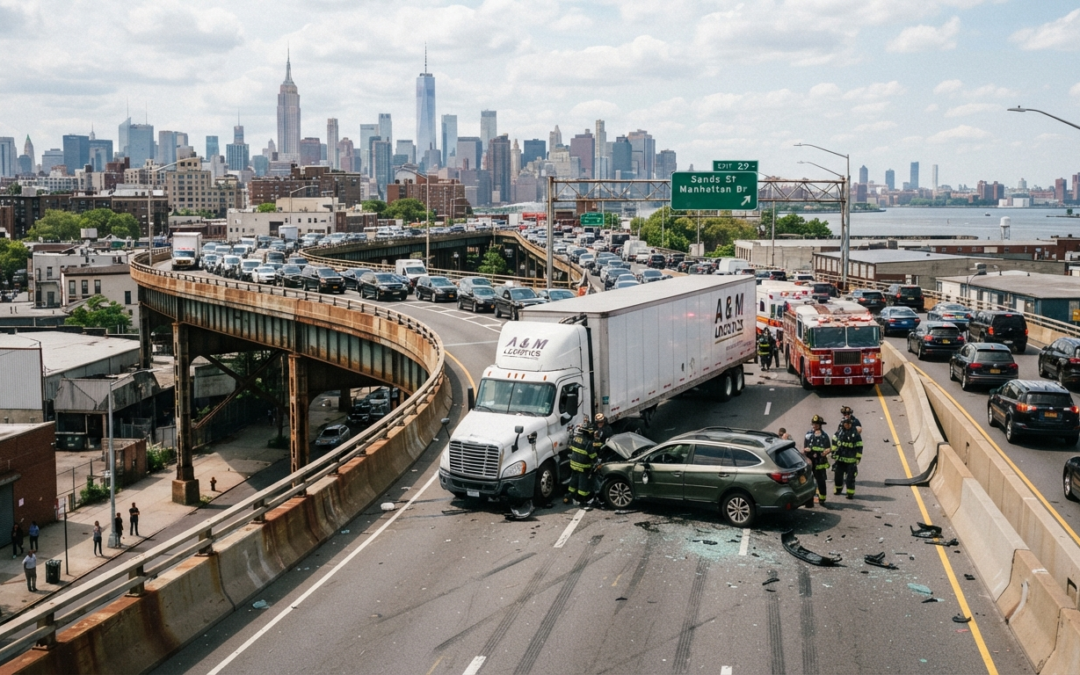
The BQE Bottleneck: Rear-Ended by a Commercial Truck Near Sands Street or Atlantic Avenue? A BQE Truck Accident Lawyer Explains What to Do First
Two miles of stacked, patched, 1950s highway carrying 13,000 trucks a day. If one of them hit you from behind, the clock on your case started before the tow truck did.
If a commercial truck rear-ends you on the BQE, call 911, stay in your vehicle until it is safe, photograph the truck's DOT number, get checked by a doctor the same day, notify your no-fault insurer in writing within 30 days, and have a BQE truck accident lawyer send an evidence-preservation letter before the trucking company's electronic logs are erased at six months.
I'm Koenig Pierre. I practice in Brooklyn, I drive this road, and I've sat across the table from more than a few adjusters who assumed a rear-end truck case was just a bigger version of a fender bender. It isn't. When an 80,000-pound tractor-trailer or a loaded box truck runs into the back of your car in stop-and-go traffic on the Brooklyn-Queens Expressway, you are not dealing with one insurance company and one driver. You are dealing with a motor carrier, its safety department, its retained defense counsel, and a truckload of electronic evidence that has an expiration date.
This is a plain-English guide to the first hour, the first week, and the first six months. No legalese. If you're reading this from a hospital bed or your couch with a heating pad on your neck, skip to the numbered steps and call me when you're ready.
Why is the BQE between Atlantic Avenue and Sands Street so dangerous?
Because it was never built for what it carries now. The 1.5-mile stretch from Atlantic Avenue to Sands Street — the section New York City owns and calls "BQE Central" — includes the Triple Cantilever, the stacked three-level structure tucked under the Brooklyn Heights Promenade. NYC DOT reports that roughly 150,000 vehicles use the BQE every day, and about 13,000 of them are trucks.1 Gothamist reported in July 2026 that the city is still hunting for an assistant commissioner to manage the aging structure, which carries about 130,000 vehicles a day.2
The city has spent years trying to keep the weight down. Its first-in-the-nation weigh-in-motion program — in-road sensors paired with cameras that automatically ticket overweight trucks $650 — cut overweight vehicles on the Triple Cantilever by 64 percent in its first year.3 That is a real safety win. It also tells you something blunt: for years, thousands of illegally overweight trucks were rolling through this corridor every single month, and heavier trucks need more room to stop.
Now add the specific geometry that makes these two exits a crash factory:
- The lane drop. DOT removed a lane on the Triple Cantilever to reduce load. Merging traffic compresses into fewer lanes right where trucks are already committed to a speed.
- Short weave distances. Traffic exiting toward Atlantic Avenue and traffic entering from Sands Street and the Brooklyn Bridge approaches have very little runway to sort themselves out.
- Phantom stops. Traffic on this section goes from 45 mph to zero without warning. A driver in a car can react to that. A loaded tractor-trailer physically cannot stop in the same distance.
- Sight lines. Curves, low overheads, and columns on the cantilever section mean a trucker often sees the back of the queue late.
- No shoulder. There is no shoulder on the cantilever. The expert panel that studied this roadway found the section carries significantly higher-than-average crash rates for that reason, and that crashes here routinely injure people and block multiple lanes for long stretches.16
- Everyone funnels toward the bridge. Nearly a third of Queens-bound BQE traffic exits at the Brooklyn Bridge, right at the Sands Street end — so merging pressure concentrates exactly where the road is worst.14
- Construction and lane closures. Ongoing repair work regularly shifts lanes and closes the Sands Street entrance ramp.4
Corridor snapshot: the Atlantic Avenue interchange
Reported crashes · 24 months, February 2021 – February 2023Crash figures reported by Streetsblog from city collision data covering the two-block segment of Atlantic Avenue at the highway entrance,14 drawn from the NYPD collision file.13 Daily volumes per NYC DOT.1 Mayor de Blasio's own BQE expert panel described the Queens-bound Atlantic Avenue entrance as one of the worst designed ramps in New York City
and recommended closing it outright — a recommendation the City never adopted.15
A car at 55 mph stops in about 133 feet. A loaded tractor-trailer needs 196. On the BQE, that extra 63 feet is often the difference between a near miss and a spine surgery.
Those are FMCSA's own figures, for ideal conditions: dry pavement, good brakes, an alert driver.12 Real conditions on the BQE are rarely ideal.
Federal crash data backs up what that geometry produces. FMCSA states plainly that in crashes, large trucks most often hit the vehicle in front of them, and its Large Truck Crash Causation Study attributed 5 percent of truck crashes to the truck driver following too closely.12 The agency's Large Truck and Bus Crash Facts adds that collision with a vehicle in transport was the most harmful event in roughly three-quarters of large-truck crashes, and that in 63 percent of fatal crashes the critical pre-crash event was something in the truck's lane or moving into it.5
What should you do immediately if a truck rear-ends you on the BQE?
Here is the order of operations. Do what your body allows and let someone else do the rest.
Call 911 — always, even if you feel fine
You want NYPD on scene and an MV-104A police crash report generated. On a truck case, the police report is the document that locks in the truck's identity, the carrier's name, and the driver's license number before anyone has a chance to get creative.
Do not stand on the shoulder of the BQE
This is the step people skip and regret — and on the cantilever there is no shoulder to stand on in the first place. Secondary crashes on this corridor are brutal. If your car is drivable and you can safely reach an exit or a wide shoulder, do that. If not, stay belted inside with your hazards on until police arrive.
Photograph the truck's DOT number and the whole rig
Every commercial vehicle carries a USDOT number on the door, usually with the carrier's legal name. Photograph the door, the license plate on both tractor and trailer, the trailer number, any placards, and — importantly — the rear of the trailer and the front of your car. Get wide shots showing the exit signage so the location is undeniable.
Note where you were, precisely
"BQE near Atlantic" is not enough. Say which direction (Staten Island-bound or Queens-bound), the nearest exit number, whether you were on the cantilever, and whether you were stopped or slowing. Liability on a rear-end case often turns on those details.
Say nothing about fault or about how you feel
"I'm okay" at the scene becomes Exhibit A eight months later when your MRI shows a herniation. Adrenaline masks injury. Give police the facts. Skip the apologies and the self-diagnosis.
Get medically evaluated the same day
Emergency room, urgent care, or your own doctor — same day if possible, within 24 to 72 hours at the outside. Gaps in treatment are the first thing a carrier's defense counsel highlights. Tell the provider every symptom, including headaches, ringing ears, numbness, and trouble concentrating.
Notify your own no-fault insurer in writing within 30 days
New York's no-fault rules require written notice of claim to the insurer within 30 days of the accident, medical bills submitted within 45 days of service, and lost-wage proof within 90 days.6 Miss the 30-day window without a good reason and your medical benefits can be denied outright.
Call a BQE truck accident lawyer before the carrier's team gets ahead of you
Large motor carriers dispatch rapid-response investigators to serious crash scenes within hours. They photograph, measure, download data, and interview the driver while it's fresh. You should have someone doing the same thing for you.
Hit by a truck on the BQE? Let's talk today.
Free consultation. No fee unless I win. Se habla español · Nou pale Kreyòl ayisyen. If your crash happened near Sands Street, Atlantic Avenue, Tillary Street, or anywhere on I-278, I want to hear what happened before evidence starts disappearing.
Why is a truck rear-end case different from a car rear-end case?
Three reasons: the evidence, the money, and the number of defendants.
1. The evidence lives in a computer, and it has a shelf life
A modern commercial truck is a rolling data recorder. Hours-of-service logs, engine control module data, GPS pings, dashcams, telematics, dispatch messages, bills of lading, fuel receipts. That's the case. And here's the part almost nobody knows: FMCSA guidance says a motor carrier must retain drivers' records of duty status and supporting documents for six months, with a backup copy of ELD records kept for six months on a separate device.7
Six months. New York gives you three years to file a personal injury lawsuit. Do that math and you'll see the problem: the electronic record of what that driver was doing in the eleven hours before he hit you can be lawfully gone long before a lawsuit is ever filed. This is the single strongest argument for calling a BQE truck accident lawyer in the first week rather than the first year. A spoliation letter — a formal demand to preserve evidence — needs to go out fast.
| Evidence | Who holds it | How fast it disappears |
|---|---|---|
| ELD / hours-of-service logs | Motor carrier | 6-month federal retention floor |
| Engine control module (ECM) data | Truck / repair shop | Overwritten or lost when the truck is repaired or sold |
| Dashcam & in-cab video | Carrier or telematics vendor | Often auto-deleted in 30–90 days |
| Dispatch & delivery records | Carrier, broker, shipper | Varies; routinely purged |
| Driver qualification file & drug test results | Motor carrier | Retained, but only obtainable in litigation |
| NYPD crash report (MV-104A) | NYPD / NYS DMV | Preserved, but takes weeks to obtain |
| Your own medical records | Providers | Preserved — but treatment gaps can't be fixed later |
2. The insurance is bigger — which means the defense is harder
Federal rules require most for-hire interstate property carriers to carry a minimum of $750,000 in public liability coverage, with higher minimums for hazardous materials.8 Many carriers and their brokers carry $1 million or more. Compare that to the $25,000 minimum bodily injury policy a private New York driver can legally carry.
That's good news for a seriously injured client. It's also why these cases are fought so hard. Nobody hands over a seven-figure policy because you sent a demand letter with an MRI attached.
3. There is usually more than one defendant
The driver is rarely the only party responsible. Depending on the facts, liability may reach:
- The motor carrier — for negligent hiring, negligent training, negligent supervision, pressuring drivers past hours-of-service limits, or failing to maintain brakes.
- The truck's owner — often a separate leasing entity from the operating carrier.
- The shipper or loader — if the load was improperly secured, unbalanced, or overweight.
- A maintenance contractor — if a brake system or air line failed.
- A parts manufacturer — in defect cases.
- The City of New York — if a roadway defect, missing signage, or a botched work zone contributed. This one matters here, because BQE Central between Atlantic Avenue and Sands Street is city-owned.1
What deadlines am I facing after a BQE truck crash?
Think of these as mile markers. Every one of them is a place a case can go off the road.
↔ Scroll for the full timeline. Deadlines vary by case — this is general information, not legal advice.
On the 10-day item: New York Vehicle and Traffic Law § 605 requires a driver involved in a crash to report it in writing to the DMV within ten days when anyone is injured or killed, or when property damage to any one person exceeds $1,000.10 The MV-104 is a sworn statement. What you write on it follows your claim for years, so be accurate and don't speculate about fault.
How does New York no-fault work when a commercial truck hits you?
Your own no-fault coverage — usually the insurer of the vehicle you were in — pays your medical bills and a portion of lost wages up to $50,000 in basic coverage, regardless of who caused the crash. That's the good part. It kicks in fast and it doesn't care about fault.
The catch is that no-fault doesn't pay you a dime for pain and suffering. To recover that from the trucking company, you have to clear New York's "serious injury" threshold under Insurance Law § 5102(d). The statute lists categories including death, dismemberment, significant disfigurement, a fracture, permanent loss of use, permanent consequential limitation, significant limitation of use, and the 90/180-day category for injuries that prevent you from performing substantially all of your usual daily activities for at least 90 of the first 180 days.11
In a truck rear-end case, the injuries frequently clear that bar without much argument — cervical and lumbar disc herniations requiring injections or surgery, rotator cuff and labral tears, fractures, and traumatic brain injuries. But "frequently" is not "automatically," and the defense will fight the threshold hard even after they've lost on fault. That's why the medical documentation you build in months one through six matters as much as the crash report.
Does the truck driver automatically lose because he hit me from behind?
Not automatically — but you start well ahead. New York courts have long held that a rear-end collision with a stopped or stopping vehicle establishes a prima facie case of negligence against the rear driver, and shifts the burden to that driver to come forward with a non-negligent explanation. Vehicle and Traffic Law § 1129(a) also requires drivers to follow at a reasonable and prudent distance, with express attention to the traffic conditions and the condition of the roadway.
What the trucking company will try to say instead:
- You cut in front of the truck and "brake-checked."
- You stopped suddenly for no reason.
- Your brake lights weren't working.
- A chain reaction pushed the truck into you.
- The roadway defect, not the driver, caused the crash.
- Your injuries are degenerative and pre-existing.
Every one of those is answerable — with ECM data showing the truck's speed and brake application in the seconds before impact, with your own dashcam, with photos of your intact tail lights, with the crush pattern on your bumper. All of which brings us back to preserving evidence early.
And even if you were partly at fault, New York is a pure comparative fault state. Being 20 percent responsible reduces your recovery by 20 percent. It does not eliminate it. Don't let an adjuster convince you otherwise.
What mistakes kill BQE truck accident claims?
- Giving a recorded statement to the truck's insurer. They call within days, sound sympathetic, and record every word. Here's why you should almost never give one.
- Waiting to treat. A three-week gap between the crash and your first doctor visit is the defense's favorite fact.
- Stopping treatment because you're "mostly better." Mostly better in month two often becomes a lot worse in month five, and the record won't show the connection.
- Posting on social media. One photo of you at a barbecue holding a plate becomes a jury exhibit.
- Accepting a fast settlement. The first offer arrives before anyone knows whether you need surgery. That's the point of it.
- Assuming a "small" truck isn't a truck case. Amazon vans, box trucks, dump trucks, and garbage trucks are commercial vehicles with commercial policies and commercial safety obligations.
- Waiting past 90 days when the City may be responsible. See the municipal trap above.
What is a BQE truck accident case worth?
Anyone who gives you a number before reviewing your imaging, your wage records, and the police report is selling something. What actually drives value: the severity and permanence of your injuries, whether surgery is recommended or performed, your age and work capacity, the available insurance, your lost earnings past and future, and how clean the liability picture is.
Truck cases tend to be worth more than comparable car cases for two reasons — larger policies and greater force of impact producing more serious injuries. For a full breakdown of how New York juries and adjusters actually calculate these numbers, read my guide to what a Brooklyn accident case is worth and how pain and suffering is calculated.
Frequently asked questions about BQE truck accidents
What should I do first if a truck rear-ends me on the BQE?
Call 911 and stay belted in your vehicle until police arrive, because standing on the BQE shoulder is dangerous. Photograph the truck's USDOT number, plates, and trailer number. Get medical care the same day. Then contact a BQE truck accident lawyer before evidence is lost.
How long do I have to file a truck accident claim in New York?
Most New York personal injury lawsuits must be filed within three years of the crash. But you must give your no-fault insurer written notice within 30 days, file an MV-104 with the DMV within 10 days, and — if the City of New York is a defendant — serve a Notice of Claim within 90 days.
Who is responsible when a commercial truck rear-ends a car?
Usually the truck driver and the motor carrier that employs him. Depending on the facts, the truck's owner, the shipper or loader, a maintenance contractor, a parts manufacturer, or the City of New York may also share responsibility. Truck cases commonly involve several defendants and several insurance policies.
Why do trucking companies delete evidence after a crash?
Not always deliberately. Federal guidance requires motor carriers to retain drivers' records of duty status and supporting documents for only six months, and dashcam footage is often overwritten in 30 to 90 days. Without a prompt preservation letter, key data can be lawfully destroyed before a lawsuit is filed.
Can I sue if I was partly at fault for the BQE crash?
Yes. New York follows pure comparative fault, so your recovery is reduced by your percentage of responsibility but is not eliminated. If you are found 25 percent at fault on a $400,000 verdict, you recover $300,000. Never assume an adjuster's fault assessment is correct.
Does no-fault insurance cover me if a truck hit me?
Yes. New York no-fault pays medical bills and part of your lost wages up to $50,000 in basic coverage regardless of fault, typically through the insurer of the vehicle you occupied. It does not pay for pain and suffering — for that you must meet the serious injury threshold in Insurance Law § 5102(d).
Should I give the trucking company's insurance adjuster a recorded statement?
No, not before speaking with a lawyer. The adjuster works for the trucking company, and the recording is used to lock in statements about fault and injuries before you know the extent of your damage. You are not obligated to give a statement to the other side's insurer.
What if the truck that hit me was a delivery van, not an 18-wheeler?
It is still a commercial vehicle claim. Delivery vans, box trucks, dump trucks, and garbage trucks are operated by companies with commercial insurance policies, driver qualification requirements, and maintenance obligations. The investigation and the available coverage look much more like a truck case than a car case.
How much does a BQE truck accident lawyer cost?
Nothing upfront. I work on contingency, which means the consultation is free and you owe no attorney fee unless I recover money for you. If there is no recovery, you owe no fee. That structure exists so injury victims can hire counsel regardless of finances.
You have one shot at this claim. Don't spend it guessing.
If you or someone you love was rear-ended by a commercial truck near the Sands Street exit, the Atlantic Avenue exit, or anywhere on the BQE, call me. I'll tell you honestly where you stand — whether or not you hire me. Serving all five boroughs. Response within 24 hours.

Sources
- New York City Department of Transportation, BQE Central Project — daily vehicle and truck volumes; city ownership of the Atlantic Avenue to Sands Street segment.
- Gothamist, City seeks BQE czar to rebuild triple cantilever, July 2026.
- NYC DOT press release, Automated enforcement has led to 64 percent reduction in overweight trucks along the BQE, July 30, 2024.
- NYC DOT press release, Staten Island-bound BQE lane closures and Sands Street ramp closure.
- Federal Motor Carrier Safety Administration, Large Truck and Bus Crash Facts 2022.
- New York State Department of Financial Services, FAQ: No-Fault Regulation 68 — 30-day notice, 45-day medical bills, 90-day lost wages. See also DFS, OGC Opinion 03-05-07 (the 30-day count starts the day after the accident).
- FMCSA, General Information About the ELD Rule, Q&A 8 (six-month retention of RODS and backup ELD data; 49 C.F.R. §§ 395.8(k), 395.22(i)). Full text at eCFR Part 395, Subpart B.
- Electronic Code of Federal Regulations, 49 C.F.R. Part 387 — Minimum Levels of Financial Responsibility for Motor Carriers.
- Office of the New York City Comptroller, File a Claim — Notice of Claim within 90 days under General Municipal Law § 50-e and NYC Administrative Code § 7-201.
- New York State DMV, Police Crash Report Submission Instructions (text of Vehicle & Traffic Law § 605, ten-day reporting requirement). See also NYPD, Non-Injury Collision FAQ.
- New York State Senate, Insurance Law § 5102 — definition of "serious injury."
- Federal Motor Carrier Safety Administration, CMV Driving Tips — Following Too Closely — 196 ft versus 133 ft stopping distance at 55 mph; large trucks most often strike the vehicle ahead; Large Truck Crash Causation Study following-too-closely share.
- NYC Open Data, Motor Vehicle Collisions — Crashes (NYPD, dataset h9gi-nx95). The underlying record set for NYC crash figures. Reports filed without usable coordinates are excluded from location-based counts, so segment totals are conservative.
- Kevin Duggan, Analysis: City Ignored BQE Panel Recs To Ease Local Traffic From Two-Lane Conversion, Streetsblog NYC, March 20, 2023 — 167 crashes with 68 injured and one killed at the Atlantic Avenue entrance over 24 months; share of Queens-bound traffic exiting at the Brooklyn Bridge.
- Brooklyn-Queens Expressway Expert Panel, BQE Expert Panel Report (January 2020) — assessment of the Atlantic Avenue ramp and recommendations for the Atlantic Avenue to Sands Street segment.
- Rebecca Baird-Remba, Inside the Fight to Rebuild the BQE in Brooklyn Heights, Commercial Observer, February 2020 — absence of a shoulder on the cantilever and above-average crash rates on the section.
This article is general information about New York law, not legal advice, and reading it does not create an attorney-client relationship. Deadlines, coverage, and liability depend on the specific facts of your case, and some deadlines are far shorter than the ones described here. If you were injured in a crash on the BQE or anywhere in New York, speak with a licensed New York attorney about your own situation. Attorney advertising. Prior results do not guarantee a similar outcome.
Koenig Pierre, Esq. · 2653 Coney Island Avenue, Brooklyn, NY 11223 · 1-800-946-4616 · koenig@koenigpierre.com