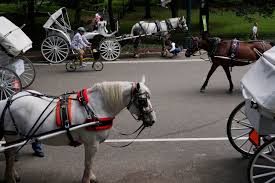
Central Park · Horse Carriage Accidents · Liability Analysis
Horses Are Dying in Central Park.
When Someone Gets Hurt, Who Pays?
I have to be honest with you from the jump. I have a personal connection to this topic — and a complicated one.
When I was five years old, my mother took me and my brother, who was seven, on a Central Park carriage ride. It was one of my first real memories of Manhattan — and I mean that in the fullest sense. Not just the park. All of it. That ride felt like New York was presenting itself to me for the first time, everything I had ever heard about this city suddenly real and right in front of my face.
That was then. Today, I would not put a member of my family on one of those carriages. Not because the memory isn't real, but because I've seen too much of what this industry actually looks like up close — and what I see is an animal that is perpetually stressed, perpetually working, and perpetually one loud noise away from a catastrophe that ends with someone in a hospital bed.
A note from Koenig
I was five years old. My brother was seven. My mother brought us into Manhattan on what felt like a special occasion — the kind you remember not because anyone told you to, but because something about it reaches all the way down into you and stays.
When that carriage started moving through Central Park, I felt like I was inside every good thing I had ever heard about New York City all at once. The skyline was right there, framed between the trees like it had been placed there specifically for us. The smell of the park — fresh grass, warm air, something that felt clean in a city that usually didn't — filled the whole carriage. The horse's hooves on the path had a rhythm that felt ancient and alive at the same time. Vendors and joggers and people on blankets passed by like a slow parade of the city just being itself. I could hear the distant sounds of the street — a cab horn, someone laughing, music drifting from somewhere — and it mixed with the quiet of the park in a way that made both feel more real than either would have alone. My brother was gripping the side of the carriage and pretending he wasn't. My mother was smiling the way she smiled when she had pulled something off. I felt like I was floating through the greatest city on earth on a day that had been made just for us.
I carry that afternoon with me. But I also carry what I know now: that the horses making that moment possible were working animals operating under chronic stress in one of the most overwhelming environments on earth. A car backfires. A tourist waves something bright. A cyclist cuts too close. And a thousand-pound animal panics. The magic of that ride was real. So is the danger. That is not a question of whether. It is a question of when.
As of tonight — June 10, 2026 — a carriage horse named Deniz collapsed and died inside Central Park while still attached to the carriage. A heat advisory had been issued for New York City today. Video shows bystanders attempting to free the animal as it lay on its side. This comes less than a month after two carriages collided near the 7th Avenue entrance, flipping one carriage and sending the driver to the hospital.
This is not a freak occurrence. This is a pattern. And patterns, in New York civil law, are exactly what turns a tragedy into a liability case.
So let me break down — in plain English, no legalese — every single person or entity that could be on the hook when one of these accidents hurts someone. And let me tell you what you need to do if that someone is you or someone you love.
The Pattern of Accidents — And Why It Matters Legally
Before we get to the defendants, you need to understand why the documented history of these incidents is so important. In New York personal injury law, we call it foreseeability. Was the harm foreseeable? Did the person or entity responsible have reason to know that something dangerous could happen?
When there is a documented pattern of accidents — police reports, news coverage, city council testimony, advocacy group records — foreseeability stops being a legal theory and starts being a fact. The city, the operators, the licensing authorities — they all had notice. They all knew. That knowledge is the foundation of a strong liability case.
Here is what the record shows:
That is not a random series of unrelated events. That is a timeline of a known, documented, repeatedly acknowledged danger that the city has failed to eliminate. In a courtroom, that timeline is Exhibit A.
Who Can Be Held Responsible When Someone Gets Hurt
There is not one defendant in a carriage horse accident. There can be four — and depending on your specific situation, you may have strong claims against all of them. Let me walk you through each one.
Defendant 01
The Carriage Operator and Driver
This is the most direct path. The driver is a licensed professional operating a commercial vehicle. When that horse spooks, bolts, collides with another carriage, or throws a passenger, the driver's conduct is the first thing that gets examined. Was the horse properly controlled? Was the driver paying attention or distracted? Was the horse showing signs of distress before the incident — panting, sweating, resisting — that a competent driver should have recognized and acted on? Commercial carriage operators are required to carry liability insurance in New York City. That insurance is the primary source of compensation for injured passengers and bystanders. Do not let anyone tell you that "horses are unpredictable" ends the inquiry. Unpredictable animals are exactly why professional handlers are required to be trained and licensed.
Defendant 02
New York City
This is where it gets powerful — and where most people don't think to look. New York City licenses and regulates every carriage horse and every driver in Central Park. The city sets the rules, inspects the horses, and renews the operating licenses. When the city has documented notice of safety failures — which the timeline above proves it absolutely does — and continues to issue licenses anyway, that is a failure of its regulatory duty. Municipal liability is real here. The city knew about the 2022 Ryder collapse. It knew about the 2025 runaways. It knew about the May 2026 collision. It kept renewing licenses. If you were hurt, that chain of inaction matters. The catch: suing the city means a 90-day Notice of Claim deadline. More on that below.
Defendant 03
Equipment Manufacturers
Less common but valuable when it applies. If defective harness hardware, a faulty carriage hitch, a broken rein, or a failed carriage component contributed to the accident, the manufacturer or distributor of that equipment can face a product liability claim. These cases require mechanical inspection of the equipment — ideally before it is repaired, replaced, or destroyed. If you were involved in an accident, one of the first things your attorney should do is preserve the equipment. Product liability defendants tend to have deep pockets and significant insurance coverage.
Defendant 04
Third Parties Who Caused the Spook
Central Park is a collision course of bikes, e-scooters, Citi Bikes, joggers, tourists, delivery workers, and cars. Any one of them can trigger a horse. If a cyclist cut too close. If a car backfired. If someone deliberately ran toward the horse. If a poorly maintained park vehicle created an unexpected noise or movement — those third parties can share liability for what followed. In the May 2026 collision, investigators noted that an "abrupt movement" triggered the initial spook. What caused that movement matters, and it is exactly the kind of fact that a thorough investigation can uncover.
Passengers vs. Bystanders — Who Has the Stronger Case?
Counterintuitively, the people who paid for the ride are not always in the strongest legal position. Here is why.
Carriage operators use release waivers and liability disclaimers. When you book a ride and sign paperwork — or when you click "agree" on a booking site — you may be waiving certain claims. New York courts do not always enforce those waivers, especially for gross negligence or reckless conduct, but they complicate things.
Bystanders assumed absolutely no risk. Joggers, pedestrians, cyclists, park visitors, people sitting on a bench — they signed nothing. They agreed to nothing. A runaway horse or out-of-control carriage that strikes a bystander creates a very clean liability case against the operator and, depending on the history, against the city.
Drivers who were working the route — food delivery workers, cyclists, car drivers — also have strong claims. They were doing their jobs in a public space and got hurt because a thousand-pound animal panicked.
This does not mean passengers have no case. It means the analysis is different. A passenger injured because a driver ignored visible signs of distress in the horse, or because the operator failed to properly maintain the carriage, or because the city looked the other way — all of those cases can succeed. They just need a good lawyer who knows what questions to ask.
What the Mayor Has Said — And Why It Matters to Your Case
The mayor, who took office in early 2026, has said publicly that he supports getting rid of the carriages, though he has pointed to the City Council as the body that needs to act legislatively. Following the May 2026 collision, the mayor's prior statements supporting a ban were widely reported alongside calls for immediate action.
Tonight, with Deniz dead in Central Park, those calls are louder than they have ever been.
Here is why this matters to a civil case: when the sitting mayor of New York City acknowledges that the carriage industry is dangerous and should be ended, that statement is evidence of the city's own awareness of the risk. It does not create automatic liability. But it makes it significantly harder for the city's lawyers to stand in front of a jury and argue that nobody knew there was a problem.
Ryder's Law — the bill that would have replaced horse carriages with electric carriages by June 2026 — failed in committee in November 2025 despite broad public support. The legislative history of that bill — the testimony, the documented incidents, the public record of the city's awareness — is subpoenable. Every hearing, every vote, every city agency report about carriage horse safety becomes potential evidence in a civil case.
The Practical Tips — What to Do If You Were Hurt
If you or someone you were with was hurt in a Central Park carriage horse incident, here is what matters in the hours and days that follow.
Document everything at the scene
Take photos and video immediately — the carriage, the horse, the driver, the area where it happened. The horse's condition — was it sweating, panting, visibly distressed before the accident? The driver's behavior before and after. The names and contact information of every witness. All of this can disappear within hours. Do not assume the city or the operator will preserve it for you.
Get medical attention immediately — and keep all records
Get checked out even if you feel fine. Adrenaline masks pain. Injuries from sudden jolts, falls from moving carriages, or being struck by a panicked horse can present hours or days later. Your medical records from that day forward are the foundation of your damages claim. Do not create a gap in treatment that a defense lawyer will later use against you. If you have been in other accidents before, those records matter too — check out our guide on how New York personal injury cases actually work.
Do not speak to the operator's insurance company
Do not give a recorded statement or sign anything. They will call. They will be friendly. They will offer you something quickly, before you know the full extent of your injuries, before you have spoken to a lawyer, before you know what your case is actually worth. That quick offer is designed to close out your claim cheaply. Do not take it. Do not give a recorded statement. Do not sign anything. The same rule applies if the city is involved — do not speak to the city's representatives without counsel.
If the city is involved, the clock is already running
The 90-day Notice of Claim deadline is not a suggestion. It is not something that gets extended because you were busy or hurt or grieving. It is a hard cutoff. Miss it and your claim against the city is gone. This article is not a substitute for calling a lawyer — it is the reason to call a lawyer today.
⚠️ Know Your Deadlines
Against New York City: Notice of Claim must be filed within 90 days of the incident. No exceptions.
Personal injury lawsuit against private operator: 3 years from the date of the accident.
Wrongful death: 2 years from the date of death — but the 90-day Notice of Claim still applies if the city is a defendant.
These deadlines run simultaneously. A family dealing with a serious injury or loss cannot afford to wait. The evidence disappears, the witnesses scatter, and the deadlines don't pause for any of it.
The Bigger Picture: What This Industry Is, and What It Costs
I said at the start that I wouldn't put my family on one of these carriages today. I want to explain that — not as a political statement, but as an observation from someone who has represented people hurt in situations where the warning signs were visible long before the accident.
These horses live and work in one of the loudest, most chaotic urban environments in the world. They are prey animals whose evolutionary response to sudden loud noises or unexpected movement is to run. New York City — with its sirens, its e-bikes, its tourists, its construction noise — is not a place designed for prey animals. The riders who get on those carriages are trusting that a thousand-pound animal with deep survival instincts can be reliably controlled in that environment, every single day, without fail.
Sometimes it works fine. Sometimes it doesn't. And the people who pay the price when it doesn't are the passengers, the bystanders, and ultimately the horses themselves.
Deniz is dead tonight. The city knew. The mayor has said so publicly. The legislative record is clear. If you or someone you care about was on a Central Park carriage when something went wrong, that context — that documented pattern, that public acknowledgment of danger — belongs in your case.
Frequently Asked Questions
Can I sue if I was injured in a Central Park carriage horse accident?
Yes. Depending on the facts, you may have claims against the carriage operator and driver, New York City itself, an equipment manufacturer, or a third party whose actions contributed to the incident. Each defendant requires a different legal strategy and has different deadlines.
Is New York City responsible for carriage horse accidents in Central Park?
Potentially yes. The city licenses and regulates the entire carriage industry. If the city renewed licenses for operators with documented safety failures, failed to enforce its own rules, or ignored years of public warnings about these risks, that chain of inaction can support a negligence claim against the city. It requires a Notice of Claim within 90 days.
What if I was a bystander, not a passenger?
Bystanders often have the cleanest cases. You assumed no risk, signed no waiver, and had no reason to expect a runaway carriage or bolting horse. If a carriage horse incident injured you while you were walking, jogging, cycling, or simply present in Central Park, you may have strong claims against the operator and potentially the city.
What is the deadline to file a claim?
Against the city: 90 days from the incident to file a Notice of Claim. Against a private operator: 3 years to file a personal injury lawsuit. For wrongful death: 2 years from the date of death. The 90-day notice deadline is the most dangerous one — it does not get extended, and missing it means losing your claim against the city entirely.
What is Ryder's Law?
Ryder's Law is proposed legislation that would ban horse-drawn carriages from Central Park and replace them with electric carriages. It was introduced after horse Ryder collapsed and died in 2022. It failed in the City Council's Health Committee in November 2025. For injury cases, the entire legislative history — the hearings, the documented incidents, the city's repeated awareness of safety risks — is valuable evidence of foreseeability.
What does the mayor's position mean for accident victims?
The mayor's public statements supporting a carriage ban are evidence that the city's own leadership recognized the danger before your accident happened. It doesn't automatically create liability, but it significantly undercuts any defense argument that the risks were unknown or unforeseeable.

The content on this page is for general informational purposes only and does not constitute legal advice. Reading this article does not create an attorney-client relationship. Every case is different. If you have been injured, contact a licensed attorney directly. — Koenig Pierre, Esq.