You got rear-ended on Linden Boulevard. At first it was just a stiff neck. Two weeks later, the pain runs down your arm and your fingers tingle when you cook. The MRI comes back: herniated disc at C5-C6. And the first question everybody asks me is the same one you typed into Google: what's the average settlement for that?
Here's the honest answer. There is no official "average." Anyone who gives you one number without knowing your case is guessing. But there are real numbers from real New York courts, and there are clear reasons why one herniated disc case settles for the insurance policy minimum and another settles for seven figures. That's what this page walks you through, in plain English, with a short section in Kreyòl at the end.


Published October 8, 2026. Reviewed for accuracy October 8, 2026.
Quick facts
- Is there an average?
- No official one. Value depends mostly on your treatment, the proof on your MRI and exams, and how much insurance is available.
- The legal hurdle
- You must prove a "serious injury" to sue for pain and suffering after a New York car accident. A herniated disc on an MRI alone isn't enough.
- Court examples
- New York appeals courts have approved pain and suffering awards from $500,000 to $2.25 million in herniated disc cases (details below).
- The ceiling in many cases
- New York's minimum car insurance is only $25,000 per person. Your own policy's SUM coverage can add more.
- Biggest mistakes
- Gaps in treatment, recorded statements to the other driver's insurer, and waiting too long to call a lawyer.
- Cost
- Free consultation. No legal fee unless we recover money for you.
What is the average settlement for a herniated disc from a car accident in New York?
There's no official average, and you should be careful with any website that gives you one. Most settlements are private. Nobody publishes a list. The numbers you see online are usually pulled from other states or from a handful of big wins, and they don't tell you anything about your neck or your back.
What I can tell you is what actually moves the number in a New York herniated disc case. In order of how much they matter:
- Whether you clear New York's "serious injury" rule. If you can't, there's no pain-and-suffering claim at all, no matter how much it hurts. More on this below.
- What treatment you needed. Physical therapy only, injections, or surgery. Each step up usually means a bigger case.
- How long the problem will last. A 30-year-old who will live with neck pain for 45 more years has a different case than someone who mostly recovered in a year.
- How much insurance is available. A great case against a driver with a $25,000 policy can be capped by that policy, unless there's more coverage somewhere else.
- How clearly the crash caused the disc problem. Insurance companies almost always argue that your disc was "degenerative" or "old." Your doctors have to answer that.
- Who was at fault. If you were partly at fault, your money is reduced by your share. And under CPLR 1411, in a car accident case you can lose the right to recover at all if you were more at fault than the other driver. A rear-end crash is usually the cleanest.
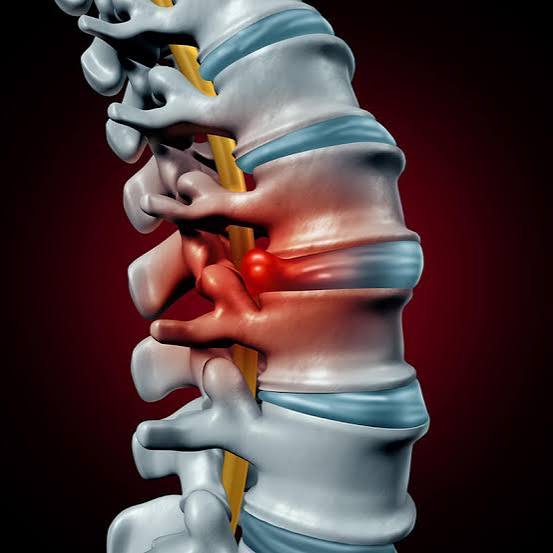
What is a herniated disc, in plain words? Between the bones of your spine are soft cushions called discs. When one tears or pushes out of place, it can press on a nerve. That's why a neck injury can make your arm tingle, and a lower back injury can send pain down your leg (sciatica). The National Library of Medicine has a simple guide to herniated disks.
Does a herniated disc count as a "serious injury" in New York?
It can, but not automatically. This is the part most people have never heard of, and it's the part that decides the most cases.
New York is a no-fault state. Your own no-fault insurance pays your medical bills and some lost wages, up to $50,000, no matter who caused the crash. In exchange, you can only sue the other driver for pain and suffering if you have a "serious injury" as defined in Insurance Law § 5102(d). For herniated discs, the categories that usually matter are:
- A permanent consequential limitation of use of a body organ or member,
- A significant limitation of use of a body function or system, or
- An injury that kept you from doing substantially all of your normal daily activities for at least 90 of the first 180 days after the accident.
New York's highest court made the key point in Toure v. Avis Rent A Car Systems (2002): a herniated or bulging disc on an MRI is not, by itself, a serious injury. You also need objective medical proof of what it's doing to you, like a doctor measuring how much motion you've lost in your neck or back and comparing it to normal, or describing your limits based on tests and exam findings. Saying "it hurts" isn't enough.
The good news: in Perl v. Meher (2011), the same court held that your first doctor didn't have to take exact range-of-motion numbers right after the crash. Your doctor was busy treating you, not building a lawsuit, and later measurements can still prove how bad the injury is.
Why this matters for your money: insurance companies know the serious injury rule better than anyone. If your medical records are thin, they will offer you very little and dare you to sue. Strong, consistent records from day one are what make them take your herniated disc seriously.
Do you need surgery to get a good herniated disc settlement?
No, but treatment is the biggest driver of value. Think of it as three levels.
Level 1: Physical therapy, chiropractic and medication
Many herniated discs get better with therapy and time. These cases are real, but they are also where insurance companies fight hardest on the serious injury rule. They usually settle for less, and many are limited by the at-fault driver's policy. But "less" doesn't mean small: in Fuentes v. Ingram (2025), a New York appeals court upheld $1,025,000 for pain and suffering for a driver with herniated discs in his neck and lower back who never had spine surgery. His case also involved a violent rollover crash and a knee injury, which helped. The key is consistent treatment and a doctor who documents your limits with real measurements.
Level 2: Epidural injections and pain management
When therapy isn't enough, a pain management doctor may give you epidural steroid injections. Injections show the injury didn't just go away, and they often come with clearer proof of nerve involvement, such as an EMG test. These cases are usually worth more than therapy-only cases.
Level 3: Surgery
A discectomy, laminectomy or spinal fusion changes a case completely. Surgery is hard proof that the injury was real, and fusion often means permanent limits and a risk of more surgery later, because the discs next to the fused level take on extra stress. These are the cases where awards reach the high six and seven figures.
A word of caution: never get a procedure just to raise the value of a case. Your health comes first, and juries can tell. Follow your doctor's advice, and if you decide against surgery, make sure your doctor writes down why.
What have New York courts awarded for herniated discs?
When a jury's award is appealed, New York appeals courts check whether it "deviates materially" from what's reasonable, under CPLR 5501(c). Those decisions are public, so they're the most honest guide we have. Here are five herniated disc cases: four from car crashes and one against the MTA's bus company. All numbers are for pain and suffering, past and future combined, as the appeals court left them.
| Case | Injury and treatment | Pain and suffering |
|---|---|---|
| Martinez v. MaBSTOA (1st Dept. 2005) | Herniated disc at L5-S1 pressing on a nerve. No surgery expected. He went back to work as a cab driver. | $600,000 ($150,000 past, $450,000 future, reduced from the jury's $750,000 future award) |
| Fuentes v. Ingram (2d Dept. 2025) | Driver whose car flipped after a crash with a police car. Herniated discs in the neck and lower back, with no spine surgery. He also had knee surgery. | $1,025,000 ($425,000 past, $600,000 future over 30 years), upheld |
| Rojas v. Brabant (2d Dept. 2021) | Herniated disc at C5-C6 after a car crash, treated with spinal fusion. More surgery expected. | $500,000 ($300,000 past, $200,000 future, raised from the jury's $150,000 because it was too low) |
| Kusulas v. Saco (2d Dept. 2015, Kings County jury) | Passenger with herniated discs at C4-5 and C5-6. Fusion, then a second surgery when the fusion failed. | $2,000,000 ($1 million past, $1 million future), upheld |
| Nieva-Silvera v. Katz (2d Dept. 2021) | Herniated disc at C6-C7 with fusion, another fusion likely, plus knee surgery. | $2,250,000 ($750,000 past, $1.5 million future), down from the jury's $41 million |
Three lessons from these cases:
- Surgery drives the biggest awards, especially fusion that failed or will need to be redone. But surgery alone doesn't guarantee a big number, as Rojas shows, and Fuentes shows that herniated discs without spine surgery can still be worth a lot when the proof is strong.
- Appeals courts cut huge verdicts, like the $41 million in Nieva-Silvera. They also raise awards that are too low, like in Rojas.
- These are trial results, not typical settlements. Most cases settle for less than a full win at trial, because a trial is always a risk for both sides. Past results also don't guarantee yours.
Pain and suffering isn't the only money in a case. You can also recover future medical costs, and lost earnings beyond what no-fault pays. In Rojas the jury also awarded $50,000 for future medical care, and in Nieva-Silvera future medical expenses were $680,000.
Why does the other driver's insurance matter so much?
Because in real life, a settlement usually comes from an insurance policy, not from the driver's pocket. And New York's minimum is low: $25,000 for injury to one person, and $50,000 for everyone hurt in the crash. A lot of cars in Brooklyn carry exactly that minimum.
So a herniated disc that's "worth" $300,000 can run into a $25,000 wall. Here's where we look for more money:
- Your own SUM coverage. Supplementary Uninsured/Underinsured Motorist coverage on your policy can pay above the other driver's limit. Many people have it and don't know it. Bring your insurance card and declarations page to your consultation.
- A commercial vehicle. If you were hit by a truck, an Amazon or FedEx delivery van, or a work vehicle, the company and its insurance are often on the hook, and commercial policies are usually much bigger. Read what happens if you're hit by a commercial vehicle on your way to work.
- Rideshares, buses and dollar vans. Uber and Lyft crashes, MTA bus accidents and dollar van accidents each have their own insurance rules.
- More than one driver at fault. In a chain-reaction crash, two or three policies may be available.
- The City. If a City vehicle hit you, like a police car or a sanitation truck, there's no $25,000 limit, but there is a 90-day deadline (see below).
What lowers a herniated disc settlement?
Most of what hurts these cases happens in the first few weeks, before people call a lawyer. Here's what the insurance company looks for:
- Gaps in treatment. If you stop going to therapy, the insurer will say you got better. New York's highest court held in Pommells v. Perez (2005) that if you stop treating, you need a reasonable explanation. In one of the cases decided with it, a doctor's note that more therapy would only ease the pain, not fix it, was enough. Whatever your reason, like no-fault cutting off payment, make sure it's in your records.
- "It's degenerative." The same case says that once the insurer shows evidence your disc problem is from age or wear and tear, your doctor has to address it head on. Many people over 40 have some disc wear on an MRI. That doesn't mean the crash didn't hurt you. It means your doctor has to explain why your pain started on the day of the accident. In a 2024 Queens case, Reyes v. State of New York, the court decided a woman's neck and back herniations were old wear and tear, not from the crash, even though she had neck fusion surgery. She was paid for her knee and shoulder, but nothing for her spine. A two-year gap in her spine treatment hurt her too.
- Waiting to see a doctor. Go to urgent care or the ER the same day or the next day if you can, and tell them about every place that hurts.
- A recorded statement. A quick "I'm okay" on the phone with the other driver's insurance company can show up later. You don't have to give them a recorded statement.
- Social media. A photo of you at a cookout, dancing at a wedding or carrying groceries can be used to say you're not hurt, even if you paid for it for three days after.
- Settling too fast. Once you sign a release, the case is over, even if you need surgery next year. Don't settle a herniated disc case before you and your doctor know where it's going.
How much of a herniated disc settlement do you actually keep?
The settlement number isn't the number that goes in your pocket. Here's what usually comes out of it:
- The lawyer's fee. In most injury cases it's a percentage of the recovery, and court rules in Brooklyn limit how much a lawyer can charge. If there's no recovery, there's no legal fee. The agreement must be in writing, and I go through it with you line by line.
- Case expenses. Things like medical records, expert doctors and court filing fees. Ask about these at your consultation.
- Liens. Under General Obligations Law § 5-335, most private health insurers in New York can't take money back from your injury settlement. But Medicare, Medicaid, some union and employer plans, and workers' compensation can. Part of my job is to find these early and negotiate them down.
Two pieces of good news. First, no-fault benefits you already got are yours to keep, and they're also why you can't recover those same bills again from the other driver, under Insurance Law § 5104. Second, money you receive for a physical injury is generally not taxable under federal law, as the IRS explains in its guide to settlements. Ask a tax professional about your own situation, especially if part of the settlement is for something like interest.
Is there a deadline for a herniated disc claim in New York?
Yes, and the first one comes fast.
| Deadline | What it's for |
|---|---|
| 30 days | Apply for no-fault insurance so your doctors, therapy and some lost wages get paid. Miss it and you may be paying out of pocket for your treatment, which is also how gaps in treatment start. |
| 90 days | File a notice of claim if a City vehicle, an MTA bus or another public agency was involved. |
| 3 years | File a lawsuit against the at-fault driver in most car accident cases. |
Three years sounds like a long time. It isn't, when your doctors need months to figure out whether you need surgery and the evidence from the crash, like video from a corner store camera, can be erased in days.
An Kreyòl: Sa ou dwe konnen sou yon disk ki soti
Si ou te nan yon aksidan machin epi doktè a di ou gen yon disk ki soti (herniated disc) nan kou ou oswa nan do ou, men sa ou dwe konnen:
- Pa gen yon sèl "mwayèn" pou kòb ou ka jwenn. Sa depann de tretman ou, prèv medikal ou, ak konbyen asirans ki genyen.
- Nan New York, yon MRI pou kont li pa ase. Fò doktè a montre ki jan blesi a limite mouvman ou ak lavi chak jou ou.
- Pa sispann al fè terapi san yon bon rezon. Si ou sispann, mande doktè a ekri poukisa.
- Pa bay asirans lòt chofè a okenn deklarasyon anrejistre anvan ou pale ak yon avoka.
- Pa siyen okenn papye pou fini ka a anvan ou konnen si w ap bezwen operasyon.
- Ou gen 30 jou pou mande asirans no-fault, epi 90 jou si se yon machin Vil New York oswa yon otobis MTA ki te frape ou.
Konsiltasyon an gratis. Ou pa peye frè avoka si nou pa jwenn lajan pou ou. Rele nou: 1-800-946-4616. Li plis sou avoka nan Brooklyn ki pale Kreyòl.
Herniated disc after a car accident? Find out what your case is really worth.
All you need is wise counsel.
Bring your MRI report, your insurance card and the other driver's information. I'll look at your treatment, your coverage and your deadlines, and tell you straight where you stand. The consultation is free, and you pay no legal fee unless we recover money for you.
Nou pale Kreyòl. Rele nou jodi a.
Se habla español.
Common questions, in English and Kreyòl
What is the average settlement for a herniated disc from a car accident in NY?
There is no official average, because most settlements are private. Value depends on whether you meet New York's serious injury rule, whether you needed therapy, injections or surgery, and how much insurance is available. New York appeals courts have approved pain and suffering awards from $500,000 to over $2 million in herniated disc cases, but many cases settle for less, often because of low insurance limits.
Konbyen kòb moun jwenn pou yon disk ki soti apre yon aksidan machin?
Pa gen yon sèl mwayèn. Sa depann de tretman ou (terapi, piki, oswa operasyon), prèv medikal ou, ak konbyen asirans ki genyen. Rele nou pou yon konsiltasyon gratis: 1-800-946-4616.
Is a herniated disc a serious injury in New York?
Not automatically. New York's highest court held in Toure v. Avis (2002) that a herniated disc on an MRI is not enough by itself. You also need objective medical proof of how it limits you, such as measured loss of motion or a doctor's comparison to normal function.
Do I need surgery to get a herniated disc settlement?
No. In 2025, a New York appeals court upheld $1,025,000 for herniated discs in the neck and lower back with no spine surgery, and another approved $600,000 for a herniated disc with no surgery. But surgery, especially spinal fusion, usually increases value a lot. Never have a procedure just for your case. Follow your doctor's advice.
Èske m bezwen fè operasyon pou m jwenn kòb?
Non. Ou ka jwenn kòb san operasyon. Men operasyon souvan fè ka a vo plis. Pa janm fè yon operasyon pou ka a sèlman. Swiv konsèy doktè ou.
What happens if I stopped going to physical therapy?
A gap in treatment can hurt your case. In Pommells v. Perez (2005), New York's highest court held that a person who stops treating needs a reasonable explanation, such as a doctor saying more therapy would only ease the pain, not fix it. Make sure the reason is in your medical records.
Is a car accident settlement taxable in New York?
Money received for a physical injury is generally not taxable under federal law, according to the IRS. Some parts of a settlement, like interest, can be. Ask a tax professional about your own case.
Should I talk to the other driver's insurance company?
You don't have to give the other driver's insurance company a recorded statement. Talk to a lawyer first. Something as simple as "I'm okay" can be used later to argue your herniated disc wasn't serious.
Related guides
Attorney Advertising. This article is general information, not legal advice for your situation, and reading it does not create an attorney-client relationship. Deadlines and rules can change and depend on your facts. Contact a lawyer about your specific case.
The court decisions described above are public records of other cases and are not results obtained by this office. Prior results do not guarantee a similar outcome. "No fee unless we recover" refers to legal fees. Clients may be responsible for court costs and case expenses; ask about this during your consultation.
Koenig Pierre, Esq., 2653 Coney Island Avenue, Brooklyn, NY 11223. 1-800-946-4616.