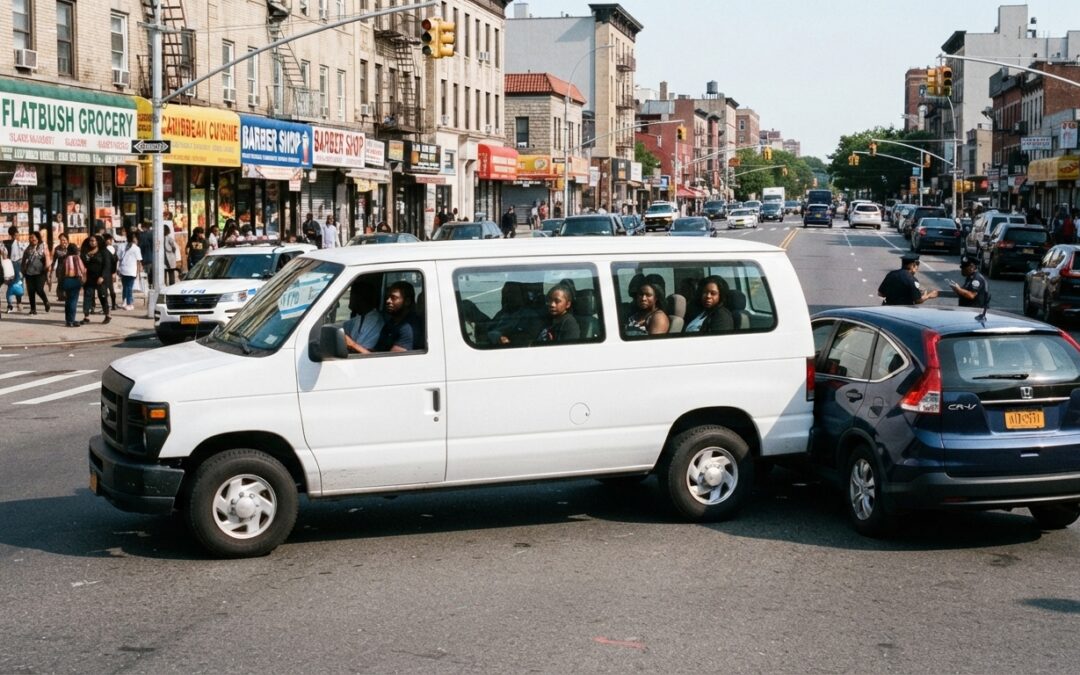
Seven-forty in the morning on Flatbush Avenue. You flagged the van at Church, squeezed into the back row and passed your fare up front. The driver is making time, cutting around the B41. Then a car noses out of a side street, he slams the brakes, and your head hits the seat in front of you.
By the time the police come, the driver is talking fast, half the passengers have walked off to catch another van, and nobody can tell you whose insurance this is. Maybe the van has no markings at all.
If that's you, or your mother, or your cousin, here is the good news. In New York, there is almost always somebody who has to pay your medical bills, even if the van turns out to be unlicensed, uninsured or gone. Who that somebody is depends on a few facts you need to lock down this week. This guide walks you through them.

Published October 5, 2026. Reviewed for accuracy October 5, 2026.
The short answer
- Your medical bills can usually be paid through New York's no-fault system, even if the van had no license or no insurance.
- Who pays first depends on how many seats the van has, whether it was insured, and whether you or a relative you live with has car insurance.
- If the van was uninsured or drove off, a state fund called MVAIC may pay. The crash must be reported to police within 24 hours.
- Send your no-fault application within 30 days, or your doctors may not get paid.
- If your injury is serious, you can also claim money for pain and suffering, usually within 3 years.
- Your immigration status does not stop you from making a claim.
How can you tell whether the dollar van was licensed?
Most of us call them dollar vans. The City calls them commuter vans. For more than forty years they've carried people up and down Flatbush, Utica, Nostrand and Church Avenues, to Kings Plaza and out to Jamaica, Queens, filling the gaps the buses and trains leave behind.
Some of these vans are legal and some are not. The NYC Taxi and Limousine Commission licenses commuter vans to run on routes approved by the Department of Transportation. Vans running without that license are operating illegally, and the TLC warns that their drivers often aren't licensed by the TLC and sometimes don't have a valid driver's license at all.
Signs of a licensed commuter van
According to the TLC, a licensed van will usually have:
- The base number and TLC license number printed on the outside of the van.
- The official TLC Commuter Van decal.
- A Commuter Van Passengers' Bill of Rights posted inside.
- A license plate with "T&LC" stamped along the bottom.
Why it matters for your claim
| Question | Licensed van | Unlicensed van |
|---|---|---|
| Insurance | Required to carry commercial insurance as a condition of the TLC license. | May have only a personal car policy, which often excludes carrying paying passengers, or no insurance at all. |
| Finding the owner | The base name and license number lead to the owner and the insurance company. | Usually traced through the license plate, photos and the DMV. |
| Who pays your bills | Usually an insurance company that can be identified quickly. | Often your own household's car policy or MVAIC (explained below). |
Don't worry if you couldn't tell which kind of van it was. Most riders can't, especially at seven in the morning with your head ringing. Take pictures of the outside of the van, front and back, if you can. Figuring out the rest is my job.
Who pays your medical bills after a dollar van accident?
New York uses a system called no-fault insurance. It pays your medical bills, and part of your lost pay, up to $50,000, no matter who caused the crash. You don't have to prove anybody did anything wrong to get it.
The tricky part with a dollar van is figuring out which policy owes you. There are three common situations.
1. The van has 15 or more passenger seats
New York law counts any vehicle that seats 15 or more passengers, not counting the driver, as a bus. For bus passengers, the law says your own car insurance pays first, or the policy of a relative you live with. Only if nobody in your household has a car policy does the van's insurance company pay. New York's Department of Financial Services has confirmed this reading.
2. The van is smaller, with fewer than 15 passenger seats
Then you're treated like a passenger in any other car. The van's own insurance usually pays your no-fault benefits. If you're ever in a crash in a car service or yellow cab, it works much the same way.
3. The van had no insurance at all
If you or a relative you live with has car insurance, that policy usually covers you when the vehicle that hurt you was uninsured. If nobody in your home has car insurance, a state fund called the Motor Vehicle Accident Indemnification Corporation (MVAIC) may step in. MVAIC has strict rules, including a police report within 24 hours, so read the deadlines below.
| Your situation | Who usually pays your no-fault benefits first |
|---|---|
| Passenger in a van with 15+ seats | Your car policy or your household's. If none, the van's insurer. |
| Passenger in a van with fewer than 15 seats | The van's insurer. |
| Van had no insurance | Your household's car policy. If none, MVAIC. |
| Van drove off and can't be found | Your household's car policy. If none, MVAIC. |
| You were walking and a van hit you | The van's insurer. If uninsured or gone, your household policy or MVAIC. |
| You were driving and a van hit you | Your own car's insurance. |
Not sure how many seats the van had? Count the rows in your photos, or let us find out from the plate. And don't wait to figure it out before you file. When the answer isn't clear, I send notice to every insurer that might owe you, all at once, so nobody can say you were late. For more on how the system works, see New York no-fault insurance, in plain English.
Copy this. Send it to your car insurance company today.
Send it if you, or a relative you live with, has a car policy, even though you were riding in a van and the crash wasn't your fault.
I am giving notice of a motor vehicle accident and applying for no-fault benefits. On [DATE] at about [TIME], I was injured as a passenger in a commuter van at [LOCATION] in Brooklyn. Van plate number, if known: [PLATE]. Police report number: [NUMBER]. I am being treated for [BODY PARTS]. Please send me the NF-2 application and confirm that you received this notice.
Email it so there's a date on it, then screenshot it. Send it even if you're missing details. Getting it in on time is what matters.
If you don't have insurance of any kind
You can still get treated. Hospital emergency rooms must examine and stabilize you whether or not you can pay. Give every doctor your Medicaid, Essential Plan or job insurance if you have it, and tell them you were hurt in a van crash so they bill correctly. In New York City, NYC Care also offers low-cost care at public hospitals like Kings County, regardless of immigration status.
What if a dollar van hit you while you were walking or driving?
Dollar vans stop wherever someone waves, and they pull back into traffic fast. That's how a lot of people get hit stepping off the curb on Utica, or by a van cutting across lanes on Flatbush.
If you were walking, the van's insurance usually pays your no-fault benefits. If the van was uninsured or drove off, your household's car policy or MVAIC may pay instead. Our guide for Brooklyn pedestrians covers more, and if it happened after dark, read why November is the most dangerous month to walk in Brooklyn.
If you were driving, your own car insurance pays your no-fault benefits, the same as any other crash. See our Brooklyn car accident page for the full picture.
Getting paid for more than your medical bills
No-fault covers bills and part of your lost pay. It does not pay for your pain, your suffering or the life you can't live while you heal. For that, you bring a claim against the driver and the van's owner. In New York, the owner of a vehicle is generally responsible for a driver who uses it with permission, so you aren't stuck chasing only the driver.
To make that claim after a car crash, New York requires a "serious injury". That includes things like a broken bone, a significant limit on how a part of your body works, or being unable to do your usual daily activities for most of the first 180 days. Head injuries count too. If you hit your head on the seat or window, read about head and brain injuries after a crash.
What if the van driver ran off or the passengers won't talk?
New York law requires every driver in a crash that hurts someone to stop and give their information. When a van driver takes off anyway, you still have options. But the first 48 hours decide how strong they are.
What to do in the first 48 hours
- Get medical care today. Go to the ER or urgent care, even if you feel "okay." Neck, back and head injuries often show up a day or two later. Tell them you were a passenger in a van crash.
- Report it to the police within 24 hours. If officers didn't come to the scene, go to the precinct and make a report. If the van turns out to be uninsured or never found, MVAIC generally requires that 24-hour report. Write down the report number.
- Photograph the van. Get the plate, the base name or phone number painted on the side, any TLC number or decal, and the route sign in the windshield. Even one blurry photo of the plate can make the case.
- Find one witness. You don't need everybody. One passenger's phone number, or the person at the bus stop who saw it, is enough to start.
- Note every camera on the block. Bodegas, beauty supply stores, churches, Caribbean bakeries and roti shops along Flatbush and Church often have cameras. Many erase video within days, so a lawyer should ask them to save it right away. If an MTA bus was nearby, its cameras may have caught it too.
- Save proof you were on the van. A text to family saying you were on your way, your phone's location history, or an OMNY tap at the subway right before or after can all help show where you were.
- Don't sign anything from the van owner or an insurance company, and don't give a recorded statement, until you've talked to a lawyer.
When the other passengers won't talk
I understand this one. In our neighborhoods, nobody wants to be the person who gets someone in trouble. Some riders worry about the driver's job. Some worry about their own papers. So they walk off and catch the next van.
That's okay. You can build a strong claim without them. The plate, the video, your medical records and your own account are often enough. And if a passenger is willing to help later, they're giving a statement for an insurance claim, not filing a criminal complaint.
"The driver is from my community. I don't want to sue him."
I hear this a lot, especially from people in Flatbush, East Flatbush, Canarsie and Crown Heights. The driver might be from your island. He might go to your church. You might ride with him every week.
Here's what you should know. Your claim is paid by insurance, either the van's, your own or MVAIC's. In most cases, nobody is coming after the driver's house or his paycheck. A claim for your injuries is a civil claim for money, not a police matter. You are protecting your health and your family's rent while you can't work. That's not personal.
And whether you came from Haiti, Jamaica, Trinidad, Guyana, Grenada or Barbados, or you were born right here in Bed-Stuy, your immigration status does not stop you from making a claim for your injuries.
Were you riding for work? If you were traveling between job sites when the crash happened, such as a home health aide going from one patient's home to the next, workers' compensation may also apply. See what counts as a work injury for home health aides and what to do if you were hit on your way to work.
Your dollar van accident deadlines, in one table
| Deadline | What it's for |
|---|---|
| 24 hours | Report the crash to police. MVAIC generally requires this if the van was uninsured or drove off. |
| 30 days | Send written notice and your no-fault application so your medical bills get paid. |
| 90 days | File a Notice of Intention with MVAIC if the van drove off or can't be identified. |
| 90 days | If a City or MTA vehicle was also involved, file a notice of claim. |
| 180 days | File a Notice of Intention with MVAIC if the van was identified but uninsured. |
| 3 years | File your lawsuit against the driver and owner for pain, suffering and lost pay. |
If a family member died, different deadlines apply, so call right away. Our page on wrongful death explains more.
The 30-day and 24-hour clocks are the ones that hurt people. They wait to see if their neck gets better, and by the time they call, the window is closing. When I take a dollar van case, the insurance notices go out in the first week, so no deadline is missed while you're focused on healing.
Hurt in a dollar van? Talk to a Brooklyn lawyer this week.
All you need is wise counsel.
Tell me what happened. I'll review it, answer your questions straight and tell you where you stand. The consultation is free, and you pay no legal fee unless we recover money for you.
Ou te blese nan yon dola van? Rele nou. Nou pale Kreyòl.
Se habla español.
Common questions about dollar van accidents
Who pays if I'm hurt in a dollar van in Brooklyn?
Your medical bills are usually paid through no-fault insurance. Depending on the van's size and insurance, that's the van's insurer, your own or your household's car policy, or MVAIC. Send your no-fault application within 30 days.
Can I make a claim if the dollar van wasn't licensed?
Yes. An unlicensed van doesn't erase your rights. If the van had any insurance, that policy may pay. If it didn't, your household's car policy or MVAIC may cover you, as long as the crash was reported to police within 24 hours.
Is a dollar van considered a bus under New York law?
It depends on its size. New York treats a vehicle with 15 or more passenger seats, not counting the driver, as a bus. For bus passengers, your own household car policy pays no-fault first. In smaller vans, the van's insurance usually pays.
What if the dollar van driver had no insurance?
If you or a relative you live with has car insurance, that policy usually covers you. If not, MVAIC may pay. File a Notice of Intention with MVAIC within 180 days if the van was identified, or 90 days if it drove off.
What if the van drove off after the crash?
Report it to the police within 24 hours, photograph anything you can, and look for cameras on the block. Your household's car policy or MVAIC may cover you. MVAIC requires a Notice of Intention within 90 days in hit-and-run cases.
Do I have to sue the driver personally?
Usually the claim is paid by insurance, not by the driver himself. New York also makes a vehicle's owner generally responsible for a driver using it with permission.
Does my immigration status matter?
No. Your immigration status does not stop you from making a claim for your injuries.
Related guides
Attorney Advertising. This article is general information, not legal advice for your situation, and reading it does not create an attorney-client relationship. Deadlines and rules can change and depend on your facts. Contact a lawyer about your specific case.
"No fee unless we recover" refers to legal fees. Clients may be responsible for court costs and case expenses; ask about this during your consultation. Prior results do not guarantee a similar outcome.
Koenig Pierre, Esq., 2653 Coney Island Avenue, Brooklyn, NY 11223. 1-800-946-4616.