Bronx MTA Bus Shooting · June 2026
He Was on His Way to Pick Up His Daughter.
A Teenager Shot Him Dead on a Bronx Bus.
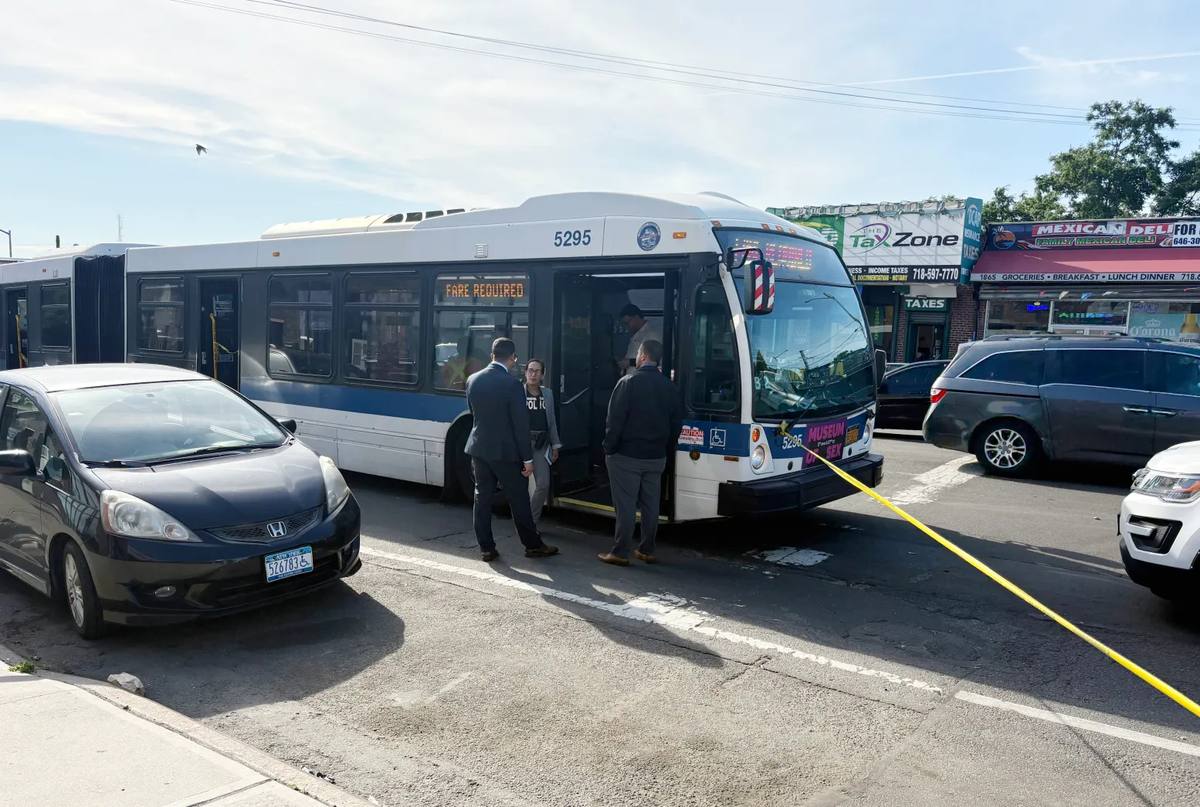
Jonathan Pettigrew, 41, was riding the BX36 bus through the Bronx on Monday afternoon. He was coming off a shift at the restaurant where he worked. He was heading home to pick up his 7-year-old daughter from school — the little girl he had just won full custody of, the whole reason he finally got his own apartment last year.
A fellow passenger was yelling into his phone. Pettigrew asked him to keep it down.
The teenager pulled out a gun and shot him once in the abdomen. Pettigrew stumbled off the bus and collapsed on the sidewalk at White Plains Road and East Tremont Avenue. He was rushed to Jacobi Hospital, where he was pronounced dead.
His daughter does not yet know her father is gone.
"They told me my brother was deceased and I didn't believe it," his brother Avery told CBS New York. "He's a good kid. He's not a street person. He's very funny, very into sports — I know he was into that Knicks game."
According to PIX11, Jonathan was a father of seven. He walked his youngest daughter to and from school every single day. He was an aspiring rapper who just wanted to be present for his kids. He was leaving his job to go get her when a stranger ended his life over a phone call.
No arrests have been made. The investigation is ongoing.
If you are reading this because you lost someone on a New York City bus or subway — or because you are part of Jonathan's family trying to figure out what comes next — this article is for you. Not for lawyers. Not for law students. For you.
I am going to tell you exactly what the law says, what it doesn't say, and what needs to happen right now.
The Question Everyone Is Asking: Does the MTA Bear Any Responsibility?
The shooter bears full criminal responsibility for what he did. That is not in question. But criminal justice and civil justice are two separate roads. One is about punishment. The other is about what happens to the family he left behind.
The civil question — the one that affects Jonathan Pettigrew's children — is whether the MTA, the agency that operates that bus and is responsible for the safety of every person on it, failed in any way that contributed to his death.
That question does not have a simple yes or no answer. But it has a real answer, and it depends on facts that need to be investigated immediately.
What New York Law Says the MTA Has to Do
The MTA runs New York City's buses and subway system. Under New York law, the MTA has a legal duty to keep its passengers reasonably safe. That word — "reasonably" — does a lot of work in a case like this.
For a long time, New York transit agencies were judged against a tougher standard than most defendants — something the courts called the "highest degree of care." That changed in 1998 when the state's highest court decided Bethel v. NYC Transit Authority and ruled that the MTA should be measured the same way everyone else is: by whether they acted reasonably under the circumstances. That shift is important here. Jonathan Pettigrew's family cannot walk into court, point to the shooting, and collect a check. They would need to show that the MTA did something wrong — or failed to do something it should have done — and that failure played a role in what happened on that bus.
That bar is real. Clearing it takes evidence. And the window to gather that evidence is already shrinking.
When Courts Have Said YES — The MTA Is Liable
New York courts have held the MTA responsible for passenger violence when specific conditions were met. Here is what those winning cases looked like:
When violence on that route was a known pattern
Courts have imposed liability when attorneys were able to show that the MTA had documented notice of violent incidents on a specific route or platform — and did nothing about it. Prior police reports, prior complaints, prior incidents at the same location are the kind of evidence that can change the outcome of a case. The Penn Station stabbing earlier this week raised the same issue — transit violence that was foreseeable because of a documented pattern the MTA knew about.
When the driver saw what was happening and did nothing
If an argument was visibly escalating on that bus — if the driver could see or hear a confrontation getting dangerous — and the driver took no action whatsoever, that failure can be the basis of a negligence claim. The bus driver has the ability to stop the bus, radio for police, open doors to let passengers off, or take other reasonable steps. Not doing any of those things when a threat is visible is not "reasonable" behavior.
When cameras weren't working
Reports indicate it is unclear whether the bus camera captured the shooting. The MTA has a documented, long-standing problem with broken surveillance cameras across its fleet. If the cameras on that bus were broken, disabled, or unmaintained, that is a separate negligence argument — and it also obstructs the criminal investigation by making the shooter harder to identify.
When security was inadequate given known risks
Transit violence in New York has surged in recent years, concentrated heavily on specific bus corridors and subway lines. When attorneys can prove the MTA was aware of elevated violence risk on a particular route and failed to add security presence, working cameras, or emergency response protocols, courts have allowed those cases to proceed.
When Courts Have Said NO — The MTA Is Not Liable
Being straight with you means sharing both sides. New York courts have also dismissed cases against the MTA for transit violence, and here is when that happens:
When the attack was sudden and no one could have seen it coming
If the confrontation went from zero to gunfire in seconds — with no warning visible to the driver or anyone else — courts have found the MTA cannot be held responsible for not preventing something that was not foreseeable. A spontaneous criminal act with no buildup is the hardest situation for a plaintiff to overcome.
When there was no history of violence on that specific route
Foreseeability is everything in these cases. If the BX36 at that location had no prior documented incidents, no complaints, no history that would have put the MTA on notice that violence could occur there, the argument for liability weakens significantly.
When a third party's act "breaks the chain"
Lawyers call it a "superseding intervening cause." The MTA's defense will argue that the teenager who pulled the trigger is 100% responsible, and that his independent criminal act severs any connection between MTA negligence and Jonathan Pettigrew's death. Courts have accepted this argument in some cases.
| Factor | MTA Liable | MTA Not Liable |
|---|---|---|
| History of violence on that route | Yes — Prior incidents = foreseeability | No — No prior history = harder to prove |
| Driver's response to visible threat | Yes — Visible escalation ignored | No — Sudden attack, no warning |
| Camera condition | Yes — Cameras broken or unmaintained | No — Cameras working, no negligence |
| Security deployment | Yes — Known risk, no security added | No — Reasonable security present |
| Criminal act by third party | Yes — MTA inaction contributed to harm | No — Shooter's act breaks causal chain |
What His Family May Be Entitled To
Under New York's wrongful death law — New York Estates, Powers & Trusts Law § 5-4.1 — Jonathan Pettigrew's estate and surviving family have the right to pursue a wrongful death claim. What that means in real terms:
Lost earnings. Jonathan was a working father in his early 40s. Had he lived, he would have worked and provided for his children for decades. Courts calculate that lost income and it becomes part of the claim.
Loss of parental guidance. His 7-year-old daughter is now growing up without her father. The value of that parental presence — the walks to school, the support, the love — is something courts take seriously in wrongful death calculations, particularly when a young child loses their sole custodial parent.
Funeral and burial expenses. Recoverable directly as damages.
Pain and suffering before death. Jonathan was shot, stumbled off the bus, and collapsed on the sidewalk. The time between when he was shot and when he died is compensable under New York law.
⚠️ Critical Deadline — Do Not Miss This
To sue the MTA, a Notice of Claim must be filed within 90 days of the incident. That clock started on June 9, 2026 — the day Jonathan Pettigrew was killed.
Missing this deadline is permanent. It does not matter how strong the evidence is. No Notice of Claim within 90 days = no case against the MTA. Period.
After the Notice of Claim, the family has one year and 90 days to file a personal injury lawsuit, and two years from the date of death to file a wrongful death claim. But none of that matters if the first step is missed.
This is not something to think about next month. This needs to happen now.
What Needs to Happen Right Now
If you are Jonathan's family, or you know someone close to this case, here is what matters in the immediate term — not in a few weeks, not after things settle down. Right now.
Get a lawyer who handles MTA cases. Not just any personal injury attorney — one who has dealt with the specific procedural requirements of suing the MTA in New York. The rules are different, the deadlines are unforgiving, and the MTA has an entire legal department whose job is to limit what families like Jonathan's receive.
Do not speak to the MTA or any insurance company without legal counsel. They will be in touch. They will seem helpful. They are not helping you — they are protecting themselves. Anything said in those conversations can be used to limit or eliminate a claim.
Preserve everything. Any video. Any photos from the scene. The contact information of anyone who was on that bus. Witness testimony starts to fade and disappear quickly. Bus camera footage gets overwritten. This evidence needs to be locked down now, before it is gone.
Document everything about Jonathan's life and role in his children's lives. Work history, wages, what he did for his kids every day. The walks to school. The custody arrangement. All of it. This documentation becomes the foundation of the damages calculation.
If you are in a similar situation — if you lost someone on an MTA bus or subway and are not sure what your options are — the same urgency applies. The 90-day clock runs for every MTA case, not just this one. If you are past 90 days but under two years, there may still be options. Call and ask.
The Bigger Picture: Transit Violence in New York
Jonathan Pettigrew is not alone. Transit violence has surged across New York City's bus and subway system in recent years. Six people were stabbed at Penn Station just two days before Jonathan was killed — the night before the Knicks' first home Finals game in 27 years. In 2023, a Bronx man fired nine shots near a bus stop, and a bullet ripped through an MTA bus window and seriously wounded a passenger. A rider was shot through the windshield of a Brooklyn bus in another incident that same year.
These are not isolated events. They form a pattern — and patterns matter enormously in civil cases against the MTA. When an agency has documented knowledge that a particular route or area is dangerous and fails to take meaningful action, that knowledge becomes evidence. It becomes the difference between a lawsuit that gets thrown out and one that goes to trial.
Every violent incident on MTA property generates paperwork. Police reports. Internal agency records. Camera logs. Maintenance records. All of it is obtainable through legal discovery. An attorney who knows what to request and when to request it can build a picture of what the MTA knew, how long they knew it, and what they chose not to do about it.
Frequently Asked Questions
Can the MTA be held responsible for a shooting on one of its buses?
It depends on the facts. The MTA has a legal duty to keep passengers reasonably safe. If the MTA failed to act on a visible, escalating threat — or had documented history of violence on that route and did nothing — there may be a negligence claim. A sudden, unprovoked attack with no warning is harder to pin on the MTA, but the answer is not automatically no.
What is the deadline to sue the MTA in New York?
A Notice of Claim must be filed within 90 days of the incident. Miss that deadline and you lose the right to sue — permanently. After that, you have one year and 90 days to file a personal injury lawsuit, and two years for wrongful death. But none of those later deadlines matter if the 90-day Notice of Claim is missed first.
Has the MTA ever been found liable for transit violence?
Yes. New York courts have held the MTA responsible when lawyers demonstrated the agency knew about a pattern of violence on a specific route and did nothing about it. The cases that succeed share recognizable patterns — prior incidents on record, cameras that were broken or unmaintained, or a threat unfolding in front of a driver who chose not to intervene.
When does the MTA NOT get held liable for transit violence?
Courts have dismissed MTA cases when the attack was sudden and completely unforeseeable, when there was no prior history of similar violence on that specific route, and when the shooter's independent criminal act was found to break the legal chain of causation between any MTA failure and the harm that resulted.
What can a wrongful death claim recover for a family?
Under New York law, recoverable damages in a wrongful death claim include lost earnings the deceased would have provided, the loss of parental and household support for surviving children, funeral and burial expenses, and compensation for pain and suffering experienced before death. For a working single father with young children, the damages calculation can be substantial.
What should I do if I lost a loved one in an MTA incident?
Contact a personal injury attorney immediately. The 90-day Notice of Claim is the most important deadline in any MTA case. Do not speak to the MTA or their insurance company without legal counsel first. Preserve every piece of evidence — video, photos, witness information — before it disappears.

The information on this page is for general informational purposes only and does not constitute legal advice. Reading this article does not create an attorney-client relationship. Every case is different. If you have a legal matter, please contact an attorney directly. — Koenig Pierre, Esq.