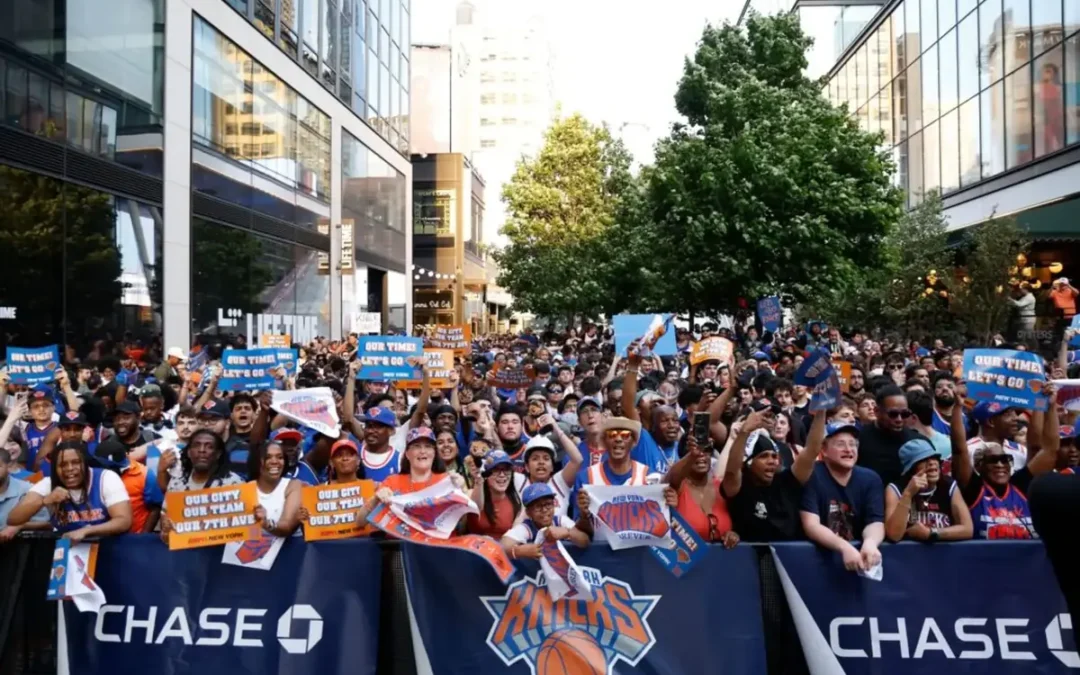
Injured at the Knicks Watch Party on 34th Street? You May Have a Case.
What New York law says about your rights — and who is responsible — after the chaos outside Madison Square Garden

Key Takeaways
- Event organizers and the City of New York owe attendees a legal duty of reasonable care
- New York courts have repeatedly held crowd crush injuries foreseeable at large public events
- You must file a Notice of Claim within 90 days if the City is a defendant
- Ticket waivers do not shield organizers from gross negligence claims
- Consultations with Koenig Pierre are free — no fee unless we win
As thousands of New Yorkers packed 34th Street for the Knicks NBA Finals watch party, what should have been a night of pure celebration turned dangerous — and for some fans, it ended with an injury that was entirely preventable under New York law.
With the Knicks holding a 2-0 series lead over the San Antonio Spurs, fans flooded the blocks outside Madison Square Garden for an outdoor watch party that drew tens of thousands of people. Surging crowds, inadequate barriers, and poor crowd control led to falls, trampling incidents, and serious injuries. EMS units treated multiple attendees on scene; several were transported to nearby hospitals.
If you were one of those people, you need to know this: being injured at a public event does not mean you simply have to accept what happened. New York premises liability law may give you the right to compensation — and there is a clock running.
Who Is Legally Responsible?
Multiple parties can share liability for a crowd crush or trampling injury at an outdoor public event in New York. Under the doctrine of premises liability, anyone who controls the space has a duty to maintain it in a reasonably safe condition for the people invited onto it.
Depending on the facts of your case, responsible parties may include:
- Event organizers and promoters — Did they anticipate and plan for crowd size?
- The City of New York — As the permitting authority and owner of city streets
- Madison Square Garden / property managers — For conditions adjacent to the venue
- Private security contractors — Licensed firms responsible for crowd management
- Barricade and staging vendors — Third parties whose equipment or setup contributed to the danger
New York follows a comparative fault system, meaning more than one party can be found liable, and their responsibility is apportioned by percentage. Your attorney's job is to identify every link in that chain.
What New York Courts Have Said: Controlling Case Law
This is not new territory for New York courts. Decades of precedent establish that crowd crush injuries at public events are foreseeable — and that organizers who fail to prevent them can be held liable.
The Foundational Duty: Landowners Must Protect Against Foreseeable Harm
New York's Court of Appeals established the bedrock rule in Nallan v. Helmsley-Spear, Inc., 50 N.Y.2d 507 (1980): property owners and operators owe a duty to take reasonable precautions to protect people on their premises from foreseeable dangers — including the foreseeable conduct of third parties. This is the foundational premise of every premises liability claim brought in New York today.
New York's Court of Appeals held that property owners owe a duty of reasonable care to protect invitees from foreseeable harm, including from the conduct of third parties. Cited in virtually every New York premises liability case since.
The Controlling Case: Childs v. City University of New York
No New York case maps more directly onto the 34th Street watch party than Childs v. City University of New York, N.Y.L.J., Jan. 21, 1999 (N.Y. Ct. Cl., Judge Louis C. Benza). On December 28, 1991, Sean "Puff Daddy" Combs and Heavy D promoted a charity celebrity basketball game at City College of New York. The event was advertised heavily on New York radio, drawing an estimated 5,000–10,000 people to a gym with a capacity of roughly 2,700. CCNY assigned only five security guards. When the oversold doors failed to open on time, the surging crowd broke through glass doors and was forced into a narrow stairwell. Nine people were asphyxiated or crushed to death. Twenty-nine more were seriously injured.
Judge Benza's 73-page decision established four principles that control your claim today:
1. No governmental immunity for proprietary functions. CCNY argued it was immune as a government entity. The court rejected this, holding that when a public body operates a place of public assembly — renting space, setting security staffing, charging fees — it acts in a proprietary capacity and is held to the same standard as any private operator. The City of New York, which issued the 34th Street event permits and controls the street, cannot claim immunity here for the same reason.
2. Foreseeability requires no special expertise. The court famously wrote: "It does not take an Einstein to know that young people attending a rap concert…who have paid as much as $20 a ticket, would not be very happy and easy to control if they were unable to gain admission to the event because it was oversold." A Knicks NBA Finals watch party drawing tens of thousands to a single city block presents an identical — and arguably more obvious — foreseeability of crowd surge injuries.
3. Failure to follow internal procedures is independently actionable. CCNY had its own crowd management policies and ignored them. The court held that immunity "presupposes an exercise of discretion in compliance with [the authorities'] own procedures." Where organizers had a safety plan, permit conditions, or crowd protocols and failed to follow them, the breach is established.
4. Venue and promoters share liability. CCNY was held 50% liable; the promoters' private security — which sealed the fatal doors — was held 50% liable. This shared-fault framework applies directly: the City, event organizers, and any private security contractors can each be named and held jointly liable, with fault apportioned at trial.
Childs is not merely persuasive — it is the closest factually analogous reported decision in New York on outdoor crowd crush liability. Any defense attorney in this litigation will face it directly, and any New York court will recognize its weight.
Foreseeability at Large Public Events
In Maheshwari v. City of New York, 2 N.Y.3d 288 (2004), New York's highest court examined the City's duty of care at a large outdoor music festival on Randall's Island (Lollapalooza). The court confirmed that event organizers who contractually assume responsibility for crowd safety — including staffing, security, and crowd flow — can be held liable when those obligations are not met. While the plaintiff in that case did not prevail on causation, the court reaffirmed the duty framework applicable here: organizers must provide sufficient trained security, and liability hinges on whether the dangerous outcome was reasonably foreseeable.
New York Court of Appeals affirmed that event organizers who assume responsibility for crowd safety under a use agreement owe attendees a duty of reasonable care. Foreseeability of harm — not just actual harm — is the key question for liability.
New York courts have long recognized that packing thousands of people into a confined space without adequate planning is not an accident — it is negligence. When organizers know a crowd is coming and fail to prepare, the law holds them accountable.
Common Injuries at Watch Party Crowd Events
Injuries at events like this range from acute trauma to conditions that only emerge in the days following:
- Broken bones and fractures from falls or crowd surges
- Torn ligaments, sprains, and soft tissue injuries
- Head, neck, and traumatic brain injuries
- Spinal injuries and herniated discs
- Crush injuries affecting muscles and organs
- Cuts, lacerations, and contusions
- Anxiety, PTSD, and other psychological trauma
Do not dismiss injuries that feel minor. A twisted ankle can mask a fracture; adrenaline suppresses pain. The only way to know — and to preserve your legal claim — is to see a doctor and get it documented.
What You Should Do Right Now
- Seek medical attention immediately. Even if you feel okay, get evaluated. Documentation of your injuries is the foundation of your case.
- Report the incident. Notify event staff, NYPD, or venue personnel. Request a copy of any incident report filed.
- Preserve all evidence. Photographs, videos, witness names and contact information, and any correspondence from event organizers. Do not discard anything.
- Do not speak to insurance adjusters alone. Insurance representatives and event lawyers will work to minimize your claim. Anything you say can be used against you.
- Contact a personal injury attorney before the deadlines pass. New York's Notice of Claim requirement is strict — see below.
Critical Deadlines — Do Not Miss These
New York's statute of limitations gives you three years from the date of injury to file a personal injury lawsuit against a private party. But if the City of New York is a defendant — which is likely given that 34th Street is a city street and the City issued the event permits — you must file a Notice of Claim within 90 days of the incident. Missing this deadline almost certainly bars your claim against the City entirely.
The watch party took place in early June 2026. If the City is liable, your Notice of Claim deadline may be as soon as early September 2026. Do not wait.
Why Choose Koenig Pierre
As a lifelong New Yorker and graduate of Hofstra University School of Law, Koenig Pierre has dedicated his practice to fighting for injury victims across New York. He understands the physical, financial, and emotional toll of a traumatic injury — the mounting medical bills, lost wages, and the anxiety that comes with not knowing what comes next.
Koenig provides every client with focused, personalized attention. He will investigate your case thoroughly, identify all liable parties, and pursue the maximum compensation available under the law. He does not rest until you receive what you are owed.
Consultations are free. There is no fee unless we win your case.
Frequently Asked Questions
Yes, you may have a valid personal injury claim. Event organizers and the City of New York have a legal duty to maintain reasonably safe conditions for attendees. Negligent crowd management, insufficient staffing, or lack of proper barriers can all give rise to liability under New York premises liability law.
Liability can fall on event organizers, the City of New York as the permitting authority, private security contractors, and staging or barricade vendors. New York courts have consistently held that all parties responsible for managing a crowd share a duty of reasonable care to attendees.
In New York, you generally have three years to file a personal injury lawsuit against a private party. However, if the City of New York is a defendant, you must file a Notice of Claim within 90 days of the incident. Given the June 2026 date of the watch party, that deadline may fall in early September 2026. Acting quickly is critical.
Not necessarily. Under New York law, waivers do not protect against gross negligence or reckless conduct. If organizers clearly ignored basic safety measures or created conditions that made injury foreseeable, a waiver is unlikely to bar your claim entirely.
Compensation can cover medical expenses (past and future), lost wages, pain and suffering, and other related losses. Every case is different, and an experienced attorney can evaluate the specific facts of your situation to give you a realistic picture of potential recovery.
Many serious injuries — herniated discs, concussions, internal trauma — do not present with immediate, obvious symptoms. Adrenaline masks pain. You should always seek medical evaluation after a crowd incident, both for your health and to create a documented record. Do not wait for pain to become unbearable before seeing a doctor.
Don't Wait. Call Today.
Free consultations. Confidential. No fee unless we win your case.
Get a Free Consultation (212) 497-2421 · koenigpierre.comThe night before the Knicks’ first home Finals game in 27 years, six people were stabbed on the NJ Transit concourse at Penn Station — just blocks from MSG. If you or someone you love is ever attacked on MTA property, the clock starts immediately — you have just 90 days to file a claim or lose your rights forever. Brooklyn personal injury attorney Koenig Pierre breaks down exactly what happened, what the law says, and what steps every New Yorker needs to take. Read: They Came to Catch a Train. They Left in an Ambulance. →