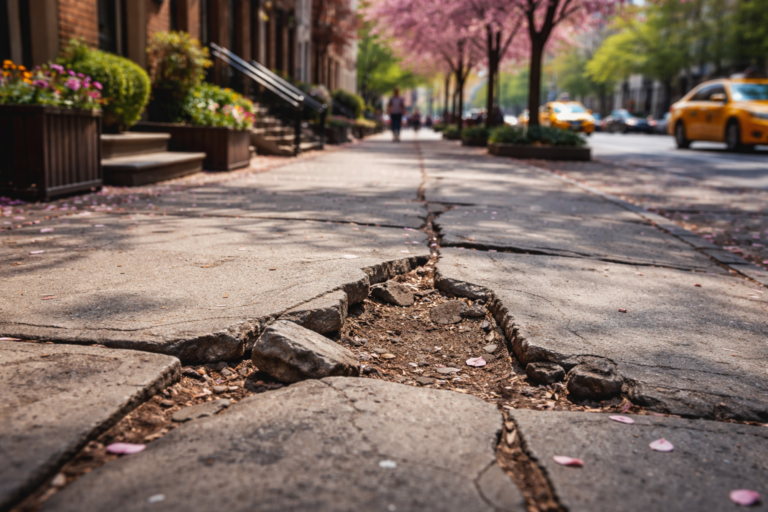
Most of the time it's the owner of the building next to the sidewalk. Sometimes it's the City, and then the clock is much shorter. Here's how to tell which one you're dealing with.
All you need is wise counsel
You were walking down your own block, maybe on the way to the bus on Nostrand, maybe coming home from church, and the sidewalk came up to meet you. A raised slab. A crack you'd stepped over a hundred times. Now your knee, your wrist, or your back reminds you about it every morning.
The first thing people ask me is simple: who do I even go after? I'm Koenig Pierre, a Brooklyn injury lawyer with an office on Coney Island Avenue. Here's the straight answer.
The short version
- In most of New York City, the owner of the building next to the sidewalk is responsible for keeping it safe, and for your injuries if they didn't.
- The big exception: if it's a one-, two-, or three-family house that the owner lives in and uses only as a home, the City is usually responsible.
- Tree pits and curbs are generally the City's problem, not the building owner's.
- If the City or another public agency, like NYCHA, is responsible, you usually have 90 days to file a notice of claim with that agency. Against a private owner, you generally have 3 years to sue.
- There's no minimum size a crack has to be. A small defect can still be a real case.
Who is responsible? It depends on what's next to the sidewalk
New York City's sidewalk law, Administrative Code § 7-210, puts the duty to keep a sidewalk reasonably safe on the owner of the property it runs in front of. That includes fixing broken or raised flags and clearing snow and ice. The question is never "who walks on it." It's "what building is it in front of?"
Apartment building, store, church, or any business
Property ownerThe six-family on Ocean Avenue, the bodega on Church Avenue: the building owner is responsible for the sidewalk out front.
1–3 family house, owner lives there, home only
City of New YorkThis is the main exception. Your claim usually goes against the City, which means the 90-day notice rule.
1–3 family house the owner rents out and doesn't live in
Property ownerThe exception only protects owners who actually live there.
1–3 family house with a business in it
Property ownerA hair salon or tax office on the ground floor means it isn't "used only as a home," so the exception usually doesn't apply.
Tree pit (the dirt square around a street tree)
City of New YorkNew York's highest court held a tree well isn't part of the "sidewalk" under § 7-210, unless the owner caused the problem.
The curb itself
City of New YorkCourts still hold that § 7-210 doesn't shift curb defects to the property owner.
Sidewalk or walkway along a NYCHA development or other public agency property
That agency, like NYCHANYCHA is its own agency, separate from the City, and it needs its own notice of claim within 90 days. In one case, a man filed with the City on time, but the walkway belonged to NYCHA. His notice to the City didn't count, and he lost the claim. Serve the right agency from the start.
Not sure what kind of building it was? Take a photo of the front door and the buzzer panel. The number of bells and any business signs usually tell me what I need to know, and I can confirm ownership from public records.
If it's a City sidewalk, expect this argument
The City's main defense is "we were never told." Under the City's own rules, it generally isn't responsible unless someone gave it prior written notice of that specific defect before you fell, often through sidewalk maps filed with the City by the Big Apple Pothole and Sidewalk Protection Committee, or through City records and complaints. Notice of a different problem nearby isn't enough, as one 2021 appeals decision made clear. There are exceptions, such as when the City itself caused the defect.
This is a big reason to call early. Finding those maps and records takes time, and they can decide whether a City case goes anywhere.
What about snow and ice?
Same rule, same people. The owner responsible for the sidewalk is also responsible for clearing it. The City's Department of Sanitation rules give owners a set window after the snow stops:
- Snow stops between 7 a.m. and 5 p.m.: clear within 4 hours.
- Snow stops between 5 p.m. and 9 p.m.: clear within 14 hours.
- Snow stops between 9 p.m. and 7 a.m.: clear by 11 a.m. the next morning.
Owners generally aren't expected to shovel while a storm is still going. Falls that happen after that window has passed, or on ice someone shoveled into a slick patch, are a different story.
"It was just a small crack." Does that matter?
Insurance companies love this argument. Owners will say the defect was "trivial," too small to count. But New York's highest court has made clear there is no minimum height or depth rule. Courts look at everything: jagged edges, how the slab sits, the lighting, and whether people walking there would naturally be looking elsewhere, like at a bus stop or a busy storefront.
That's why photos matter so much. A close-up with a coin or your shoe next to the defect, plus a wide shot of the block, can make the difference.
Your deadlines
| If the responsible party is… | Deadline | What it means |
|---|---|---|
| The City of New York | 90 days | File a notice of claim with the NYC Comptroller (General Municipal Law § 50-e). |
| The City of New York | 1 year + 90 days | The deadline to file the lawsuit itself. |
| NYCHA or another public agency | 90 days | File a notice of claim with that agency, not just the City. For NYCHA, that rule comes from Public Housing Law § 157 (see this 2023 decision). Lawsuit deadlines vary by agency. |
| A private property owner | 3 years | The general deadline to sue for a personal injury (CPLR 214). |
If you don't know yet who's responsible, act as if the 90-day clock is running. The City may also ask you to come in and answer questions under oath before you can sue. My MTA bus accident guide explains how that hearing works.
What to do this week
- See a doctor and say exactly how you fell. "I tripped on a raised sidewalk slab" belongs in your chart. Don't skip care because you think it'll pass.
- Go back and photograph the spot, today if you can. Owners often fix a slab fast after someone gets hurt. Get close-ups with something for scale, and wide shots showing the building number.
- Write down the exact address and the nearest cross street.
- Get names and phone numbers of anyone who saw you fall or helped you up.
- Keep your shoes and clothes as they were. Don't wash or throw them out.
- Don't give a recorded statement to an insurance company, and don't post about the fall on social media.
- Call before day 90. If it turns out to be a City sidewalk, that deadline is strict.
What a sidewalk claim can cover
A successful claim can cover your medical bills, wages you lost, including cash and off-the-books work if you can show it, and your pain and suffering. Common sidewalk injuries include broken wrists, knee and ankle injuries, shoulder tears, and back and neck injuries. My herniated disc guide explains what drives the value of a spine injury.
There's no no-fault insurance for a sidewalk fall the way there is for a car accident, so use your health insurance or Medicaid to get treated now. And if the owner says you weren't watching where you were going, that usually reduces what you recover; it doesn't end your case. I explain how that works on my pedestrian accident page.
Falls inside a building, on stairs, in a lobby, or in a store, follow different rules. Start with my premises liability page. If you're a home health aide who fell on the way to a client's home, you may have two claims; read my guide for injured aides.
An Kreyòl: Ou tonbe sou yon twotwa nan New York?
- Pi souvan, se mèt bilding ki devan twotwa a ki responsab.
- Si se yon kay 1, 2 oswa 3 fanmi kote mèt la rete, epi se sèlman lakay li, se Vil New York ki responsab anjeneral.
- Si se Vil la, ou gen sèlman 90 jou pou depoze yon "notice of claim."
- Pran foto kote ou tonbe a jodi a, epi ale kay doktè.
Rele 1-800-946-4616. Nou pale Kreyòl. Li plis sou avoka ki pale Kreyòl nan Brooklyn.
Questions people ask me
Can I sue the City of New York for tripping on a sidewalk?
Sometimes. The City is generally responsible for sidewalks next to owner-occupied, home-only 1–3 family houses, next to City-owned property, and for tree pits and curbs. You usually need to file a notice of claim within 90 days and sue within 1 year and 90 days. Expect the City to argue it never got prior written notice of the defect.
Who is responsible for the sidewalk in front of a house in Brooklyn?
If it's a 1–3 family house, the owner lives there, and it's used only as a home, usually the City. If the owner doesn't live there, or part of the house is used for business, usually the owner.
How big does a sidewalk crack have to be to have a case?
There's no set size. Courts look at the whole picture: the edges, the shape, the lighting, and where it is, not just how high it sticks up.
How long do I have to file a claim for a sidewalk fall in NYC?
Against the City: 90 days for the notice of claim and 1 year and 90 days to sue. Against a private owner: generally 3 years to sue.
I fell in a tree pit. Who is responsible?
Generally the City. The building owner usually isn't responsible for a City tree pit unless the owner caused the problem.
I was looking at my phone when I fell. Do I still have a case?
Usually yes. In New York, being partly at fault reduces what you recover. It doesn't automatically end your claim.
Does my immigration status matter?
No. Your immigration status does not stop you from bringing an injury claim in New York. Talk to me before you assume you can't.
Tell me what happened
I'll tell you straight who's responsible, which deadline is running, and whether you even need a lawyer. One phone call. No cost. No pressure.
Where this information comes from
- NYC Department of Transportation: Sidewalk responsibilities (Admin. Code §§ 19-152, 7-210)
- NYC Department of Sanitation: Snow removal responsibilities
- NYC Comptroller: Personal injury claim FAQs
- N.Y. General Municipal Law § 50-e (notice of claim)
- N.Y. CPLR 214 (three-year deadline)
- Vucetovic v Epsom Downs, Inc., 10 NY3d 517 (2008) (tree wells)
- Hutchinson v Sheridan Hill House Corp., 26 NY3d 66 (2015) (no minimum size rule)
- Landro v Abadiotakis, 2026 NY Slip Op 02258 (2d Dept 2026) (curbs)
- Fisch v City of New York, 194 AD3d 786 (2d Dept 2021) (prior written notice)
- Matter of Roman v New York City Hous. Auth., 212 AD3d 816 (2d Dept 2023) (NYCHA 90-day notice)
- Kelly v City of New York, 153 AD3d 1388 (2d Dept 2017) (notice to City not notice to NYCHA)
Attorney Advertising. Prior results do not guarantee a similar outcome. This article is general information about New York law, not legal advice for your situation, and reading it does not create an attorney-client relationship. Deadlines can be shorter in some situations; call to confirm yours. Se habla español. Nou pale Kreyòl.