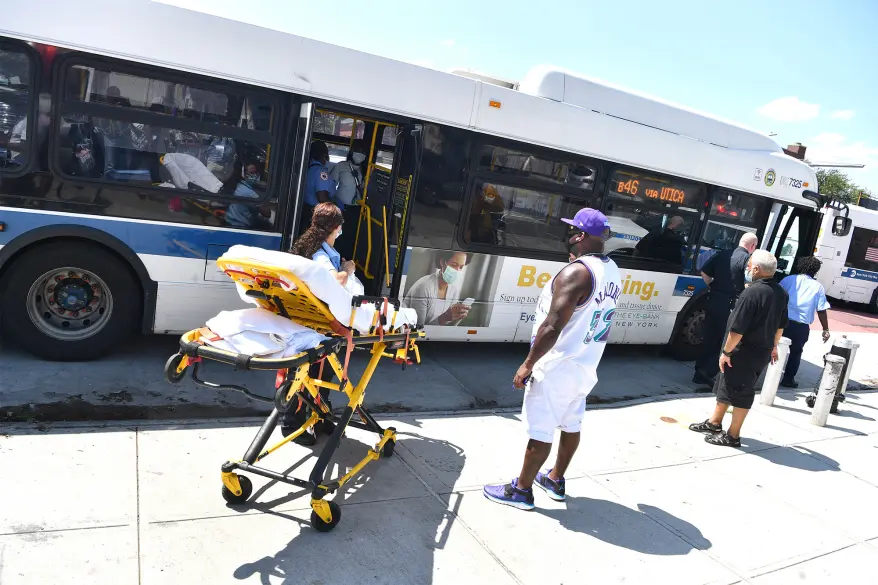
Hit by the B46 or B8 Bus on Utica Avenue? Here's What East Flatbush Riders Need to Know.
- The B46 hauls 44,000 people a day — it's Brooklyn's busiest bus and runs one of the borough's most dangerous corridors.
- You've got 90 calendar days to file a Notice of Claim against the MTA. Not 90 business days. Not three months. Ninety days — starting the moment of your accident.
- Suing the MTA is completely different from suing a private driver. Most injured riders don't find out until the deadline has already passed.
- Whether you were on the bus, crossing the street, or driving a car that got swept up in the crash — your legal path is different. This guide breaks each one down.
- East Flatbush residents deserve real answers — not corporate-speak legal blogs written for Manhattan high-rises.
If an MTA bus hit you recently, your 90-day window started the day it happened. If you're reading this on day 85 because something felt "not that serious," please stop reading right now and call (800) 946-4616. The rest of this article will be here when you're done.
Most people don't know this: being hit by an MTA bus is legally nothing like being hit by a private car. With a private driver you'd have three full years to sue. With the MTA, you have 90 calendar days to file a Notice of Claim — or you almost certainly lose your right to any compensation, no matter how serious your injuries. That single rule kills more valid cases in East Flatbush than anything else. If a B46 or B8 bus hurt you, that deadline is the first thing you need to understand. The rest of this guide walks you through everything else.
Utica Avenue and the Community That Rides It Every Single Day
Let's talk about what Utica Avenue actually is — because it's not just another Brooklyn street on a map. It is the main vein of East Flatbush. It's where people wait for the bus at 6 a.m. before a hospital shift at Kings County. It's where aunties carry grocery bags from the Ideal Food Basket. Where kids transfer from the A/C at Eastern Parkway to get to school. Where families navigate strollers around double-parked delivery trucks. Where the smell of Haitian patties and Jamaican oxtail drifts out of storefronts onto a sidewalk that is almost always full of people with somewhere to be.
East Flatbush is home to roughly 149,000 residents — over 72% Black, with deep roots in Caribbean immigration going back generations. Jamaican, Haitian, Trinidadian, Bajan. Working-class families. Nurses, teachers, home health aides, construction workers, people running small businesses. The median per capita income sits around $37,000, and nearly one in five residents lives below the poverty line. For the vast majority of people in this neighborhood, the B46 isn't a lifestyle choice — it's the only way to get where they're going.
That matters legally, because courts and juries understand context. When a neighborhood this dense, this dependent on transit, this consistently underserved by safety infrastructure, becomes a documented crash corridor — that negligence didn't happen by accident. And it doesn't have to be accepted as normal.
Key landmarks along the B46 and B8 corridor in East Flatbush:
- SUNY Downstate Health Sciences University and Kings County Hospital (Clarkson Ave) — constant foot traffic, many workers riding the B46
- Triangle Junction Shopping Mall at Utica & Church Ave — Target, Aldi, heavy pedestrian crossings throughout the day
- Crown Heights–Utica Avenue Station (Eastern Parkway) — where A/C trains and the B46 converge, creating bottleneck crossings
- Wingate Park, PS 208, PS 135 — schools and recreation along the Utica corridor that put children near bus traffic daily
- Nostrand Avenue's "Little Caribbean" — commercial strip whose foot traffic spills onto crossings shared with B8 routes
The B46 and B8: What These Routes Cover and Where Crashes Concentrate
The B46 — Brooklyn's Workhorse Bus
The B46 is the single busiest bus in Brooklyn and one of the top five in all of New York City. It runs approximately 8 miles from Kings Plaza (Flatbush Ave & Avenue U) up through Flatlands, East Flatbush, Crown Heights, Bed-Stuy, and into Williamsburg. Every single day, 44,000 riders board and exit at stops where pedestrians must step into or adjacent to active, moving traffic.
In 2016, the B46 became the B46 SBS (Select Bus Service) on Utica Avenue — with dedicated bus lanes, off-board fare payment, and signal priority. The SBS upgrade improved travel times, but it also created new dynamics: dedicated bus lanes that cars routinely invade, forcing buses to merge unexpectedly; off-board boarding that places passengers at curbside kiosks with minimal protection from moving vehicles; and intersection configurations at SBS stops that remain confusing to both drivers and pedestrians years after implementation.
- Utica Ave & Clarendon Road — Site of a multi-vehicle B46 crash injuring 25 people, including three critically, when a car exiting a parking lot set off a chain collision into the bus
- Utica Ave & Church Avenue — Heavy foot traffic near Triangle Junction, frequent bus lane violations by commercial vehicles
- Utica Ave & Eastern Parkway — Major transit hub; subway transfer crowds create dangerous pedestrian bottlenecks at the crosswalk
- Utica Ave & Flatbush Avenue — Multi-lane merge with documented Vision Zero injury clusters
- Utica Ave & Avenue D — Dense commercial strip, limited signal timing for pedestrians
The B8 — The Crosstown Route That Cuts Through Crash Zones
The B8 runs east-west along Avenue D and Flatbush Avenue, crossing the B46 corridor and threading through East Flatbush's busiest commercial and residential streets. A documented B8 crash on Avenue D and 40th Street involved a sanitation truck striking a car, which then slammed into a B8 bus stopped at the curb with 14 passengers onboard — injuring 15 people total, two seriously. The B8 crosses active crash corridors at Utica Avenue, Nostrand Avenue, New York Avenue, and Ralph Avenue — intersections where bus passengers, pedestrians, cyclists, and motorists compete for the same narrow, often poorly timed spaces.
Together, these two routes form an overlapping grid of transit dependence and elevated danger across a neighborhood that has waited too long for the infrastructure improvements it deserves.
Why Utica Avenue Has Been a Danger Zone for Over a Decade
New York City's Department of Transportation designated Utica Avenue as a Vision Zero Priority Corridor years ago. That designation is not an honor — it's an acknowledgment that the city knew this road was killing and injuring people at disproportionate rates, and that something had to be done. Some things were done. More things are still needed.
NYC DOT studies found that 63% of vehicles on Utica Avenue exceeded the 30 mph speed limit (NYC DOT Utica Ave SBS Environmental Impact Study). Crash data from a five-year period before SBS improvements recorded 1,682 total crashes and 9 fatalities along the corridor (NYC Vision Zero corridor data). Here is what the road's design continues to allow:
- Wide travel lanes that invite higher speeds between signals — especially in off-peak hours when enforcement thins out
- Chronic double-parking near bus stops that forces buses to swing into traffic to board and discharge riders
- Inadequate pedestrian refuge time at signalized intersections — crossings that time out before slower-moving riders, elders, or parents with strollers can complete them safely
- Bus bulb extensions at SBS stops that bring boarding passengers physically closer to the moving lane without consistent barrier protection
- Heavy commercial truck traffic on Avenue D and surrounding blocks creating blind spots for passengers stepping off
None of this excuses a negligent bus driver, a distracted car operator, or a sanitation truck that doesn't check its clearance. The road being dangerous doesn't give anyone a pass for making it more dangerous. If anything, the City and the MTA's documented awareness of these hazards strengthens — not weakens — the argument that they owed riders a greater duty of care.
Dollar Vans on Utica Avenue: A Hidden Danger With No Safety Net
If you've spent any time on Utica Avenue or Church Avenue, you've seen them. A van pulls up to the curb, horn tapping, the side door sliding open before it's fully stopped. Somebody gets in, pays $2, and they're moving — faster than the B46, no waiting, no MetroCard. Dollar vans have been part of East Flatbush's transportation fabric for decades, and for a lot of residents they're not optional. They fill gaps the MTA doesn't.
But dollar vans also add a layer of danger to an already dangerous corridor — and when something goes wrong, the legal situation for victims is far more complicated than a standard bus or car crash.
What's Actually Happening on the Street
Dollar vans on the Utica and Church Avenue corridors operate in a gray zone between licensed and unlicensed. Some carry legitimate commuter van permits from the TLC. Many do not. What they share is competitive, aggressive driving — jostling for position at bus stops, pulling sudden U-turns, stopping mid-block to pick up a fare, and squeezing past B46 buses in the same lanes. State Senator Roxanne Persaud, who represents this area, has publicly described nearly being hit by a dollar van on the street, noting drivers are "jostling to get customers."
The crashes are documented. A dollar van crossed its lane at Utica and Church Avenue and slammed into the front of a school bus, injuring five children and two adults. NBC News producers going undercover in Flatbush witnessed unlicensed dollar cabs making illegal U-turns, cutting off other vehicles, driving in the wrong lane, and caught the aftermath of a crash that sent two people to the hospital — one a pregnant woman. In another incident, a dollar van struck a cyclist on Avenue U and Flatbush, and the driver attempted to flee before witnesses physically stopped him — police found he had a suspended license.
As one Brooklyn rider put it plainly: "It's not safe. They don't have insurance. You get into a car accident, you're just beat." That's not entirely true legally — but it captures the real risk. An estimated 500 unlicensed vans are currently in service across New York City. Unlicensed means uninsured. And uninsured means that if a dollar van injures you, there's no straightforward insurance policy to claim against.
Your Legal Options If a Dollar Van Hurt You
Being hit by an uninsured dollar van doesn't leave you without recourse — but it does mean your path to compensation is different, and harder to navigate without a lawyer.
If you have auto insurance, your Uninsured Motorist (UM) coverage kicks in when the at-fault driver has no insurance. New York requires minimum UM limits of $25,000 per person. Your own insurer becomes the paying party — and will fight your claim just as hard as an adverse insurer would.
The Motor Vehicle Accident Indemnification Corporation (MVAIC) provides no-fault and liability protection for accident victims involved with uninsured drivers. It can cover up to $50,000 in no-fault benefits and $25,000 per person in bodily injury liability — for victims who don't have their own auto policy or household coverage to draw on.
Even if the driver was unlicensed, the van's owner may carry separate liability. Vehicle owner liability under New York law can attach even when the owner wasn't driving — if the driver had permission to use the van, or if the owner negligently entrusted it to someone unfit to operate it.
Dollar van drivers who flee the scene — a documented pattern — trigger New York's hit-and-run protections. UM coverage and MVAIC both apply to hit-and-run injuries, provided you report the accident to police promptly and comply with claim filing requirements.
One thing that does not apply to dollar van crashes: the 90-day MTA Notice of Claim. Dollar vans are private operators, not government agencies. The standard three-year personal injury statute of limitations governs — but that doesn't mean you should wait. Evidence disappears, witnesses move on, and uninsured operators are harder to track down the longer you wait. Move quickly.
If You Were a Pedestrian: Your Rights and What Can Go Wrong
A fully loaded MTA bus weighs up to 40,000 pounds. Even a low-speed strike — a bus making a left turn, a side mirror clipping a crosswalk, a bus door swinging open into foot traffic — can fracture bones, cause traumatic brain injuries, and change a person's life permanently. If you were walking near Utica Avenue and a B46 or B8 hit you, here is what you need to understand.
If a private driver had hit you, you'd have three full years to file a lawsuit. Because it was an MTA bus, you have 90 days to file a Notice of Claim — or your right to compensation is almost certainly gone. The MTA's legal team knows that most injured people don't learn this rule until after the window has closed. Don't be one of them.
As a pedestrian hit by an MTA bus, you're also entitled to no-fault benefits — the MTA's no-fault insurance can pay for medical treatment and a portion of lost wages while your case develops. This is separate from your personal injury claim and doesn't require proving fault. But you have to apply for it, and delays create gaps the MTA will exploit.
One thing pedestrians consistently underestimate: New York's comparative negligence law means partial fault doesn't kill your case. Maybe you stepped out slightly early. Maybe you were crossing at an angle. Your award is reduced by your percentage of fault — but it's not eliminated. Don't let an insurance adjuster convince you that because you weren't perfect, you have no case. That is not how New York law works.
Pedestrian accident cases in Brooklyn involve several intersecting legal theories — read more on our New York Personal Injury page.
If You Were a Motorist: How Multi-Vehicle Bus Crashes Get Complicated Fast
The documented B46 crash at Utica Avenue and Clarendon Road is the clearest illustration of how these crashes spiral: a car pulled out of a parking lot, struck a BMW, and the BMW slammed into the B46 bus. Twenty-five people injured. Three critical. Multiple vehicles. Multiple drivers. One chain of negligence.
In multi-vehicle crashes that involve an MTA bus, liability can fall across several parties at once:
The vehicle that triggered the chain — whether pulling from a lot, running a light, or failing to yield — carries primary liability for the chain reaction their negligence started.
Bus operators are held to a professional standard. Failure to brake, signal, or take evasive action — even as a secondary vehicle — can create MTA liability.
Maintenance failures, driver training deficiencies, and scheduling practices that produce fatigued drivers are all grounds for institutional MTA liability.
Broken signals, missing signage, road defects, and inadequate intersection design can make the City a defendant alongside the MTA.
If you were inside a car and got swept into a crash involving an MTA bus, your no-fault auto insurance covers initial medical costs. But if your injuries meet New York's serious injury threshold — fractures, permanent limitations, significant disfigurement, or a disability lasting 90+ days — you can pursue a tort claim for pain and suffering. The 90-day MTA Notice of Claim requirement applies to you as a motorist too, if the bus driver's conduct contributed to your injuries. That clock doesn't care whether you were on the bus or behind the wheel of your own car.
For a detailed breakdown of how car accident claims work across Brooklyn, including multi-vehicle crashes, visit our New York Car Accident Lawyer page. If you were in a crash specifically along Flatbush Avenue or East Flatbush, our Flatbush Car Accident Lawyer page speaks directly to the conditions in your area.
The Legal Pitfalls That Cost East Flatbush Riders Everything
Other legal blogs give you a numbered checklist. Here's something more useful: the specific mistakes real people make — and why those mistakes happen more often in communities like East Flatbush, where legal information is scarce and the pressure to "just deal with it" is real.
This is the single most common case-killer in MTA litigation — and it happens constantly in this neighborhood. People spend weeks dealing with medical recovery, fielding insurance calls, managing lost income, helping family, and by the time they think about a lawyer, the window has quietly closed. Courts grant late-notice petitions in the minority of cases. The reasons people most commonly give — didn't know, was recovering, couldn't afford a lawyer yet — are the exact reasons courts most often reject. If your accident was within the last 80 days, the most important thing you can do is make one phone call today.
The MTA and New York City are legally separate entities. Many people — and even some attorneys unfamiliar with transit law — file the Notice of Claim against "the City" or "NYC Transit" when the correct respondent for a B46 or B8 crash is the MTA Bus Company or the New York City Transit Authority, depending on which entity operates the specific route. An improperly named Notice can be challenged and dismissed. This is not a form to complete off a government website at 11 p.m. without legal guidance.
After your Notice of Claim is filed, the MTA has the right to conduct a 50-H examination — a sworn, recorded examination under oath — before any lawsuit can proceed. This is not a formality. What you say there is binding and will be used by MTA defense attorneys at trial. People walk in alone, thinking it's just a conversation, and inadvertently describe their injuries in ways that conflict with their medical records — or volunteer information they were never asked for. Never attend a 50-H hearing without a lawyer sitting next to you.
Within days — sometimes hours — of a serious crash, MTA representatives or their insurance adjusters may call you. They sound helpful. They ask how you're doing. They offer to assist with paperwork. What they are actually doing is getting a recorded statement that locks in a minimized version of your injuries before you've had time to fully assess the harm, consult a doctor, or understand your rights. The kindest-sounding adjuster is still working for the other side. Get their name and number, say you'll be in touch through your attorney, and hang up.
Many bus accident victims — particularly passengers jostled in a collision — walk away feeling shaken but not dramatically hurt. Soft tissue injuries, concussions, herniated discs, and internal trauma often don't fully present until 24 to 72 hours later. Insurance defense attorneys and MTA lawyers zero in on gaps in treatment. A one-week delay between the crash and your first medical visit will be presented at trial as evidence that you weren't seriously hurt. Go to the hospital or an urgent care clinic the same day. Tell them about every area of discomfort — not just the most obvious injury.
Every MTA bus displays its vehicle number on the front and sides. That number is how the specific vehicle and driver are identified in litigation. Bus surveillance footage is MTA-controlled and may be overwritten within 30 days without a preservation demand from an attorney. Without the bus number, locating incident records becomes significantly harder. If you were hurt and didn't get the number — because you were in pain, because it was chaos, because nobody told you to — an attorney can subpoena MTA dispatch logs using the route, time, and location. But only if you move quickly.
What a Personal Injury Attorney Actually Does for You After a Bus Crash
People sometimes hesitate to call a lawyer because they're not sure what they're actually getting. Here's what real representation looks like after a B46 or B8 accident in East Flatbush — beyond just filing paperwork.
The MTA has a full-time legal department whose job is to minimize what they pay you. A personal injury attorney knows their playbook — the delay tactics, the lowball offers, the way they use your own 50-H testimony against you — and counters it. You should have someone in your corner who's done this before.
Serious injuries need serious treatment — orthopedists, neurologists, physical therapists. Many attorneys, including Koenig Pierre, have relationships with Brooklyn-area specialists who treat accident victims on a lien basis, meaning your care isn't gated by what's currently in your bank account. Treatment gets documented properly, which also strengthens your case.
If your car was damaged in the crash, insurance companies will try to cover the cheapest repair they can justify. An attorney who handles the full picture — injury and property damage together — means you're not left fighting that battle alone while you're still recovering.
What to Actually Do After a B46 or B8 Crash — Real Guidance for Real People
Here's what matters most, in the right order:
- Photograph before you move Get the bus number, the route sign, your position relative to the bus, the damage, the intersection, and your visible injuries. If you're too hurt to do this yourself, ask someone nearby. Your phone camera is the single most valuable tool you have in the first five minutes.
- Get witness phone numbers — not just names Names without contact information are useless. Witnesses disappear. Utica Avenue is busy, people have places to be, and three weeks from now you will not find the person who saw everything without a number you grabbed at the scene.
- Go to the hospital or urgent care the same day Tell the doctor about every area of discomfort — neck, back, shoulder, headache, anything. What's documented in the medical record on day one carries enormous weight. What's raised for the first time at week three gets questioned.
- Don't give any recorded statement to anyone Not to the MTA. Not to their insurer. Not to any driver's insurance. Not until you have legal representation. Politely decline and note their information.
- Contact a personal injury attorney within the first two weeks Not because you need to rush into a lawsuit — but because you need to protect the 90-day window, send a bus footage preservation demand, and have someone handling insurance communications while you focus on healing.
- Stay off social media about the accident MTA defense attorneys and insurance adjusters monitor Instagram, Facebook, and TikTok. A single photo of you looking fine at a cookout while claiming a debilitating back injury has ended otherwise strong cases. Keep your accident off your feeds.
If you were on a bicycle when the B46 or B8 hit you — at a bus stop, in a bike lane, or crossing an intersection — your case has additional complexity around how bike infrastructure interacts with bus lanes and SBS boarding zones on Utica Avenue. See our Brooklyn Bicycle Accident Lawyer page for guidance specific to cyclists. The same 90-day MTA Notice of Claim deadline applies whether you were walking, riding, or driving.
"My job doesn't end when the legal paperwork is filed. You called me because your life got turned upside down. I'm not satisfied until you're healed, your car is fixed, and the people responsible have been held accountable. That's what full representation means in this community." — Koenig Pierre, Esq.
Your Questions, Answered Straight
These are the questions Koenig hears most from East Flatbush riders who've been hurt on or near the B46 and B8 corridors. No legalese. No runaround.
How long do I actually have to sue the MTA after a bus accident?
Ninety calendar days from the date of your accident to file a Notice of Claim. This is a hard cutoff under New York General Municipal Law §50-e — not a soft deadline, not a guideline. After you file the Notice of Claim, you then have one year and 90 days to file the actual lawsuit. Both deadlines are strictly enforced. Missing the 90-day Notice deadline is almost always fatal to a case, no matter how strong the facts are.
Can I sue the MTA if a car actually caused the crash?
Yes — and you should pursue both claims at the same time. The at-fault private driver's claim follows the standard three-year statute of limitations for personal injury. The MTA claim still requires the 90-day Notice of Claim regardless of who triggered the crash. An attorney handles both timelines at once, making sure neither slips.
What is the 50-H examination and do I have to do it?
The 50-H hearing is a sworn examination under oath that the MTA is entitled to conduct after you file a Notice of Claim, before any lawsuit proceeds. It's effectively mandatory if you want to move your claim forward. Everything you say there is binding and will be used by MTA defense attorneys. You should never walk into a 50-H without a lawyer sitting next to you. It is not a casual conversation — it is a formal legal proceeding designed to lock in your testimony before you're fully prepared.
I was partially at fault — crossing mid-block or stepping out early. Do I still have a case?
Yes. New York is a pure comparative negligence state. Whatever percentage of fault is assigned to you reduces your recovery — it doesn't eliminate it. If you were 30% at fault and your damages are $120,000, you recover $84,000. Don't walk away from a legitimate injury claim because an insurance adjuster suggested you were partially responsible. That framing exists specifically to discourage you from pursuing what you're actually owed.
What evidence does the MTA have from my crash and how do I get it?
MTA buses carry onboard cameras, GPS tracking, and electronic event logs. Bus stops along the B46 SBS corridor often have surveillance equipment. The MTA also maintains dispatch records and driver incident reports. All of this can be obtained through the legal process — but only if it's preserved before it's overwritten. An attorney can send a litigation hold notice to the MTA demanding preservation. Bus camera footage in particular may be erased in 30 days without that demand.
Can I file the Notice of Claim myself without a lawyer?
Technically yes. The form is publicly available. But an incorrectly filed Notice — wrong entity named, wrong description of the incident, defective service — can be challenged and thrown out. The MTA's legal team reviews these filings carefully and knows exactly what to challenge. Given that the consequence of a defective Notice is losing your entire right to recover, this is not a document to experiment with on your own.
Still Have Questions? Get Real Answers — Free.
Koenig Pierre offers free consultations for injured riders, pedestrians, cyclists, and drivers across East Flatbush and all of Brooklyn. No obligation. No fee unless he wins.
Talk to Koenig for Free 📞 Call (800) 946-4616 · 7 Days a WeekRelated Legal Guides
If your situation involves a related type of accident, these pages go deeper on the specific law that applies.
