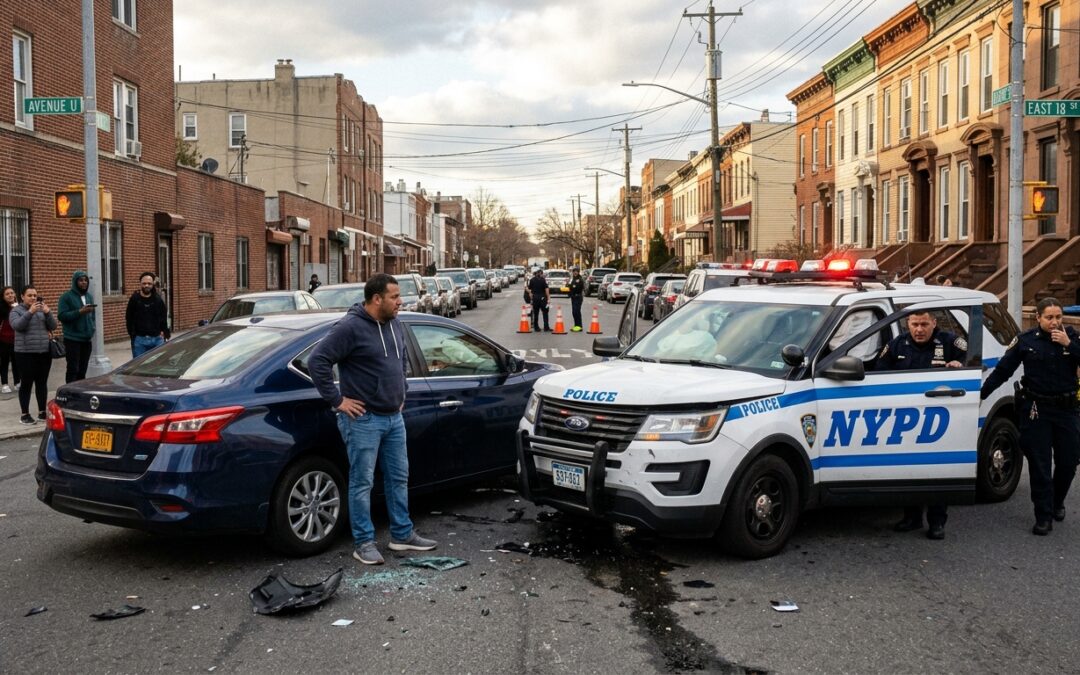
A patrol car pulling out on Utica. An unmarked car speeding down Eastern Parkway. A police SUV backing out of the precinct lot. If an NYPD vehicle hit you, you can bring a claim against the City. But the City gives you far less time than a regular driver would.

By Koenig Pierre, Esq., Brooklyn personal injury lawyer
Published . Reviewed for accuracy .
The short answer
- Yes, you can sue. The claim is against the City of New York, not the officer.
- You must file a notice of claim within 90 days. Miss it and you can lose your case.
- You have 1 year and 90 days to file the lawsuit, not the usual 3 years.
- Lights and siren on does not automatically end your case.
- Your immigration status does not stop you from making a claim.
Can you really sue the police?
Yes. When an on-duty NYPD driver hits you, you bring the claim against the City of New York. The City owns the car and is responsible for the people it pays to drive it. New York law generally requires the City to defend and cover its employees who were doing their jobs, so you are not going after the officer's own money.
These cases are not rare. The NYC Comptroller found that from 2012 to 2021, the City paid $246.8 million to settle crash claims involving NYPD vehicles, more than any other City agency. In fiscal year 2023, the latest year the Comptroller has broken down by agency, people filed 1,196 motor vehicle claims against the NYPD, again the most of any agency.
The City pays when it is responsible. But it also has special rules that protect it, and the biggest one is time.
Are police immune when they're on an emergency call?
Not completely. This is the question that shapes the whole case, and it's the one people get wrong most often.
Police officers do get some legal protection when they drive to an emergency. Courts call it a kind of qualified immunity. But it's limited protection, not full immunity. It doesn't stop you from bringing a claim. It raises what you have to prove, and only for certain kinds of driving.
What the law lets officers do in an emergency
When a police car is on a real emergency run, New York law lets the officer speed, go through a red light after slowing down, or ignore turning and one-way rules. An emergency includes answering a police call or chasing a suspect, but not driving back afterward. New York's highest court has held that even a routine radio call can count as an emergency operation.
Where the immunity stops
Those privileges have limits. The officer must still drive with due regard for everyone's safety. If the officer showed reckless disregard, for example racing through a busy intersection on Flatbush Avenue without slowing down, the City can be held responsible.
And here is what many people don't know. The tougher "reckless" standard only covers those specific emergency acts. If the crash came from something else, ordinary carelessness is enough. The Court of Appeals ruled this way in a case where a deputy rear-ended a car while looking at his computer on the way to a call.
| What the officer was doing | What you have to show |
|---|---|
| Routine patrol, parking, backing up, a U-turn, driving back to the precinct | Ordinary carelessness, the same as any driver. |
| Responding to a call, but the crash had nothing to do with speeding, a red light or a turn | Usually ordinary carelessness. |
| Speeding or running a light on an emergency run | Reckless disregard for your safety. Harder, but not impossible. |
Lights and siren on does not end your case, and lights and siren off does not prove it. Police cars don't always need sirens to count as being on an emergency run. What matters is what the officer was actually doing, minute by minute. Radio logs, body camera video and dashcam footage usually tell that story, which is why a lawyer should ask the City to preserve them right away.
You may also hear about other kinds of government immunity, like the rules that protect the City when police fail to stop a crime. Those usually aren't the issue when an officer hits someone with a car. In a crash case, the fight is almost always about the emergency rules above.
What to do in the first days
- Get medical care today. Go to the ER or urgent care, even if you feel "okay." Injuries to the head, neck and back often show up a day or two later.
- Write down who hit you. The officer's name and shield number, the precinct, and the car number painted on the back or side of the vehicle. If it was an unmarked car, describe it and note the plate.
- Ask for the accident report number. Get it before you leave the scene. If no report was made, go to the local precinct and ask for one.
- Find witnesses and cameras. Get phone numbers from anyone who saw it. Note every store, bodega and building camera on the block. Many erase video within days.
- Don't sign anything or give a recorded statement to the City until you've talked to a lawyer.
- Call a lawyer quickly. A lawyer can send the City a letter demanding that it keep body camera, dashcam and radio records, and can file your notice of claim correctly.
Your deadlines, in one table
| Deadline | What it's for |
|---|---|
| 30 days | File your no-fault or insurance paperwork so your medical bills get paid (see below). |
| 90 days | File a notice of claim with the NYC Comptroller. This is the big one. |
| When asked | Attend the City's 50-h hearing, a recorded interview under oath about what happened. |
| 1 year, 90 days | File your lawsuit against the City. |
If you miss the 90 days, a court may allow a late notice in some cases, but it's not guaranteed and you have to ask before the 1-year-and-90-day deadline runs out. If a family member died, different deadlines apply, so call right away. For more on the 90-day rule, read our guide to suing the City, MTA or NYCHA.
The people who lose these cases usually don't lose on the facts. They lose on the calendar. They wait to see if their back gets better, and by the time they call, the 90 days are almost gone. Don't let that be you.
Who pays your medical bills
This part works differently from a normal car crash. New York's insurance law does not treat police vehicles the same way it treats ordinary cars. That can change which no-fault policy pays, or whether no-fault applies at all. Don't wait for anyone to figure that out. Protect every option at once.
In the first 30 days
- Send written notice to your own car insurance company. Do this if you, or a relative you live with, has a car policy, even though you were walking or the crash wasn't your fault. Ask for the no-fault application, called the NF-2. If they say no-fault doesn't apply to a police car, get that in writing.
- File a no-fault claim with the City too. The NYC Comptroller's online claim system accepts no-fault claims, not just injury claims. This is separate from your 90-day notice of claim.
- Give every doctor and hospital your health insurance. That includes Medicaid, the Essential Plan or a job plan. Tell them a police car hit you so they bill correctly.
Copy this. Send it to your car insurance company today.
I am giving notice of a motor vehicle accident and applying for no-fault benefits. On [DATE] at about [TIME], I was injured at [LOCATION] in Brooklyn when I was struck by a New York City Police Department vehicle. Police report number: [NUMBER]. I am being treated for [BODY PARTS]. Please send me the NF-2 application and confirm that you received this notice.
Email it so there's a date on it, then take a screenshot. Send it even if you're missing details. Getting it in on time is what matters.
If you don't have insurance
You can still get treated. Hospital emergency rooms must examine you and stabilize an emergency whether or not you can pay. Many doctors will also treat injury patients and wait to be paid from the case at the end, which is called treating on a lien. In New York City, NYC Care offers low-cost care at public hospitals regardless of immigration status.
What happens at the end
If your health insurance or Medicaid paid your bills, they may ask to be paid back from your settlement. That's normal. Your lawyer handles it and can often negotiate the amount down, so more of the money stays with you.
Keep every bill, receipt, pharmacy slip and note from your job about missed days. Money for your pain and suffering, your lost pay and your future care comes from the claim against the City itself, and those papers are how you prove it.
When I take one of these cases, I send the insurance notices and the City paperwork in the first week, so no deadline is missed while you're focused on getting better.
"I don't want trouble with the police"
I hear this a lot, especially from people in East Flatbush, Crown Heights, Flatbush and Canarsie. Some worry that filing a claim will put them on the police's radar. Others worry about their papers.
Here is what you should know. A claim for a car crash is a civil claim for money against the City. It is not a criminal complaint against the officer, and you are not accusing anyone of a crime. And whether you were born here or came from Jamaica, Trinidad, Guyana, Grenada, Haiti or anywhere else, your immigration status does not stop you from making a claim for your injuries.
Fault still matters. If you were partly to blame, for example crossing mid-block, the City will argue that your recovery should go down. How much it matters depends on the facts, which is one more reason to get the witnesses and the video locked down early.
If you were walking when it happened, see our guide on being hit by a car after dark in Brooklyn. If a bus was involved instead, read about MTA bus accidents, which have their own rules.
Talk to a Brooklyn lawyer before the 90 days run
Tell me what happened. I'll review it, answer your questions straight, and tell you where you stand. The consultation is free, and you pay no legal fee unless we recover money for you. Se habla español. Nou pale Kreyòl.
Common questions
Can I sue if an NYPD car hit me?
Yes. You bring the claim against the City of New York. File a notice of claim with the Comptroller within 90 days, and file the lawsuit within 1 year and 90 days.
Are police immune from lawsuits for car accidents?
No, not completely. During an emergency run, officers get limited protection: if the crash came from speeding, running a light or an emergency turn, you must show reckless disregard instead of ordinary carelessness. For anything else, including routine patrol, the normal rules apply.
What if the police car had its lights and siren on?
You may still have a case. During a real emergency, an officer can speed or go through a red light, but must still drive with due regard for everyone's safety. If the crash came from something other than those emergency acts, ordinary carelessness can be enough.
Do I sue the officer personally?
Usually not. The claim is against the City, which generally defends and pays for employees who were doing their jobs.
Does my immigration status matter?
No. Your immigration status does not stop you from filing a claim against the City for your injuries.
What if a State trooper, MTA police or Port Authority police car hit me?
Those agencies are not the City, and each has its own rules and deadlines. Some are shorter. Call a lawyer right away so the right papers go to the right agency on time.