
Commercial vehicle crashes · Commuting injuries · Brooklyn, Queens & NYC
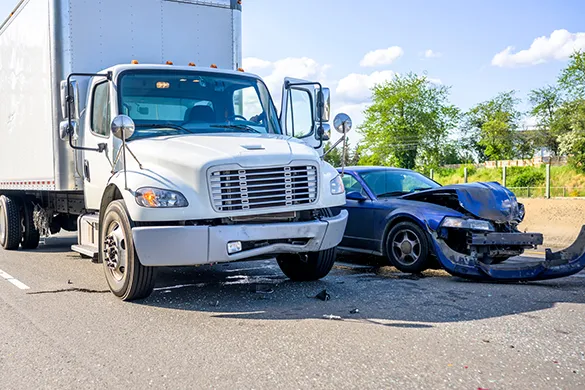
4 min read · or just read the summaryYou were on your way in. Same route you take every morning. Then a box truck came out of a driveway on Atlantic, or a delivery van ran the light on Utica, and now you are sitting in an emergency room at seven in the morning trying to reach your job to say you are not coming.
Two clocks started the second that truck hit you. One is 30 days. The other is six months. Almost nobody hears about either one in time.
- Free consultation
- No fee unless we win
- Nou pale Kreyòl ayisyen
- Your papers are not the issue
- 30 days to put your insurance company on notice, or they can refuse to pay your doctors. This is the one people miss.
- Six months before the trucking company is legally allowed to erase the driver's logs. That is your best evidence.
- Comp probably does not cover a commute. That is fine. The claim against the truck is bigger anyway.
- A commercial policy is not a car policy. Cases that look minor are not always worth what they look like.
- If it was an MTA bus or a City truck, you may have 90 days, not three years.
- Papers are not the issue. Neither is who was at fault, for the medical part.
- Today
- The 30-day clock
- The 6-month clock
- Is this comp?
- Who hit you
- Suing for the pain
- "It looked minor"
- Kreyòl
- FAQ
- Talk to me
I am Koenig Pierre, an injury lawyer in Brooklyn. A big part of what I do is people who got hit by something bigger than them — a box truck, a delivery van, a bus, a sanitation truck, a tractor trailer on the BQE.
Commuters are the ones who get hurt worst by the paperwork. Not because their injuries are worse, but because nobody at a job site or a hospital tells them the rules, and the first rule has a thirty-day fuse on it.
You do not have three years to start. You have thirty days to protect the part that pays your doctors.
Start here
What to do today
Get the police report number. Photograph the truck, the plate, and the company name on the door. See a doctor now, not next week. Tell your own auto insurer within 30 days even if the crash was not your fault. Do not give a recorded statement to the truck's insurance company.
Photograph the door of the truck
The company name. The DOT number painted on the side. The plate. Most people photograph the damage and forget the one thing that identifies who has to pay. If you were too hurt to do it, the police report should have it — get the report number before you leave the scene or the hospital.
See a doctor the same day
Not "if it still hurts Monday." Adrenaline hides things for about a day, and a gap between the crash and your first visit is the single most common thing used against people later. Say you were struck by a vehicle, say what hit what, say every part of you that hurts — not just the worst one.
Tell your own insurance company within 30 days
This is the step people skip because the crash was not their fault. In New York it does not matter whose fault it was. Your own auto policy is what pays your medical bills first, and if you do not give written notice inside 30 days, they can refuse. If you do not own a car, the notice goes to the insurer of the vehicle that struck you.
Write down what you were doing and where you were going
Where you left from, where you were headed, what time you were due in, whether you were running any errand for your job. That last part matters more than it sounds — it can turn a plain commute into a covered work injury.
Do not talk to the truck company's insurer
They call fast on commercial claims, sometimes the same day, and they are pleasant. Read what a recorded statement really is before you say a word. "I'm okay, thank God" is a sentence that gets read back to people a year later.
Get a preservation letter out
This is the one that needs a lawyer, and it needs one quickly. See the six-month clock below.
Copy this. Send it to your insurance company today.
I am giving notice of a motor vehicle accident and applying for no-fault benefits. On [DATE] at approximately [TIME], I was injured at [LOCATION] when I was struck by a [DESCRIBE VEHICLE - e.g. commercial box truck, company name if known]. Police report number: [NUMBER]. I am receiving medical treatment for [BODY PARTS]. Please send me the NF-2 application and confirm receipt of this notice.
Email it so there is a date on it, then screenshot it. Send it even if you are missing details — you can fill the rest in later. Getting the notice in on time is what matters.
Clock one
Thirty days, or they stop paying your doctors
New York requires written notice of the accident to the insurance company within 30 days. Miss it and they can deny your no-fault benefits — the money that pays your medical bills and part of your lost wages. It does not matter that the crash was the truck's fault.
New York is a no-fault state. That word confuses everybody, so here is what it actually means in your life:
- Your medical bills get paid no matter who caused it. Up to $50,000 per person, under basic coverage.
- You get part of your lost pay — 80% of your wages, capped at $2,000 a month.
- It pays nothing for your pain. Not a dollar. That comes from somewhere else.
Here is the trap. That coverage is not automatic. You have to claim it, and the State's own insurance regulator has confirmed the rule: written notice of the claim within 30 days of the accident, and an insurer is permitted to deny for late notice. The form is called the NF-2.
Thirty days means thirty days. Weekends and holidays count. The clock starts the day of the crash — not the day your neck starts hurting, not the day you finally get an MRI, not the day somebody tells you that you should probably call a lawyer.
And two more deadlines run behind it, which is why people who file late end up paying out of pocket even after they fix the first problem:
- 30 daysWritten notice to the insurer — the NF-2
- 45 daysEach medical bill, from the date of that treatment
- 90 daysTo claim your lost earnings
Already past 30 days? Call anyway. There is a process for explaining a late filing, and a good reason backed by records — you were hospitalized, you were in surgery, nobody could reach the carrier — is sometimes accepted. It is worth a phone call, and it costs nothing to ask.
Clock two
Six months before the truck's own records can be erased
Federal law makes trucking companies keep the driver's hours-of-service logs for only six months. After that, they can be legally deleted. Those logs are usually the best proof you will ever get of why that driver hit you.
This is the part that separates a commercial vehicle case from an ordinary fender bender, and it is the reason waiting hurts you more here than anywhere else.
Trucks and commercial fleets are watched by the federal government. The driver logs his hours electronically. The truck records speed, braking, and throttle. Dispatch records where he was told to be and when. Most of these vehicles now have cameras.
All of that answers the only question that matters: how long had this man been driving before he hit you?
Here is the problem. Under federal rule 49 CFR 395.8(k)(1), a carrier only has to keep those duty records and supporting documents for six months. The FMCSA says the same about electronic logging device data. Six months is the floor, not a promise. Meanwhile you have three years to sue. Do that subtraction.
The record of what that driver was doing in the eleven hours before he hit you can be legally gone before you have finished physical therapy.
What stops it: a preservation letter, sent to the carrier and its insurer, demanding they hold the logs, the ELD data, the dashcam footage, the dispatch records, the maintenance file, and the driver's qualification file. It has to go out early and it has to name the right things. That is the single most time-sensitive thing a lawyer does on a truck case, and it is why I would rather hear from you in week one than month seven.
"But I was on my way to work" — is this workers' comp?
Usually no. New York generally treats a normal commute as not being work yet. There are real exceptions. But even when comp does not apply, you still have the claim against the truck — and that is the bigger one.
People assume that because they were headed to work, work owes them something. Most of the time the answer is no, and the reason is simple: the law generally treats your commute as your own time.
The exceptions worth checking — and they come up more than you would think:
| Situation | Why it may count |
|---|---|
| Your boss drove you, or paid for the van | Employer-provided transportation is often treated as part of the job |
| You stopped for coffee, supplies, or a drop-off for the job | Running an errand for your employer can pull the trip into work |
| You have no fixed workplace — home care, construction, delivery | If you travel between jobs, travel may be part of the work itself |
| You were already on the clock, or on call and responding | Being paid for that time changes the analysis |
| You were driving between two job sites | That is generally not a commute at all |
If you are a home health aide moving between clients, read this one too — travel between cases is a different question from a morning commute.
Either way, do not let a "no" from your employer's insurance stop you. The truck's insurance is the deeper pocket.
Not all trucks are the same
Who hit you changes your deadline
A private company's truck gives you three years. An MTA bus or a City truck can give you 90 days. A postal truck is a federal claim with its own process. Find out who owns that vehicle before you assume you have time.
Everybody assumes three years. Three years is only true for private vehicles. On the streets of this city, a lot of what hits people is not private.
- MTA bus or MTA vehicleCity buses, paratransit, MTA fleet90 days
- City of New York truckSanitation, DOT, Parks, City agency vehicles90 days
- School busDepends — often a private contractorCheck first
- USPS truckFederal — separate claim process entirelyFederal rules
- Private carrier or delivery companyBox trucks, tractor trailers, delivery vans3 years
- Vehicle fled, or has no insuranceHit and run, uninsuredAct immediately
On the public ones: a claim against the MTA or the City generally requires a formal notice of claim within 90 days of the accident, then suit within a year and 90 days. I wrote the whole thing out here: the 90-day notice of claim rule. If it was a bus specifically, see MTA bus claims.
If it fled or had no insurance: New York has a fund called MVAIC that can step in when the vehicle is unidentified or uninsured. The notice requirements are short and strict. Report it to the police immediately — without a police report this gets very hard.
If you were walking when it hit you, you are still covered by no-fault, and the same 30-day rule applies. See pedestrian claims in Brooklyn.
The claim that actually pays for what happened to you
No-fault covers your bills. To get money for the pain, the limitation, and the life you had before, you sue the driver and the company — and in New York you have to clear a bar called the "serious injury" threshold. A fracture clears it outright.
No-fault is the floor. It keeps the hospital off your back. It does not compensate you.
For that, New York requires that your injury meet a legal standard. In plain terms, you generally qualify if you have any of these:
- A fracture — a broken bone qualifies on its own
- Significant disfigurement or scarring
- Permanent loss of use of a body part or system
- A permanent or significant limitation in how a part of your body works
- Being unable to do substantially all of your usual activities for 90 of the first 180 days after the crash
That last one is why I keep telling people to keep treating and keep records. It is measured in days, and days only count if somebody wrote them down.
Why a commercial vehicle case is worth more
A private car in New York can legally carry as little as $25,000 in coverage. You can break a leg and find out the driver's whole policy would not cover the surgery.
Commercial trucking is different. Federal minimums for interstate carriers start far higher and go up sharply with weight and cargo. There is usually a company behind the driver, sometimes a broker or shipper too, and often layers of coverage above the primary policy.
Same broken leg. Very different outcome, depending on what hit you.
A real file from my practice
"It looked minor." A $100,000 commercial truck settlement.
A minor-looking crash with a commercial truck is not the same as a minor case. What a claim is worth turns on the coverage behind the vehicle and how well the injury is documented — not on how bad the photographs look. I settled one such case for $100,000. Prior results never guarantee a similar outcome.
I represented someone struck by a commercial truck in what everybody involved called a minor accident. No ambulance drama. No cast. On paper, looking at the photographs of the vehicles and the first set of records, it did not look like much — and the client told me more than once that she was not sure it was worth anybody's time.
That case settled for $100,000.
Not because I turned a small injury into a big one. Because of two things that have nothing to do with how bad you look in the emergency room.
First, the policy. A commercial carrier does not carry the state minimum. There was real coverage behind that truck, which meant nobody could look at the file and say the claim was worth whatever was left in a $25,000 policy. The ceiling was high enough that the injury had room to be valued honestly.
Second, and this is the part people never see: an adjuster on a commercial file is not just deciding what your case is worth. He is calculating what happens if he guesses wrong at trial. If a jury comes back above the policy, that is a very bad day for the company that had the chance to settle and passed. That risk sits on the adjuster's side of the table the entire time, and it is why a well-documented case with real coverage behind it gets treated seriously even when the photographs are unimpressive.
What made it work was not drama. It was a clean file — treatment that started immediately and stayed consistent, records that said the same thing every time, and the truck's own paperwork requested before it could go anywhere.
About this example. Details have been changed or omitted to protect client confidentiality. Prior results do not guarantee or predict a similar outcome in any future case. Every claim is different and depends on its own facts, its own injuries, its own medical proof, and the coverage actually available. I am not telling you what your case is worth — I am telling you why "it looked minor" is not the answer to that question.
What the trucking company is doing while you recover
It also means a different opponent. Commercial carriers have people whose job is to get to the scene fast and start building the file. That is not paranoia — it is standard practice. It is another reason the preservation letter goes out early.
If you hit your head, even without blacking out, get it documented: brain injuries get missed when there is a more obvious injury to treat. And before you sign anything, read what you actually keep from a settlement.
Cash pay, no papers, no car of your own
None of it disqualifies you. No-fault does not ask your immigration status. You do not need to own a car — if you were walking or riding, the vehicle that hit you covers you.
On papers. New York's highest court held in Balbuena v. IDR Realty that immigration status does not bar an injured worker from recovering lost wages — the decision is in the New York Official Reports. The City's guidance for immigrant workers says the same about benefits generally: you may qualify even if you are paid in cash or off the books.
On not owning a car. Very common in this city and not a problem. If you were a pedestrian, a cyclist, or a passenger, the no-fault coverage of the vehicle involved is what applies to you. The 30-day notice still runs — just to a different company.
On lost wages if you are paid in cash. Harder to prove, not impossible. Bring whatever exists: texts about your schedule, deposit records, a letter from your employer, pay envelopes. Do not decide on your own that it cannot be shown.
An Kreyòl ayisyen
Yon kamyon frape ou pandan ou t ap ale nan travay?
- Ou gen 30 jou pou avize konpayi asirans lan alekri. Si ou pa fè l, yo ka refize peye doktè ou yo — menm si se pa fòt ou.
- Asirans "no-fault" la peye jiska $50,000 pou swen medikal ak 80% salè ou (jiska $2,000 pa mwa) — kèlkeswa moun ki lakòz aksidan an.
- Men li pa peye anyen pou doulè ou. Pou sa, ou dwe fè yon dosye kont chofè a ak konpayi an.
- Gen yon dezyèm revèy: 6 mwa. Apre sa, konpayi kamyon an gen dwa efase rejis chofè a. Se pi bon prèv ou.
- Si se yon bis MTA oswa yon kamyon Vil la, ou ka gen sèlman 90 jou — pa twazan.
- Pran foto pòt kamyon an — non konpayi an ak nimewo DOT la. Se sa ki di nou kiyès ki dwe peye.
- Papye ou pa yon pwoblèm. Ou pa bezwen gen machin pa ou non plis.
Rele Koenig Pierre: 1-800-946-4616. Konsiltasyon an gratis. Ou pa peye anyen si nou pa genyen. Ou ka rele oswa ekri m an Kreyòl.
About the author
I am an injury lawyer on Coney Island Avenue in Brooklyn. Most of the people I represent are working people who got hit by something much bigger than they were, on their way to somewhere they had to be. I work on contingency: no retainer, nothing owed unless there is a recovery. The consultation is free either way, because on a truck case the most useful thing I do is often the call in the first week — the one that gets a preservation letter out before the logs are gone.
- Admitted
- New York State
- Law school
- Maurice A. Deane School of Law at Hofstra University
- Focus
- Truck and commercial vehicle collisions, no-fault benefits and denials, MTA and City vehicle claims, pedestrian injuries
- Languages
- English · Kreyòl ayisyen · Français · Español
- Office
- 2653 Coney Island Avenue, Brooklyn, NY 11223 · 1-800-946-4616 · koenig@koenigpierre.com
- Serving
- Brooklyn, Queens, Manhattan, the Bronx, Staten Island and Nassau County
- Reviewed
Check the record
Questions people ask me
What people ask after a truck hits them
I was on my way to work. Is this workers' comp?
Usually not — an ordinary commute is generally your own time. But check the exceptions: employer-provided transportation, an errand for the job, no fixed workplace, or already being on the clock. And either way you still have the claim against the truck, which is normally the bigger one.
How long do I really have to file for no-fault?
Thirty days from the date of the crash. Written notice to the insurer. Miss it and they can deny your medical coverage, no matter who was at fault. If you are already past it, call anyway — a documented reason for the delay is sometimes accepted.
The crash wasn't my fault. Why do I file with my own insurance?
Because that is how New York works. Your own policy pays your medical bills first regardless of fault. That is what "no-fault" means. If you do not own a car, notice goes to the insurer of the vehicle that hit you.
My accident looked minor. Is it even worth calling?
Often yes, and the reason surprises people. What a case is worth depends heavily on the coverage behind the vehicle and on how well the injury is documented — not only on how dramatic the crash looked. Commercial vehicles carry substantially larger policies than private cars, which changes the whole calculation. I have resolved a case that everyone involved called minor for $100,000. Prior results never guarantee a similar outcome, and I will not put a number on your case in a first call. But "it looked minor" is not a reason to skip the call.
Does no-fault pay me for the pain?
No. It pays medical treatment and part of your lost wages. Pain, permanent limitation, and the difference in your life come only from a claim against the driver and the company — and for that your injury has to meet New York's serious injury standard. A fracture meets it outright.
Why do you keep talking about six months?
Because federal law only makes the trucking company keep the driver's hours-of-service logs for six months. After that they can be legally deleted. Those logs usually tell you how long that driver had been working before he hit you. A preservation letter sent early is what keeps them.
An MTA bus hit me. Same rules?
No. Public entities generally require a formal notice of claim within 90 days, and suit within a year and 90 days. That is a fraction of the usual three years, and it is the deadline that quietly ends good cases.
The truck took off. Do I have anything?
Possibly, through a state fund called MVAIC that covers unidentified and uninsured vehicles. The notice requirements are short and unforgiving, so report it to police immediately and get help fast.
What does it cost to hire you?
Nothing up front. My fee comes out of a recovery, and if there is no recovery there is no fee. The first call is free either way.
One call · No cost · No pressure
You were just going to work. Let somebody else handle the paperwork.
Tell me what happened and I will tell you straight: whether your 30 days is still open, who actually owns the vehicle that hit you, what your real deadline is, and whether we need to get a letter out this week to save the driver's records.
You do not need the police report in hand. Just what you remember and any photos from your phone. I read these myself and answer within 24 hours. Ou ka rele oswa ekri m an Kreyòl.
Confidential · No fee unless we win · 2653 Coney Island Avenue, Brooklyn, NY 11223