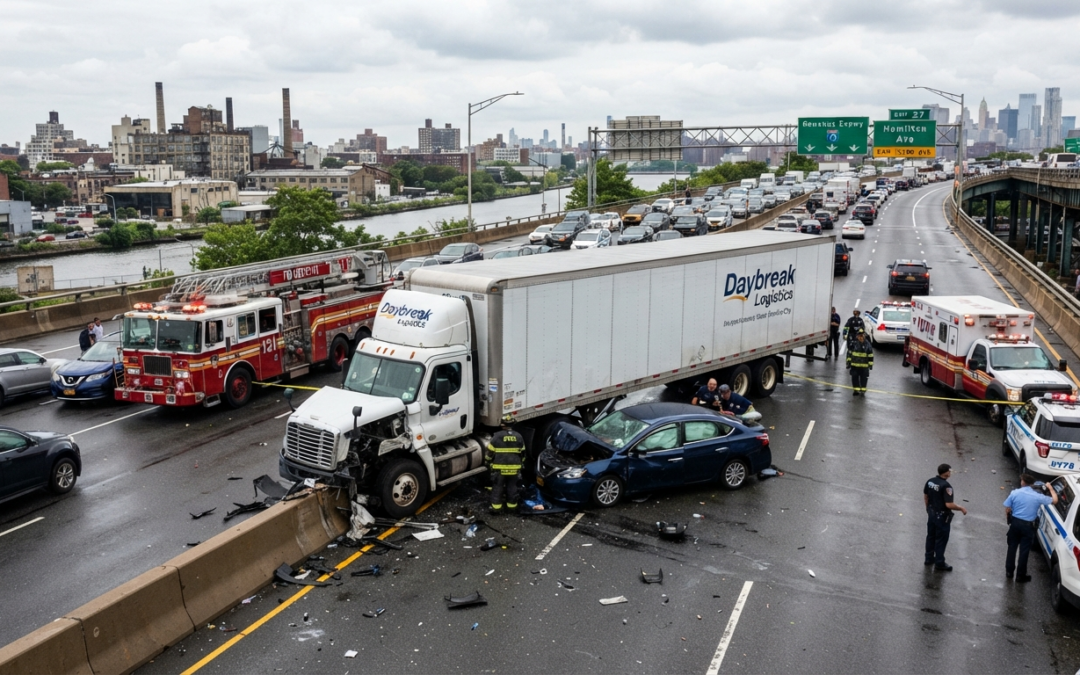
Six Months. Then the Truck Erases Its Own Confession.
The Gowanus Expressway is Brooklyn's truck funnel. If an 18-wheeler wrecked your life up there, the single best piece of evidence in your case sits on a company server with a shelf life — and federal law says the trucking company can legally hit delete on month seven.
Do these six things before you do anything else
- Get treated today. Not next week. Adrenaline hides broken things, and a gap in treatment is the first argument the insurer makes.
- Photograph the truck's doors. The company name, the USDOT number, and the plate on both tractor and trailer. That number is how I find every record in this article.
- Do not give a recorded statement. The trucking company's adjuster may reach you within hours. They are very friendly. They are not on your side.
- Do not sign a "medical authorization." A blanket release hands them your entire life's medical history.
- Write down what you remember tonight. Weather, lane, the sound, what the driver said. Memory decays faster than data.
- Call a lawyer inside the first week. Not because I'm selling you something — because of the clock this whole article is about.
1-800-946-4616 — free, no pressure. If I'm not the right fit, I'll tell you.
Most people think a truck crash case is about the crash. The skid marks, the police report, who had the light.
It isn't. Not really.
A truck crash case is about the eleven hours before the crash. Whether the driver had been awake since 4 a.m. in Baltimore. Whether dispatch pushed him to make one more drop at Industry City before the Battery Tunnel backed up. Whether the company knew he'd blown through his hours three times that month and kept sending loads anyway.
All of that is written down. Automatically. By a little box wired into the truck's engine.
And here's the part nobody tells you: federal law only requires the trucking company to keep that record for six months. You have three years to file your lawsuit in New York. Do the math — the evidence is legally gone two and a half years before your deadline to sue.
That gap is where good cases go to die. This article is about how not to let yours end up there.
Why the Gowanus is a truck trap, not just a bad road
Here's a piece of Brooklyn geography that costs people their health every year: trucks are banned from the parkways. No commercial vehicles on the Belt, the Shore, the Prospect Park drives. So every tractor-trailer coming off the Verrazzano, every box truck heading for the Red Hook container terminal, every delivery rig aimed at Manhattan gets funneled onto one road.
That road is the Gowanus. According to NYSDOT, it's the only interstate highway in Brooklyn — 5.7 miles of I-278 running from the Verrazzano-Narrows Bridge to the Hugh L. Carey (Brooklyn-Battery) Tunnel, with 3.8 of those miles up on a viaduct over 65th Street, Third Avenue, and Hamilton Avenue. Robert Moses opened it as a parkway in 1941 and it was widened into a six-lane expressway in 1961. About 200,000 vehicles a day use it now.
It was designed for a Brooklyn that had streetcars. It is carrying a Brooklyn that has Amazon.
What that means when you're actually driving it:
- No real shoulder. On the elevated stretch, a broken-down car and a 40-ton truck are sharing space measured in inches.
- Merges that are basically dares. The Prospect Expressway, the Shore Parkway, the BQE split, the Hamilton Avenue ramps — vehicles crossing three lanes in a few hundred feet, next to trucks that need the length of a city block to stop.
- Stop-and-go at highway speed. Traffic slams from 55 to 5 without warning. A loaded tractor-trailer physically cannot do that. Rear-end and underride crashes here are a physics problem, not an accident.
- Columns everywhere. Underneath, Third Avenue is a wall of support columns, double-parked trucks, and blind corners for anyone walking in Sunset Park.
- Fatigue's finish line. The Gowanus is the end of long hauls, not the middle. Drivers hit it on hour ten of an eleven-hour day, at the exact moment the road demands the most.
Schematic, not to scale. Trucks are barred from NYC parkways, so port, warehouse, and bridge traffic all compresses onto a single 1941-era viaduct.
The Gowanus doesn't cause truck crashes. It just guarantees that when a tired driver finally makes a mistake, there's nowhere for anybody to go.
Elevated Gowanus Expressway viaduct over Third Avenue, Sunset Park, with tractor-trailer traffic.
gowanus-expressway-truck-accident-lawyer-brooklyn.jpgALT TEXT: “Tractor-trailers on the elevated Gowanus Expressway viaduct above Third Avenue in Brooklyn, where truck accident lawyer Koenig Pierre handles I-278 crash cases.”
The number nobody wants to say out loud
I can tell you the Gowanus is dangerous and you can nod politely. So let me give you the number instead.
Run your eye down from the viaduct to the street underneath it — Third Avenue, Sunset Park. Over the past seven years, more than 80 people have been killed or seriously injured in crashes on that corridor, according to figures compiled by Transportation Alternatives and reported by Streetsblog in May 2026.
Do that division. That is roughly one life-altering crash every single month, on one stretch of one Brooklyn street, for seven years running.
Earlier city figures told the same story from a different angle: thirteen people killed on that corridor since 2016 — five walking, four on bicycles, four in vehicles.
When the Gowanus jams, the trucks come down.
This is the piece outsiders miss. Third Avenue isn't a separate problem from the expressway — it is the expressway's overflow valve. When the viaduct locks up, drivers and truckers drop down to the surface street to beat it. Sunset Park residents have been telling the city this for years. So the corridor's danger isn't split between two roads. It's one machine with two floors, and southwest Brooklyn lives inside it.
Fifteen lanes, stacked
Here's the geometry, and it's genuinely hard to believe until you draw it. The elevated Gowanus carries seven lanes. Third Avenue underneath carries eight more, between moving traffic and parked cars. A kid walking to school in Sunset Park is crossing beneath a total of fifteen lanes of motor vehicles, stacked two stories high.
Cross-section, schematic. Seven lanes of interstate on a 1941 viaduct, eight lanes of Third Avenue underneath, and a Sunset Park neighborhood in between.
What that looks like when it goes wrong
Statistics are easy to skim past, so here are three real ones off this road, none of them exotic:
- A driver rear-ended a stopped tractor-trailer near the Verrazzano entrance at roughly 75 mph. Brooklyn prosecutors said the brakes weren't touched until under a second before impact. The passenger, 30 years old, was killed. That's the stop-and-go physics problem I described above, with a name attached.
- A tire came off a truck on the Gowanus and killed the driver of an SUV. Think about which records prove that case — the maintenance file and the driver's inspection reports. Under federal rules those are kept for one year and three months respectively.
- A medical episode at the wheel near the 39th Street exit in Sunset Park set off a six-vehicle chain in December 2024. On a road with no shoulder, one failure becomes six.
And the fix keeps getting postponed
This part matters legally, because it goes to notice — the city has known for years. In late 2023 DOT put forward a redesign covering more than 40 blocks of Third Avenue between Prospect Avenue and 62nd Street. Community Board 7 endorsed a road diet in early 2024. Then business groups pushed back, the Adams administration shelved it, and as of this spring residents were still asking City Hall to revive it.
The frustrating part is that nobody disputes the fix works. DOT's own evaluation found road diets cut deaths and serious injuries by roughly 30 percent. The near-identical redesign on Fourth Avenue a few blocks over dropped pedestrian injuries by as much as 61 percent. Meanwhile, last-mile freight warehouses keep multiplying in Sunset Park, which means more trucks, not fewer.
A road that produces a catastrophic injury every month is not having accidents. It is producing exactly what it was built to produce.
Which brings us back to the point of this whole article. If this corridor is generating a serious crash a month, and a good share of them involve commercial vehicles, then somewhere out there right now is a truck whose data is quietly aging toward its expiration date. Here's what's on it.
What an ELD is, minus the alphabet soup
Since December 2017, virtually every interstate commercial truck on that road has been required to run an Electronic Logging Device — an ELD. Think of it as the truck's Fitbit, except it's wired straight into the engine and the driver can't take it off.
Before ELDs, drivers kept paper logbooks. The industry nickname for them was "comic books," which tells you everything about how accurate they were. A driver could write down eight hours of sleep he never took, and nobody could disprove it.
The ELD ended that. It doesn't ask the driver anything. It reads the engine directly and records, automatically:
The last box is the one trucking defense lawyers hate. An ELD keeps the original entry and every change made to it — so a “cleaned up” log leaves fingerprints.
Read that last one again. If someone at the company went in afterward and softened the driver's hours, the ELD keeps the original and the edit and the username of whoever made it. Federal rules also flatly prohibit disabling, jamming, or tampering with the device so it doesn't record accurately (49 C.F.R. § 395.8(e)).
So the honest truth about ELD data is this: it's the most objective witness in your case, and it never gets nervous on cross-examination.
The six-month rule, in plain English
Here's where it gets frustrating, and where most people injured on the Gowanus lose without ever knowing it happened.
Federal regulations tell trucking companies how long they must hang onto records. For hours-of-service data, the number is six months. Three separate rules say it:
- 49 C.F.R. § 395.8(k)(1) — the carrier must keep the driver's records of duty status and all supporting documents for six months from the date received.
- 49 C.F.R. § 395.22(i) — the carrier must keep a back-up copy of the ELD records for six months, on a separate device from the original.
- 49 C.F.R. § 395.11 — the supporting documents that corroborate the log (dispatch records, bills of lading, fuel receipts, tolls) also get six months.
FMCSA says the same thing in its own words in the agency's ELD rule guidance: carriers must retain ELD records of duty status and back-up data for six months. That's the floor. It is not a ceiling — plenty of well-run carriers keep data for years — but the floor is what a company reaches for when a claim shows up.
Deleting it on day 181 is not a crime. It's compliance.
A carrier that purges hours-of-service data at six months and one day hasn't broken the retention rule. That's exactly what the rule permits. The only thing that changes the math is a legal duty to preserve — and that duty doesn't switch on by itself. Somebody has to trigger it. Usually a lawyer. Usually in writing. Usually fast.
Meanwhile, the ELD is only one clock. Almost everything else that proves a truck case is also on a timer, and several of them are shorter:
| The evidence | Minimum it must be kept | What it proves in your case |
|---|---|---|
| Dashcam & in-cab videoNo federal retention rule | Often 7–90 days Company policy only | The crash itself, and whether the driver's eyes were open |
| Driver vehicle inspection reports49 C.F.R. § 396.11 | 3 months | Brakes, tires, lights the driver flagged and nobody fixed |
| ELD logs, back-ups & supporting docs§ 395.8(k), § 395.22(i), § 395.11 | 6 months | Fatigue, hours violations, dispatch pressure, log edits |
| Truck maintenance records49 C.F.R. § 396.3(c) | 1 year (+6 months after the truck leaves the fleet) | A known defect the company never repaired |
| Annual inspection reports49 C.F.R. § 396.21 | 14 months | Whether the rig was road-legal at all |
| Accident register & file49 C.F.R. § 390.15(b) | 3 years | A pattern — this wasn't the company's first crash |
| Driver qualification file49 C.F.R. § 391.51 | 3 years after the driver leaves | They hired someone they never should have hired |
| Positive drug & alcohol tests49 C.F.R. § 382.401 | 5 years | Impairment — and a company that kept him driving |
One more, because it's the one people don't know to ask about: after a serious crash, the carrier is required to test the driver — alcohol within 8 hours, controlled substances within 32 hours (49 C.F.R. § 382.303). Whether that test happened, and how fast, is itself evidence. Sometimes the missing test says more than the results would have.
The evidence clock: watch the gap open up
Put every one of those timers on the same line, next to your three-year deadline to sue, and the problem stops being abstract:
§ 396.11
§ 395.8(k) / § 395.22(i)
§ 395.11
§ 396.3(c)
§ 396.21
§ 390.15(b)
§ 391.51
CPLR 214(5)
Bars show federal minimum retention. The window where the truck's own data still exists is the first six months — roughly one-sixth of the time New York gives you to file suit.
You have three years to bring the case. You have six months to be able to win it.
The letter that stops the delete button
Now the good news, and it's real good news.
That six-month clock is a default. It can be overridden. The tool is a spoliation letter — lawyers also call it a litigation hold or preservation letter — and it is exactly what it sounds like: a formal written notice to the trucking company, its insurer, and often its ELD vendor saying this crash is going to be litigated, you are now on notice, and destroying any of the following is going to cost you.
A good one is not a form letter. It lists, by name and by regulation, the specific things that must be frozen: the ELD file in its native format with the edit history, the engine control module download, the dashcam footage, dispatch messages, the driver's qualification file, the maintenance records for that VIN, the bills of lading, the toll and fuel records for that trip. It asks that the tractor and trailer be preserved before they're repaired and put back in service. It goes out certified, and it goes out early.
Why does a letter carry any weight? Because New York courts take the destruction of electronic evidence seriously once a party knows a claim is coming.
- In VOOM HD Holdings LLC v. EchoStar Satellite L.L.C., 93 A.D.3d 33 (1st Dep't 2012), the Appellate Division held that the duty to preserve electronic evidence kicks in as soon as a party reasonably anticipates litigation — not when the lawsuit is filed. EchoStar let its automatic email deletion keep running after that point. The court sanctioned it. (Read the opinion in the official New York Official Reports.)
- In Pegasus Aviation I, Inc. v. Varig Logistica S.A., 26 N.Y.3d 543 (2015), New York's highest court laid out the framework: a party seeking sanctions has to show the other side controlled the evidence and had an obligation to preserve it, that it was destroyed with a culpable state of mind, and that it was relevant. Even negligent destruction can draw a sanction.
The available sanctions under CPLR 3126 — and under Federal Rule of Civil Procedure 37(e) if the case ends up in federal court — run from making the company pay for the mess it created, to barring it from arguing certain defenses, to an adverse inference instruction: the judge tells the jury it may assume the destroyed evidence would have hurt the company. In the right case, that instruction is worth more than the data would have been.
The preservation letter is one of the cheapest, fastest things a lawyer does — often within days of being retained — and it is the single highest-leverage act in a truck case. If you were hurt on the Gowanus and nobody has sent one yet, that is the reason to make a phone call this week rather than next season. 1-800-946-4616.
Close-up of an in-cab ELD unit / driver logbook display in a tractor-trailer.
electronic-logging-device-eld-truck-accident-evidence.jpgALT TEXT: “Electronic logging device screen inside a commercial truck cab showing hours-of-service data used as evidence in Brooklyn truck accident cases.”
What the data actually proves — and why the company fights so hard
Getting the ELD file isn't a scavenger hunt for its own sake. It changes who you can sue, and that changes what your case is worth.
1. It proves fatigue instead of "an accident"
Federal hours-of-service limits cap a property-carrying driver at 11 hours of driving inside a 14-hour on-duty window, after 10 consecutive hours off. If the ELD shows hour 13 on the Hamilton Avenue ramp, "he didn't see me stopped" turns into "he was too exhausted to see anything." That's not bad luck. That's a rule violation.
2. It reaches past the driver, to the company
A driver has one job and usually one modest insurance policy behind him. A motor carrier has a fleet, a compliance department, a safety director, and a much bigger policy. The ELD data — combined with the qualification file and the accident register — is how you show negligent hiring, negligent supervision, negligent retention, or a dispatch culture that pushed loads over limits. Those are claims against the company itself, not just the guy behind the wheel.
3. It catches the cover-up
Unassigned driving time. Logs edited after the crash. A driver "sleeping" in the sleeper berth at 60 miles an hour according to the engine. Every one of these leaves a trace in the audit trail. Juries forgive mistakes. They do not forgive a company that changed the records afterward.
4. It corroborates you
The GPS pings and engine data can independently confirm the truck's speed and position in the moments before impact — which matters enormously when the driver's story and yours don't match, and there are no witnesses because everyone else on the Gowanus was doing 50 and kept going.
Real talk about the ECM, too
The ELD is not the only box. Modern tractors also carry an engine control module — the truck's true "black box" — which can capture last-stop data: speed, throttle, brake application, hard-braking events in the seconds before impact. There is no federal rule forcing a carrier to preserve that. Worse, it can be overwritten simply by driving the truck again, and it often is, because a repaired rig is a rig back earning money. This is why the preservation letter asks that the vehicle be held before repair — and why waiting is so expensive.
Who pays, and how much coverage is actually out there
Two different buckets, and people mix them up constantly.
Bucket one: your medical bills right now. New York's No-Fault system covers the immediate stuff regardless of who caused the crash — at least $50,000 in benefits for medical treatment and part of your lost wages. There's a hard 30-day deadline to file the No-Fault application, and missing it lets the insurer deny your bills. If you want that in more detail, I wrote a plain-English breakdown of how New York No-Fault insurance works.
Bucket two: everything No-Fault won't touch. Pain, permanent injury, future surgery, the career you can't go back to. For that you have to bring a claim against the at-fault parties — and in a truck case, "parties" is plural on purpose:
- The driver
- The motor carrier that employed and dispatched him
- The owner of the tractor or trailer, if it's leased from someone else
- The broker or shipper, in the right circumstances
- The maintenance contractor, if a repair failed
- A parts or equipment manufacturer, where something was defective — see my page on defective trucks, trailers and parts
And here is the number that surprises people most: interstate trucking companies hauling general freight in vehicles over 10,001 pounds must carry at least $750,000 in liability coverage under 49 C.F.R. § 387.9 — and $5 million for certain hazardous materials. Many carriers carry far more, layered in excess policies. Compare that to the $25,000 minimum on the private car that rear-ends you in Brooklyn, and you understand why identifying every responsible party is the whole ballgame. I go deeper into fault in negligence in a truck accident case.
Your real deadlines — all four of them
| Clock | You have | Miss it and |
|---|---|---|
| No-Fault application (form NF-2) | 30 days | The insurer can refuse to pay your medical bills |
| Preserve the truck dataNot a law — a practical cliff | ~6 months | The ELD record can lawfully be deleted |
| Notice of Claim, if a City or MTA vehicle was involvedGen. Mun. Law § 50-e | 90 days | You generally lose the right to sue that agency at all |
| Personal injury lawsuitCPLR 214(5) | 3 years | The case is over before it starts |
Wrongful death claims run on a different and shorter clock than injury claims, and the rules around a decedent's estate add steps that take time to set up. If you lost someone in a crash on the Gowanus, please don't sit with it for a year — start with how wrongful death cases work in New York and then call.
Let's find out if the data still exists.
If a commercial truck hurt you on I-278, the first call costs nothing and the first letter can save your case. Ten minutes on the phone tells us both a lot.
Call 1-800-946-4616Or schedule a free consultation · Se habla español · Nou pale Kreyòl ayisyen
Questions people ask me after a Gowanus truck crash
How long does a trucking company have to keep ELD data after a crash?
What is a spoliation letter and why does it matter so much in a truck case?
I was hit six months ago. Is it too late?
Why is the Gowanus Expressway so dangerous for truck crashes?
Who can I sue besides the driver?
Does the truck have a black box like an airplane?
The trucking company's adjuster called me the same day. Should I talk to them?
What does a truck accident lawyer cost?
- New York Truck Accident Lawyer
- Negligence in a Truck Accident Case
- Defective Trucks, Trailers & Parts
- Brooklyn Car Accident Lawyer
- Hit at Tillary St & Flatbush Ave Ext
- Crown Heights Car Accident Lawyer
- Canarsie Car Accident Lawyer
- Car Accident Lawyer — Flatbush
- Traumatic Brain Injury Lawyer
- Wrongful Death Lawyer
- Understanding New York No-Fault
- New York Personal Injury Lawyer
Attorney Advertising. This article is general information about New York and federal law, not legal advice, and reading it does not create an attorney-client relationship. Regulations change and retention periods described here are federal minimums; the facts of your case control. Prior results do not guarantee a similar outcome. If you were injured in a commercial vehicle crash, speak with a licensed attorney about your situation as soon as possible.
© 2026 Koenig Pierre, Esq. — Serving truck accident victims throughout Brooklyn, including Sunset Park, Red Hook, Bay Ridge, Park Slope, Gowanus, Dyker Heights, and the I-278 corridor.